
Bhutanese Farmhouse
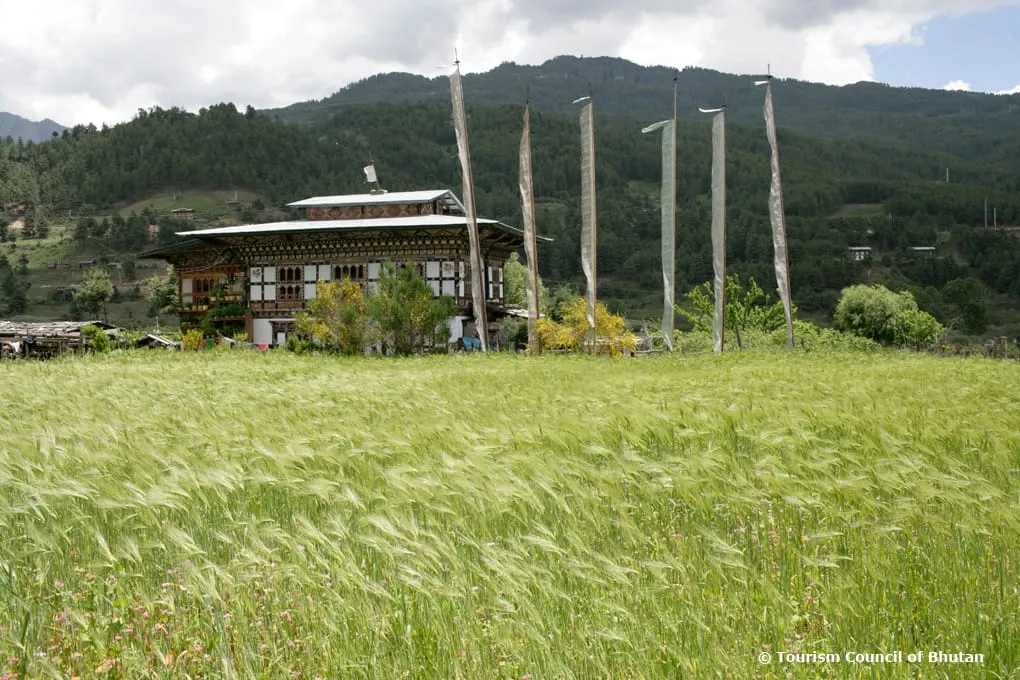
A farmhouse evening is the last thing most of our guests do in Paro: a working house, a meal with the family who live in it, and a hot stone bath — dotsho — in a wooden tub in an outbuilding. Allow two to three hours; it is included in your tour and we book it in advance.
What the evening actually involves
You arrive at a house, not a venue. Rammed earth and stone, a timber frame put together without nails, painted outside in the pattern the valley uses. The ground floor once held the livestock and now holds the family’s things — that change came out of a national push on household sanitation, and it is the single biggest difference between the house you are standing in and the same house fifty years ago.
Upstairs is where life happens: a large kitchen that doubles as the living room, a choesum — the shrine room, which every Bhutanese house has and which is usually the best room in it — storage, and sleeping rooms. You will eat here, sitting on the floor, and it will be more chilli than you were expecting.
Then the bath.
The hot stone bath
Dotsho is old and it is domestic. River stones are heated in an open fire until they glow, then carried across and dropped into a long wooden tub of spring water — into a compartment at one end, screened from where you sit, so that more stones can go in while you are in the water without anyone being scalded.
Artemisia goes in with them. It is the herb Bhutanese associate with the bath and it is what gives the water its smell, which is the detail people describe years later when they have forgotten everything else about the evening.
You sit in it for a long time in the dark and the steam and the woodsmoke, and the water gets hotter rather than colder, because someone outside is still feeding the fire.
It is genuinely hot. Tell us in advance if anyone in your group is pregnant or has a heart or blood-pressure condition, and we will talk it through before we book. You will also find the bath sold everywhere as a cure for arthritis, hypertension and dozens of skin complaints. Those are the traditional uses, and we will happily tell you what they are — but we are not going to put a medical claim on a page about a tub of hot water.
When to do it, and where it fits
Whenever it is cold — which in Paro means most evenings outside high summer, and which is why this is the standard answer to the day you climb Tiger’s Nest. You come down off the mountain with your legs gone, and an hour in that tub is the traditional Bhutanese response to exactly that problem. Our Tiger’s Nest guide has been sending people here for years.
It runs year-round otherwise, and it is 10–20 minutes out of Paro town depending on which house we use.
Tell us early. The bath needs a fire lit hours ahead, so this is not something we can add on the afternoon of the day.
Two practical things
Stairs. Bhutanese farmhouse stairs are steep, narrow and sometimes a notched log, and there is a step over the side of the tub. If that is a factor for anyone in your group, say so while we are planning — we will pick the house accordingly.
Photographs. Ask the family first. This is somebody’s kitchen, and the difference between a visit and an intrusion is that one of them asked.
See things to do in Paro for how the rest of the valley compares.
Tours that visit Paro


Frequently asked questions
What is a Bhutanese hot stone bath?
Dotsho. River stones are heated in an open fire until they glow, then dropped into a wooden tub of spring water in a compartment separated from where you sit, so more can be added without scalding anyone. Artemisia goes in with them — it is the smell people remember years later. It is a centuries-old household practice, not a spa treatment invented for visitors.
How long does a farmhouse visit and hot stone bath take?
Two to three hours, usually an evening. That covers the house, a meal with the family and the bath itself. We book it in advance, so tell us early if you want one.
Is the hot stone bath safe?
It is very hot, and that is the point of it. Tell us beforehand if anyone in your group is pregnant or has a heart or blood-pressure condition and we will talk it through before booking. You will also see the bath sold as a treatment for arthritis, hypertension and dozens of skin conditions — those are traditional uses, not medical claims, and we are not going to make them.
What is a traditional Bhutanese farmhouse like?
Rammed earth and stone with a timber frame put together without nails, painted outside. The ground floor traditionally held livestock and is now storage in most houses. Upstairs is a large kitchen that doubles as the living room, a choesum (shrine room), storage and sleeping rooms.
Can you stay overnight in a Bhutanese farmhouse?
Sometimes, and it is a different booking from the evening visit — ask us and we will tell you what is available in Paro for your dates rather than promise it in general.
Tailor-made travel
Begin your journey to the Last Shangri-La
Every Little Bhutan itinerary is private and tailor-made. Tell us what draws you to Bhutan — festivals, treks, monasteries, food — and we will design the journey around it.