Samdrup Jongkhar Town

Samdrup Jongkhar is the end of the eastern highway, on the Assam border at 173 metres — the hot, low corner of Bhutan. It is a trading town rather than a sight, and an hour to ninety minutes covers what there is to walk to. For most guests it is the exit: Guwahati’s airport is about three and a half to four hours away.
Why the town is here
A road built it. Samdrup Jongkhar grew out of the construction of the Samdrup Jongkhar–Trashigang national highway in the 1960s, and it remains one of the most important trading towns for the whole of eastern Bhutan — the point where the east’s goods meet India. It counted 9,325 people at the 2017 census, in 4.47 square kilometres.
That history is what you are looking at. The town is busy, industrial at the edges, and does not pretend otherwise.
What is there to see?
Two landmarks and the walk between them: the border gate into Assam, and the Zangto Pelri Lhakhang in the town centre, a temple dedicated to Guru Rinpoche.
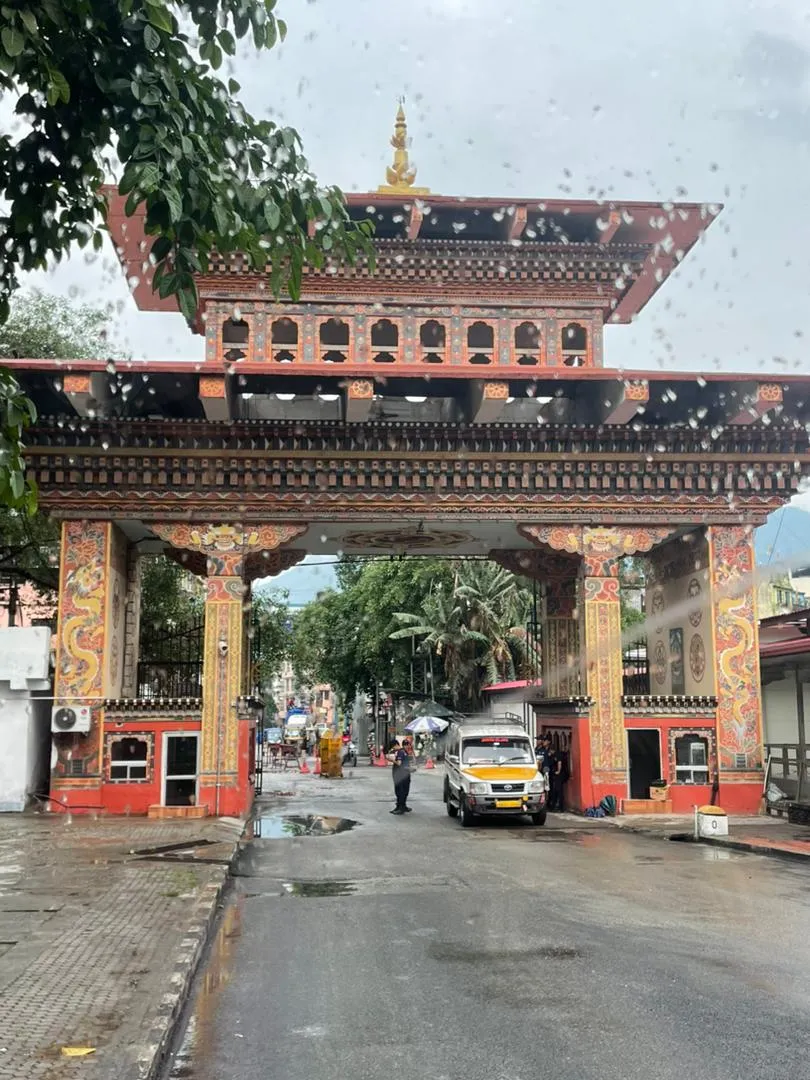
The gate at the end of the eastern highway. Photo: SingyeDzong, CC0.
On who built the lhakhang, we’ll be honest with you: nobody reliable says. Travel sites credit Dasho Aku Tongmi in 1990 — and credit the same man and year to the Zangto Pelri in Phuentsholing and to a chapel in Thimphu as well. One attribution, three buildings, no primary source. We would rather give you a temple with no date than a date we can’t stand behind.
Crossing into India
As a way in or out of Bhutan, the crossing is open to international travellers — it has been since 7 November 2024 — and it is the smart end to an eastern journey: finish in Trashigang, cross here, and reach Guwahati in about three and a half to four hours instead of driving the length of the country back west. Your Bhutan visa works the same overland as by air, and your guide sees you to the gate. Getting to Bhutan has the detail.
Crossing here means entering India, so you need India’s permission as well as Bhutan’s — for most nationalities that is an Indian visa, arranged before you travel. Bhutan’s side of the border being open does not open India’s, and that applies just as much to the Guwahati exit as it does to stepping across for an afternoon look and coming back.
And not just any Indian visa. India’s e-Visa — the one most people use to fly into Delhi or Kolkata — is valid for entry only at the ports India designates, and turning up at a land gate with the wrong visa is how people get turned around holding a visa they were sure was valid. Twelve land ports are on that entry list today. Darranga, the post on the other side of this gate, is one of them; Jaigaon, at Phuentsholing, was added on 10 August 2026 and was absent before that date. Tell us early if you are planning to leave this way; the full picture is in entering Bhutan by road.
When should you come?
October to March. At 173 metres this is the plain — hot, humid, and heavy with rain from April onwards, when the eastern roads are at their worst as well.
See things to do in Samdrup Jongkhar for the district, and Dewathang, 18 kilometres up the road, for the battlefield.
Frequently asked questions
Can you cross the border into India at Samdrup Jongkhar?
On Bhutan's side, yes — Samdrup Jongkhar has been open to international travellers since 7 November 2024, and it is the sensible exit after an eastern Bhutan journey, putting you in Guwahati in about three and a half to four hours. See getting to Bhutan for how that works. But crossing here means entering India, which needs India's permission as well — for most nationalities an Indian visa arranged in advance. That applies to the Guwahati exit exactly as it applies to stepping across for a look and coming back. Be careful which visa: India's e-Visa is valid for entry at twelve land ports, and both Darranga, the post opposite this gate, and Jaigaon at Phuentsholing are on that list — Jaigaon since 10 August 2026. Tell us early if you want to leave this way and we'll confirm what your passport needs.
How high is Samdrup Jongkhar, and how hot?
173 metres — one of the lowest towns in Bhutan, and it feels it. This is the plain, not the mountains: hot and humid, heavy with rain from April through the monsoon. October to March is when it is comfortable. Pack for the tropics, not for altitude.
What is there to see in Samdrup Jongkhar town?
An hour to ninety minutes covers it: the border gate, the Zangto Pelri Lhakhang in the centre, and the walk between them. It is a working trading town rather than a sight, and after three weeks of eastern Bhutan the food — which skews to what a border town gets — may be exactly what you want.
Who built the Zangto Pelri Lhakhang here?
We don't know, and we would rather say so. Travel aggregators credit it to Dasho Aku Tongmi in 1990 — but they credit the same man and the same year to at least two other buildings, one in Phuentsholing and one in Thimphu, with no primary source behind any of them. Zangto Pelri means Guru Rinpoche's celestial paradise and there are many temples of the name across Bhutan, including one in Phuentsholing. This is not that one.
Tailor-made travel
Begin your journey to the Last Shangri-La
Every Little Bhutan itinerary is private and tailor-made. Tell us what draws you to Bhutan — festivals, treks, monasteries, food — and we will design the journey around it.