

Entering Bhutan by Road (2026): The Two Land Borders from India
Last updated:
Most of our guests fly into Paro. But Bhutan has land borders, two of them can process a third-country passport, and for some journeys the road is the better answer — arriving from Darjeeling or Sikkim, or finishing an eastern tour a few hours from Guwahati airport rather than retracing the road west.
One question decides whether the road works for you, and it is not Bhutan’s. It is India’s, and it is about which Indian visa you hold. Settle it before you book anything non-refundable. Here is the whole picture.
- Two crossings can process a third-country passport: Phuentsholing (opposite Jaigaon, West Bengal) and Samdrup Jongkhar (opposite Darranga, Assam, since 7 November 2024).
- Twelve land ports are now listed for e-Visa entry into India, both Jaigaon and Darranga among them — Jaigaon since 10 August 2026.
- Your Bhutan visa and the SDF work the same overland as by air.
- Passenger-processing hours on the Indian side are limited and not reliably published. They are what shapes your arrival day.
- We arrange the Bhutan side end to end; the Indian visa stays yours, and we check your routing against it before confirming.
Border rules on this page were checked on 24 August 2026. India expanded its e-Visa land-port list on 10 August 2026, and Bhutan’s arrangements are being expanded too, so we reconfirm the position for your travel dates in writing before you book.
The two crossings
Throughout this page, third-country national means a traveller who is a citizen of neither India nor Bhutan — the category the border rules turn on.
| Phuentsholing | Samdrup Jongkhar | |
|---|---|---|
| Indian side | Jaigaon, West Bengal | Darranga, Assam |
| Processes third-country passports | Long-standing | Since 7 Nov 2024 |
| Nearest Indian airport | Bagdogra (IXB), 4–5 h | Guwahati (GAU), 3.5–4 h |
| Onward drive in Bhutan | Thimphu, 165 km, 5–5.5 h | Trashigang, 175 km, 6–6.5 h |
| e-Visa entry into India here | Listed since 10 Aug 2026 | Listed |
| Usually used as | The way in, from Darjeeling or Sikkim | The way out, after eastern Bhutan |
Bhutan also runs border posts at Samtse and Gelephu, and you will see both listed as entry points. They are — but the Indian posts facing them are not currently set up to process an ordinary third-country tourist passport. See the other border towns below.
The Indian visa question
If you intend to enter India by road at any point, check the Indian entry port before booking.
India publishes a list of land ports where an e-Visa is valid for entry, under Authorized Immigration Checkposts → Entry Points → Landport. There are twelve in the whole country:
Raxaul, Rupaidiha, Darranga, Jogbani, Agartala, Gede, Ghojadanga, Haridaspur, Jaigaon, Dawki, Moreh, Attari — Indian Bureau of Immigration
Departure is governed by a looser rule on the same page: an e-Visa holder may leave from any Indian immigration check post.
What changed is Jaigaon’s status, on 10 August 2026. Until then it was absent from the entry list, and we published that as a firm no. A notification of that date added it, along with seven other land ports, and it is on the list today — as it has always been on the departure list. The position we published before that date no longer describes what India publishes.
What this means in practice:
- A Darjeeling → Bhutan → Darjeeling loop on an e-Visa is no longer ruled out on paper, now that Jaigaon is a listed e-Visa entry port. A regular visa issued by an Indian embassy or consulate stays what we recommend for any itinerary whose return leg is by road, and it means applying weeks ahead rather than online the week before.
- Leaving Bhutan by road is entering India — including when you have flown into Paro. It is not a “re-entry” exemption; it is an entry, and the port rules apply to it in full.
- The cleanest e-Visa routing through Phuentsholing is still India → Bhutan by road, then out by air from Paro. It depends only on leaving India, and at Jaigaon that is doubly supported: the page says an e-Visa holder may depart from any Indian check post, and it names Jaigaon on its own list of departure posts.
- A regular Indian visa removes the question entirely at both crossings, and is what we suggest for anyone whose plans need a road movement in each direction.
We are quoting India’s own published list rather than interpreting policy for you. Confirm your Indian visa type with an Indian mission before you book non-refundable travel — and tell us what you hold, because we will check the routing against it.
Phuentsholing: the western gateway
Phuentsholing sits on the plain where Bhutan meets West Bengal — a long border wall with a single Bhutanese gate in the middle of it, opening straight onto the Indian town of Jaigaon.
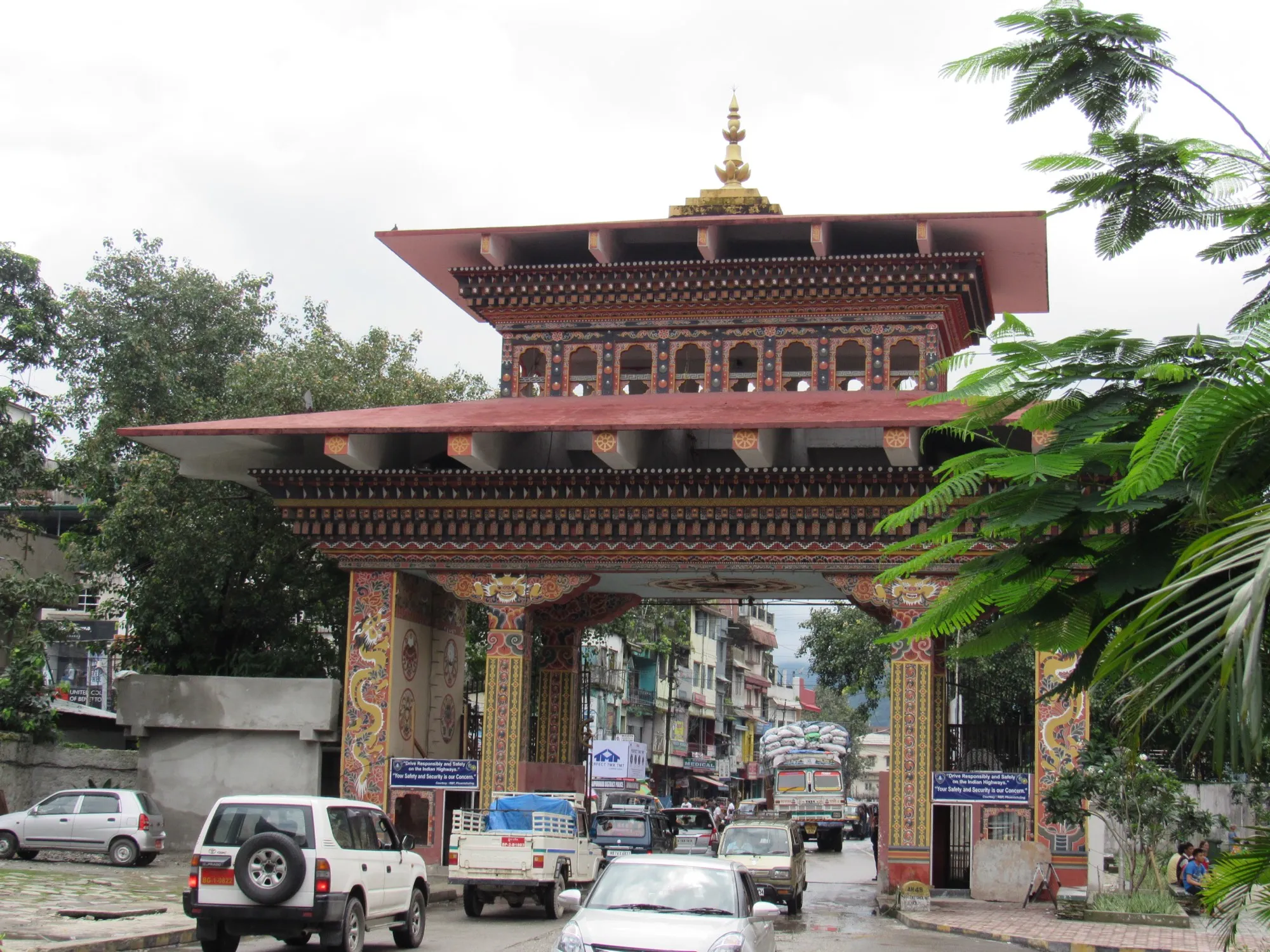
The Bhutan Gate at Phuentsholing, from the Jaigaon side. Photo: Afifa Afrin, CC BY-SA 3.0.
Getting there. Bagdogra airport (IXB) is about 165 kilometres and four to five hours away, via Siliguri and Hasimara; Siliguri’s traffic decides whether it is four or five. It is the classic route for pairing Bhutan with Darjeeling, Kalimpong or Sikkim, all within a morning’s drive of the same airport.
At the border. The pedestrian terminal runs 24 hours a day; the vehicle gate keeps shorter hours, roughly 6am to 11pm, and a vehicle is how you will arrive. Bhutanese immigration is open around the clock — you present your visa clearance, your passport is stamped, and your guide meets you inside the immigration complex, which you cannot leave unaccompanied.
What actually constrains the day is on the Indian side. Third-country travellers must be stamped out of India at the Indian immigration office in Jaigaon, a separate building a few hundred metres from the gate, and it keeps office hours rather than border hours. Published accounts of those hours contradict each other, so we do not print a number here — we confirm them for your date and time your arrival around them, which in practice means leaving Bagdogra in the morning.
Then the climb. Thimphu is 165 kilometres and about five to five and a half hours north, from roughly 300 m on the plain to a capital between about 2,250 m and 2,650 m. It is the most abrupt change of scene in Bhutan, and it is a full day — see Phuentsholing and Jaigaon for what the town and the drive are like.
Samdrup Jongkhar: the eastern exit
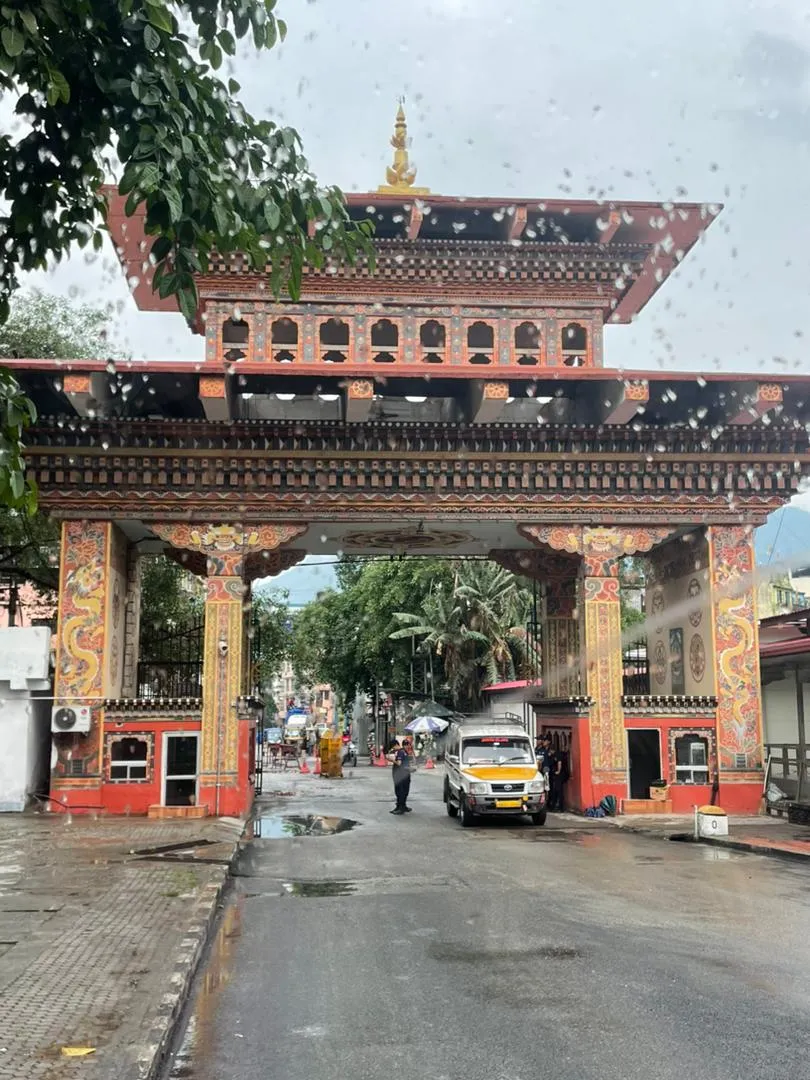
The gate at Samdrup Jongkhar. Photo: SingyeDzong, CC0.
Bhutan’s south-eastern border town sits at the end of the lateral highway, on the Assam plain. It opened to third-country travellers on 7 November 2024, when the Darranga Immigration Check Post was inaugurated opposite — the second Indo-Bhutan land post able to process a third-country passport, after Jaigaon.
Why it matters. Before that date, a third-country visitor had two ways into Bhutan: Paro airport, or Jaigaon–Phuentsholing. Everything in eastern Bhutan was a there-and-back proposition. Now an eastern journey can end where it ends geographically: Trashigang to Samdrup Jongkhar is 175 kilometres and about six to six and a half hours, and Guwahati airport is about 98 kilometres and three and a half to four hours beyond the gate.
Two honest cautions. It is a new and quiet crossing — expect a small post rather than a busy terminal, and expect published opening hours to be inconsistent; we confirm them before your travel date. And the drive is not an afternoon: Trashigang to a Guwahati flight is a two-day movement, so leave real buffer rather than connecting the same day.
Whether it beats the alternative depends on your itinerary — see which route to take below.
Your visa and the SDF work the same overland
Arriving by road changes nothing about what you pay or what you need.
- The Bhutan visa is arranged in advance. Bhutan does not operate visa on arrival for most nationalities, and travellers without correct documentation are refused entry — at the gate exactly as at the airport. We apply on your behalf once your trip is confirmed.
- For most non-Indian guests: a USD 40 visa fee, one-off, and the Sustainable Development Fee at USD 100 per adult per night, confirmed at that rate through 31 August 2027. Indian nationals travel on a permit rather than a visa and pay the regional SDF rate. Children’s rates and the border-town day-visit waiver are set out in the SDF guide.
- Your visa is stamped at the border, at the immigration check post in Phuentsholing or Samdrup Jongkhar rather than at Paro. Carry your visa clearance printed or on your phone — see travel requirements.
One genuine difference: an overland arrival is a formality in two countries, and the Indian one keeps shorter hours. Build the day around it.
What about Gelephu, Samtse and Nganglam?
You will find travel sites listing three or four Bhutanese land borders as open to foreign visitors. Bhutan does run border posts at Samtse and Gelephu, and they do record arrivals — but the Indian posts facing them are not currently authorised to process an ordinary third-country tourist passport. Bhutan’s side being open does not open India’s, and both sides have to work.
Gelephu is the one to watch. During the Indian Prime Minister’s state visit to Bhutan on 11–12 November 2025, India announced it would build an immigration check post at Hatisar, Assam, opposite Gelephu, to serve visitors and investors heading for Gelephu Mindfulness City. As of August 2026 it has been announced, not opened. When it does open, Bhutan will have a third crossing usable by third-country travellers — and we will say so here.
There is no road from Nepal or Tibet
Two questions we are asked constantly:
- Bhutan and Nepal do not share a border. Sikkim sits between them. Every Bhutan–Nepal journey is a flight — Kathmandu to Paro is daily, and it is the great Himalayan flight — or a long drive through India.
- There is no open immigration crossing between Bhutan and China. A Bhutan–Tibet itinerary has to route through a third country, in practice Nepal.
If you are combining countries by land, the neighbour to plan around is India, and only India.
Which route should you actually take?
- Flying into Paro is the right default for most guests. It is faster, the landing is one of the world’s great arrivals, and it raises no Indian entry question at all.
- Come in by road if you are already in Darjeeling, Kalimpong, Sikkim or the Dooars, or if you want to watch the country change from plain to mountain in a single day.
- If your journey finishes in eastern Bhutan, compare two exits. The 45-minute Yonphula–Paro domestic flight is what our 14-night eastern journey uses today, and it is hard to beat when your onward flight leaves from Paro. The Samdrup Jongkhar road exit wins when you want to finish in India — but it costs the drive from Trashigang and needs an Indian visa that covers entry by land. We can build either; ask and we will price both.
- Settle the Indian visa first, not last. It is the only part of an overland plan that cannot be fixed on the day.
What we do and what stays yours
We arrange your Bhutan visa and SDF, the road transfers on both sides, and the guide and vehicle waiting in Bhutan. We confirm the border’s passenger hours for your date before fixing transfer or flight times.
The Indian visa stays yours — we cannot issue or guarantee one — but tell us which type you hold and we will check your routing against it before the trip is confirmed, rather than after you are standing at a gate.
Plan your trip with our team in Thimphu, or start with what a trip costs and getting to Bhutan.
Plan the trip
Private tours that pair with this guide


Frequently asked questions
Can non-Indian travellers enter Bhutan by road?
Yes, at two crossings from India: Phuentsholing, opposite Jaigaon in West Bengal, and Samdrup Jongkhar, opposite Darranga in Assam, which opened to third-country travellers on 7 November 2024. Bhutan also has border posts at Samtse and Gelephu, but the Indian posts facing them are not currently set up to process third-country tourist passports. Your Bhutan visa must be arranged in advance either way — Bhutan has no visa on arrival for most nationalities, by road or by air.
Can I use an Indian e-Visa to cross into Bhutan and come back?
Leaving India for Bhutan works on an e-Visa at both gates: India permits departure from any of its immigration check posts. Coming back is the part to settle. India's checkpost list now names twelve land ports for e-Visa entry, Jaigaon and Darranga among them — Jaigaon added by a notification dated 10 August 2026. A regular visa from an Indian mission removes the question entirely.
How do I get from Bagdogra airport to the Bhutan border?
Bagdogra (IXB) to Phuentsholing is about 165 kilometres and four to five hours by road, through Siliguri and Hasimara. Siliguri traffic is the variable. We arrange the transfer and meet you at the border gate.
How do I get from Bhutan to Guwahati airport?
Exit at Samdrup Jongkhar in the far south-east. Guwahati airport is about 98 kilometres and three and a half to four hours from the border. From Trashigang it is a further 175 kilometres and about six to six and a half hours to reach the border, so this is a two-day movement rather than an afternoon — compare it against the 45-minute Yonphula–Paro domestic flight before choosing.
Can I enter Bhutan by road from Nepal or Tibet?
No. Bhutan and Nepal do not share a border — Sikkim lies between them — so every Bhutan–Nepal journey is a flight or a drive through India. There is no open immigration crossing between Bhutan and China, so a Bhutan– Tibet itinerary has to route through a third country, usually Nepal.
Is the Sustainable Development Fee different if I arrive by road?
No. For most non-Indian guests the SDF is USD 100 per adult per night and the visa fee USD 40, whether you land at Paro or walk through the gate at Phuentsholing. Indian nationals travel on a permit rather than a visa and pay the regional SDF rate. Arriving overland changes the logistics, not the cost.
Can I drive my own car into Bhutan?
Private vehicles are permitted, on a charge of Nu. 4,500 per car per day, with your driving licence, insurance, pollution-control and vehicle documents, plus an authorisation letter if the car is not yours. Route permits are no longer required for tourists moving around Bhutan. In practice almost everyone doing this is driving up from India; on our tours the question does not arise, because a vehicle and driver are included and meet you at the border.
Tailor-made travel
Begin your journey to the Last Shangri-La
Every Little Bhutan itinerary is private and tailor-made. Tell us what draws you to Bhutan — festivals, treks, monasteries, food — and we will design the journey around it.