
Motithang Takin Preserve
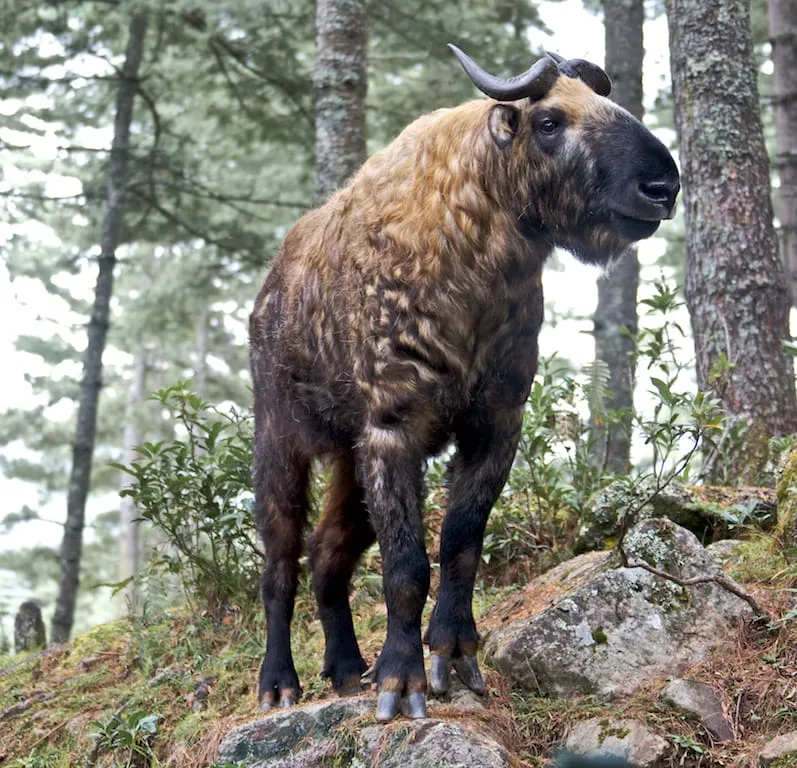
The Motithang Takin Preserve is a fenced hillside above Thimphu holding a herd of takin, Bhutan’s national animal. It exists because the animals refused to be set free. Allow 30–45 minutes; entry is included in your tour.
What you’re looking at
A takin is a heavy, shaggy goat-antelope — the body of a small ox, the muzzle of a moose, and a coat that looks permanently damp. Every visitor has the same reaction, which is that it appears to have been assembled from parts. That is precisely what Bhutanese tradition says happened, and we will come back to it.
The animal here is the Bhutan takin, Budorcas taxicolor whitei, listed as vulnerable. In the wild it lives in Bhutan, north-east India and the adjoining fringes of China and Tibet, moving above 3,700 m in summer. It is not found in Nepal — a claim this very page made for years until we went back to the source — and the takin of Myanmar are a different subspecies again.
The enclosure covers about 3.4 hectares (8.4 acres) of wooded hillside, so this is a large fenced patch of forest rather than a pen. There are sambar and barking deer in with them.
Why a Buddhist country fenced them in
This is the good story, and it runs the opposite way to the one you’d expect.
The site was a small zoo. The Fourth King had it closed, on the grounds that keeping animals in captivity did not sit with a Buddhist country’s religious and environmental values. The animals were released.
The takin would not go. They came back down, and for weeks they wandered the streets of Thimphu looking for food — too habituated to fend for themselves in the hills. So the enclosure was re-established, not as a zoo but as a preserve for a herd that could no longer be wild. The infrastructure was improved in 2004 by the Royal Government with WWF.
It is a Bhutanese story in miniature: a decision taken on principle, an outcome nobody wanted, and a pragmatic accommodation that keeps the principle intact.
When to go, and what to expect
Year-round. There is no bad season, and the walk along the fence takes half an hour whatever the weather.
Morning and late afternoon are the better bets, when the herd is up and moving rather than lying in shade — and the takin are easier to see in winter, when they come lower down the enclosure. In high summer they can be a long way up the slope and half of what you see will be a brown shape behind a tree. That’s wildlife.
Opening days are the one real risk. Some sources say the preserve closes on Mondays and public holidays; others give no closing day; nothing official exists. Your guide checks the morning you go, rather than us publishing a schedule we cannot stand behind.
How it fits your day
It sits in Motithang, ten minutes up from Thimphu town, and it is almost never visited on its own. Directly above it is Sangaygang, the viewpoint at the radio tower — and from there the Wangditse hike sets off, the gentlest real walk in Thimphu. Preserve, viewpoint, walk: that’s a good half-morning.
Guests travelling with children usually rate this the best half-hour of their Thimphu day, which is worth knowing if you’re building an itinerary around one. See Bhutan with children for the rest of that thinking, or things to do in Thimphu for how everything in the capital compares.
The legend, because it explains the animal
Drukpa Kunley — the 15th-century saint Bhutanese call the Divine Madman, the same figure behind Chimi Lhakhang in Punakha — was asked by a crowd to perform a miracle. He agreed, on the condition that he was first fed a whole cow and a whole goat.
He ate both and left the bones. Then he set the goat’s head on the cow’s skeleton, snapped his fingers, and the animal stood up and walked off to graze. He named it dong gyem tsey, the takin.
Look at one for a minute and you will find the story hard to argue with. We tell it properly, with what it means for the animal’s religious standing, in the legend behind the takin, Bhutan’s national animal.
Tours that visit Thimphu


Frequently asked questions
What is a takin?
Bhutan's national animal — a heavy, shaggy goat-antelope, Budorcas taxicolor whitei, listed as vulnerable. It has the body of a small ox and the face of a moose, and it looks assembled rather than evolved, which is exactly what the legend says happened. It was declared the national animal on 25 November 2005.
Where are takin found in the wild?
The Bhutan takin lives in Bhutan, north-east India and the adjoining parts of China and Tibet, summering above 3,700 m. It is not found in Nepal — a claim this page itself carried for years before we checked it — and the takin of Myanmar are a different subspecies.
Why is there a takin enclosure in the middle of Thimphu?
Because the animals wouldn't leave. The site was a small zoo until the Fourth King decided that caging animals didn't sit with a Buddhist country's values and had it closed. The takin were released — and spent weeks wandering the streets of Thimphu looking for food, too tame to go back to the hills. The preserve was built around them.
How long do you need at the takin preserve?
Thirty to forty-five minutes. It's a walk along a fence line with a herd on the other side of it, not a zoo circuit, and it pairs naturally with the Sangaygang viewpoint just above.
Is the takin preserve open every day?
Published answers disagree — some sources say it closes on Mondays and on national holidays, others give no closing day at all, and there's no official schedule we'd stake a morning on. Your guide checks before you set off, which is the only reliable way to handle it.
What's the legend behind the takin?
Drukpa Kunley, the 15th-century "Divine Madman", was asked to perform a miracle and agreed on condition he was fed a whole cow and a whole goat. He ate both, set the goat's head on the cow's skeleton, snapped his fingers — and the animal stood up and started grazing. We tell the full story in the legend behind the takin.
Tailor-made travel
Begin your journey to the Last Shangri-La
Every Little Bhutan itinerary is private and tailor-made. Tell us what draws you to Bhutan — festivals, treks, monasteries, food — and we will design the journey around it.