
Royal Manas National Park
Royal Manas is Bhutan’s oldest protected area and the fourth largest of its national parks — 1,057 km² of forest running down from the hills to the Indian border, entered from the riverside town of Panbang. Our itineraries give it a day; what fills that day depends on which itinerary you are on.
What is Royal Manas National Park?
A wildlife sanctuary from 1966 and a national park since 1993, spread across three districts — eastern Sarpang, the western half of Zhemgang and western Pemagatshel. The Royal Government calls it “the conservation showpiece of the Kingdom” and a “genetic depository” for valuable plants.
The elevation is what makes it. The park runs from about 108 metres on the Manas river plain up to 2,600 metres in the hills, and roughly 92 per cent of it is forest. That range is why the species list reads like two countries at once.
It sits directly against Manas National Park in Assam, a UNESCO World Heritage Site, and is linked by biological corridors to Jigme Singye Wangchuck National Park, Phrumsengla National Park, Phibsoo Wildlife Sanctuary and Jomotsangkha Wildlife Sanctuary. Royal Manas itself is on Bhutan’s Tentative List for World Heritage inscription — proposed, not inscribed.
What can you see there?
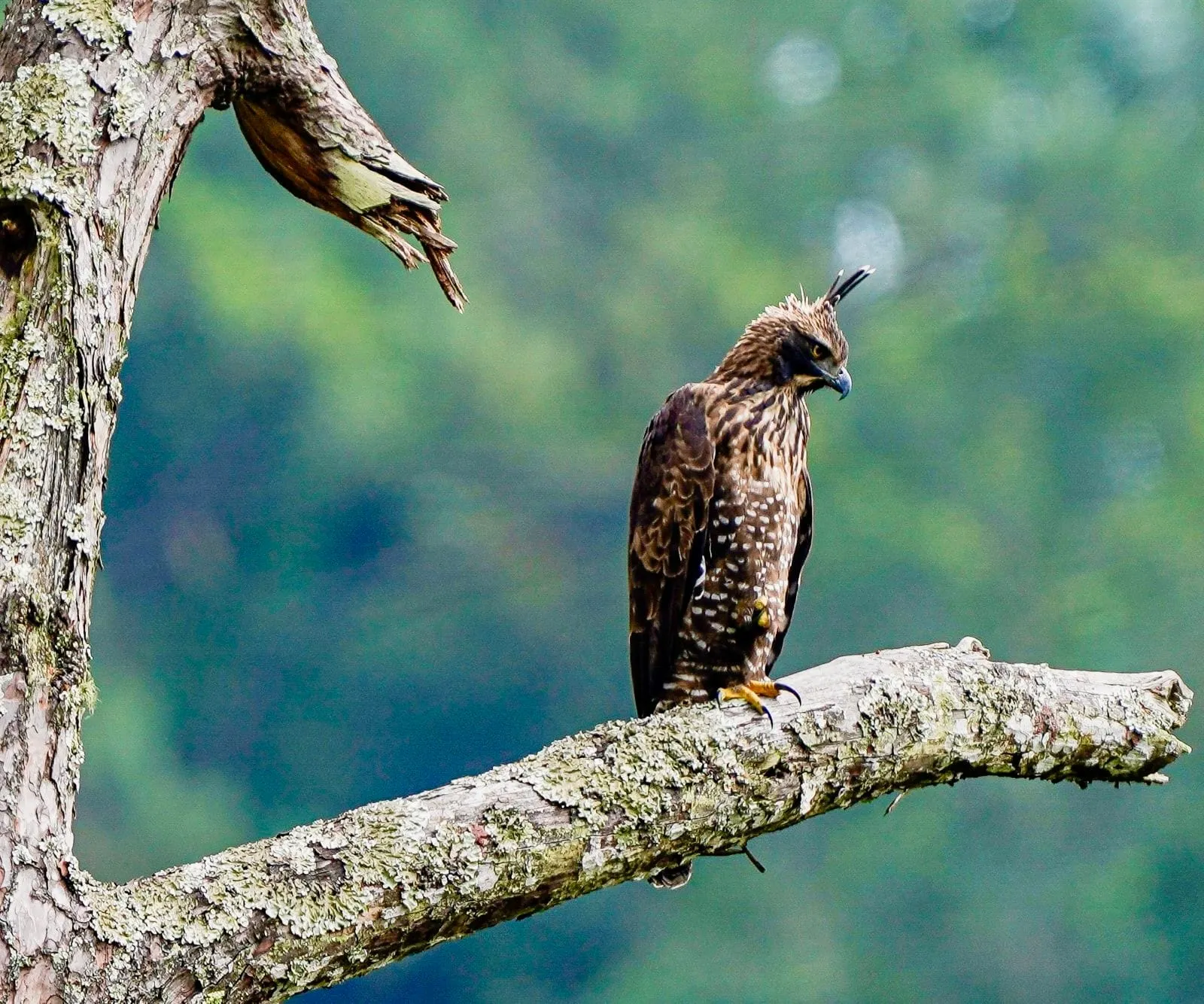
Elephant, Bengal tiger, gaur, clouded leopard, golden langur, capped langur, pygmy hog, hispid hare and Ganges river dolphin. It is the only park in Bhutan where the one-horned rhinoceros and the wild water buffalo are found.
Four hornbill species live here — rufous-necked, wreathed, pied and great — and the Manas and its tributaries hold three kinds of mahseer: deep-bodied, golden, and the chocolate mahseer that Bhutan calls katle.
The golden langur is the one people come for, and it is worth knowing what it is: an animal of this forest on both sides of the border, endemic to the eastern Himalayan foothills rather than to Bhutan alone. A troop moving through the canopy is the image this park sells, and nobody can promise you one.
We don’t publish a bird count. Two numbers circulate on our own older pages and they disagree with each other; a park’s recorded-species list only grows, so the smaller cannot be a later correction of the larger. What is not in doubt is that this is one of the richest patches of forest in the country.
Who lives inside the park?
About 5,000 people, in remote villages inside the boundary — and roughly 10,646 people in 1,026 households once you count the settlements around it as well. Most are Khengpas, farming maize, millet, rice and wheat, with oranges and cardamom in some valleys.
That shapes how you visit. A community ecotourism programme began here in 2010 with WWF Bhutan, built around five community-managed eco-camps on the Gomphu–Manas–Norbugang trail — Gomphu at 1,457 m, Pangtang at 239 m, Shilingtoe at 420 m, Panbang at 160 m and Norbugang. The revenue split was set at 70 per cent to the person providing the service, 25 per cent to a community fund and 5 per cent to the park, and each camp takes a maximum of thirteen guests at a time.
How long do you need, and when should you come?
A day from Panbang is what our own itineraries do — the drive in, the day in the park, and back to the town for the night. What that day holds is not the same on all three: one gives about two hours to an eco trail on foot, one puts you on the river, one is a birding day. Check the itinerary you are actually booked on.
The four-day walk is a separate trip. The Gomphu–Manas–Norbugang trail links those five camps at roughly four hours of walking a day. Its ends pass through India, and when we last wrote about it in detail it needed a park permit and double-entry visas for both countries. Those are exactly the arrangements that change, so it is a conversation with us rather than something to plan around a web page.
November to March, once the monsoon is out of the way. This is the low, hot end of Bhutan: pack for humidity rather than for altitude.
We don’t give a map pin for the park. It covers 1,057 square kilometres, and the only point on the map carrying its name is the park office — which is in Gelephu, in the next district.
See things to do in Zhemgang for the rest of the district.
Tours that visit Zhemgang


Frequently asked questions
How long do you need at Royal Manas National Park?
A day, based at Panbang. Every itinerary we run does it that way: a short drive in from the town, the day in the park, and back to Panbang for the night. What fills that day varies by itinerary — an eco-trail walk of about two hours on one, rafting on another, birding on a third — so check yours rather than assume all three. There is also a multi-day walk — the four-day Gomphu–Manas–Norbugang eco-trail between five community camps — but that is a different trip with its own permits, and it is one to ask us about rather than to assume.
When was Royal Manas National Park established?
It became a wildlife sanctuary in 1966 and a national park in 1993, which makes it Bhutan's oldest protected area — the next oldest national park, Jigme Dorji, dates from 1974. One thing is not settled: some accounts, including one of our own older blog posts, give 1964 rather than 1966 for the sanctuary. The two years do not change the "oldest" part.
What animals live in Royal Manas National Park?
Elephant, Bengal tiger, gaur, clouded leopard, golden langur, capped langur, pygmy hog, hispid hare and Ganges river dolphin — and it is the only park in Bhutan where the one-horned rhinoceros and the wild water buffalo are found. Four hornbill species live here: rufous-necked, wreathed, pied and great. Seeing any of them is luck, and we don't publish a species count — the two figures on our own older pages disagree with each other.
How do you get to Royal Manas National Park?
Through Panbang, in the far south of Zhemgang. Our itineraries reach it either down the Tingtibi–Panbang highway from Trongsa and Zhemgang, or from the east through Nganglam. It is a long way from anywhere — which is the point of it, and why the park belongs on itineraries with days to spare.
Tailor-made travel
Begin your journey to the Last Shangri-La
Every Little Bhutan itinerary is private and tailor-made. Tell us what draws you to Bhutan — festivals, treks, monasteries, food — and we will design the journey around it.