Bhutan Is Planning a Yeti Tracking Trail in Eastern Bhutan
On 6 July 2026, a team returned to Trashigang after eight days on foot in the highlands of eastern Bhutan. Their task was to survey a proposed Yeti Tracking Trail: a route beginning in Sakteng, passing through Merak and continuing towards Samcholling at Samkhar.
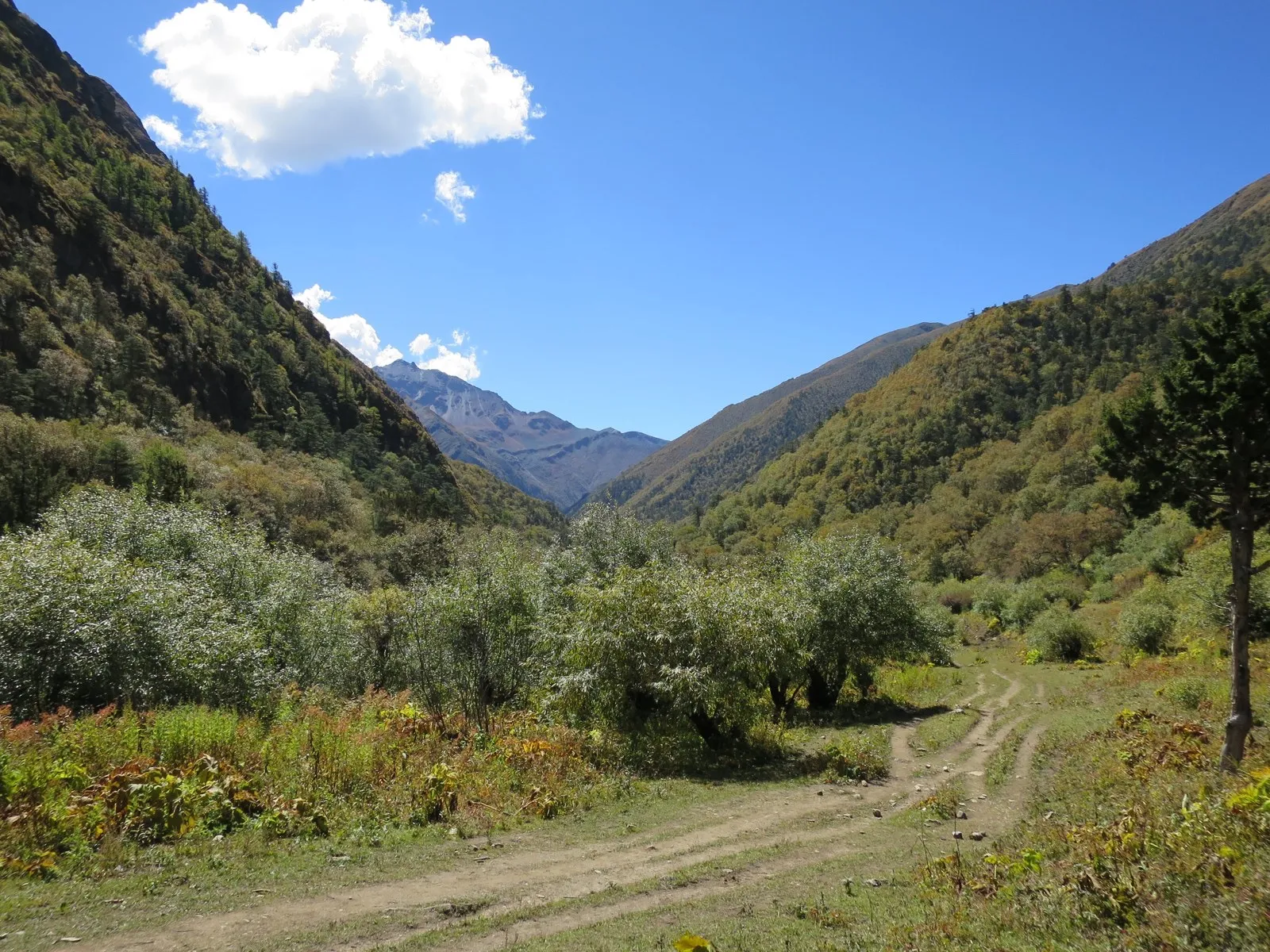
A dirt track through a mountain valley in Bhutan. Little Bhutan archive; exact location unrecorded.
It is an extraordinary name for a trail. It is also a very early announcement.
Current status, 2 August 2026: the route has been surveyed and is being planned. No public opening date, visitor itinerary, price or booking process has been announced. This is not yet a trek that we—or any responsible operator—can sell as a finished product.
What Bhutan has announced
The official announcement from Trashigang Dzongkhag Administration describes a proper survey expedition. The team included planners, surveyors, engineers, forestry officers, medical personnel and three local guides.
They walked for eight days, crossing high-altitude passes and dense forest on a corridor that connects some of the most remote communities in Trashigang. The administration says the intention is to create a route around living folklore, highland culture and community-based tourism.
That is the confirmed part. The same announcement ends by saying the trail is being planned, with further updates to come.
| Confirmed | Not announced yet |
|---|---|
| A survey team completed eight days on foot | A public opening date |
| The corridor passes through Sakteng and Merak | The eventual number of trekking days |
| The route continues towards Samcholling at Samkhar | Daily distances, ascent or maximum altitude |
| The terrain includes high passes and forest | Camps, homestays, permits or a price |
The distinction matters. Eight days describes the survey expedition. It does not yet prove that the finished visitor itinerary will also be eight days.
The route that was surveyed
The Dzongkhag announcement gives a broad sequence rather than a day-by-day trek:
Sakteng → Rongjung Goo → Tsholing Goenpa → Merak → Phreangla → Samcholling at Samkhar
We have kept the official announcement’s spellings here while we confirm the local romanisation of the intermediate names. No published source currently tells us where the survey team camped, how far it walked each day, or which of those places are intended as overnight stops.
That is why we are not drawing a polished route map from one sentence. A line on a map would look authoritative while quietly inventing the detail that matters most to a walker: distance, gradient, water, shelter and a safe exit.
What is clear is the shape of the idea. The proposed route would carry walkers beyond the familiar western circuit and into the Brokpa highlands, through a landscape where roads remain rough, distances take time and local knowledge is not optional.
Why call it the Yeti Tracking Trail?
In Bhutan the Yeti is generally known as the migoi. In the highlands around Sakteng it belongs to living oral tradition—not simply to the imported image of an abominable snowman wandering through snow.
The trail’s name follows a wider effort to present that folklore through local culture. In May 2026, Sakteng held the Great Yeti Quest, a three-day event centred on Brokpa performance, food, homes and stories. Bhutan Broadcasting Service reported that more than 1,000 people, including international visitors, attended the opening day. Its stated aims were to promote eco-tourism, preserve Brokpa culture and create income opportunities for residents.
The Dzongkhag’s account of the festival describes traditional songs, dances and a Brokpa marriage performance. That context is important. “Yeti tracking” is a cultural frame, not a promise that a guide will produce an animal or manufacture footprints for a photograph.
If you want the older stories—expeditions, hair samples and the advice once given to walkers who might meet a female migoi—we have a separate account of Bhutan’s Abominable Snowman. This page is about the proposed trail and what is actually known in 2026.
Merak, Sakteng and the Brokpa highlands
The trail’s real centre is not a mythical animal. It is the two highland communities it would connect.
Merak and Sakteng are home to the Brokpa, semi-nomadic yak and sheep herders with their own language and a form of dress instantly recognisable across Bhutan. Merak sits at about 3,500 metres; Sakteng is lower, at roughly 2,950 metres. These are living villages, not staged heritage exhibits, and a raised camera should always follow a question.
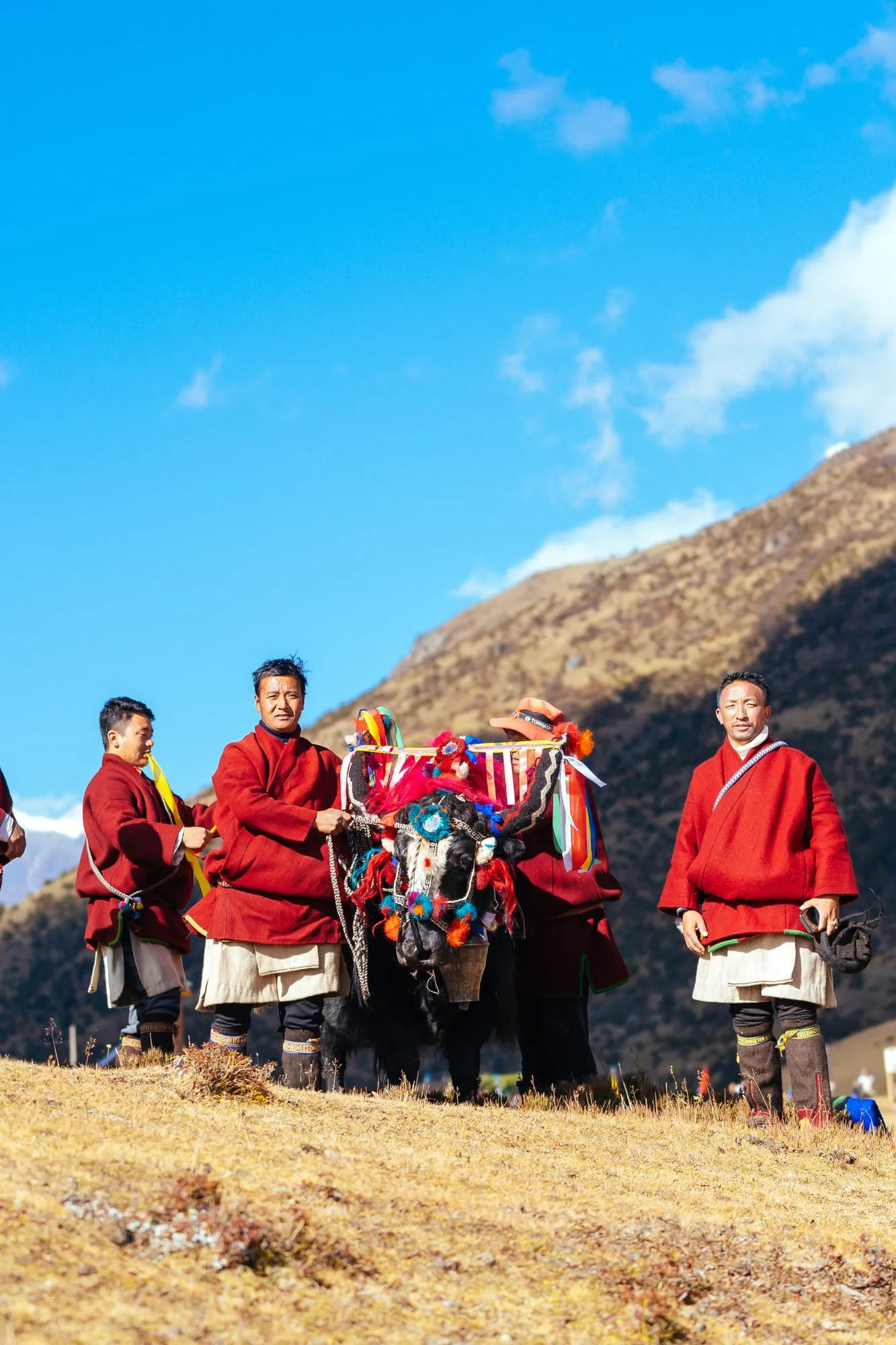
Brokpa highlanders in Trashigang. Ask before photographing people in Merak and Sakteng; the villages are homes, not displays.
Both communities sit inside Sakteng Wildlife Sanctuary, which covers 740.60 square kilometres and is on Bhutan’s UNESCO World Heritage tentative list. The UNESCO nomination records 35 rhododendron species, 20 mammal species and 147 bird species in the sanctuary. Those figures come from the 2012 nomination record, rather than a new 2026 wildlife survey, but they convey the biological range surrounding the proposed trail.
This is not simply the old Merak–Sakteng trek renamed
There are already itineraries described as the Merak–Sakteng trek. They vary widely because the road network has changed what “the trek” means.
A rough road now reaches Merak, and some walking itineraries begin from a roadhead rather than from Trashigang. Published trips range from short village visits to multi-day camps. Road conditions can also change with the season, so even the honest drive time is something to ask locally rather than copy from an old itinerary.
The newly announced Yeti Tracking Trail is different: it is a specific surveyed corridor from Sakteng through Merak and onward towards Samcholling. Until a route plan is published, an existing Merak–Sakteng package should not be presented as the new trail.
| Name | What it means in 2026 |
|---|---|
| Merak–Sakteng trek | Existing itineraries using different roads, trailheads and walking sections |
| Great Yeti Quest | The three-day cultural festival held in Sakteng in May 2026 |
| Yeti Tracking Trail | The newly surveyed corridor still being planned for visitors |
What still needs to be answered
Before this can become a responsible trekking itinerary, we need more than a name and a sequence of places.
- Opening: Who formally opens the route, and when?
- Walking: How long is each stage, how much climbing is involved, and what is the highest point?
- Sleeping: Will visitors camp, stay in village homes, or use both?
- Access: Which trailhead and road transfer will operate in each season?
- Protection: Are additional sanctuary or route permissions required?
- Safety: Where are the evacuation points, and what communications work beyond the villages?
- Community: Who provides guides, horses, food and accommodation, and how will income stay in the highlands?
Those questions are not bureaucratic footnotes. They are the difference between an evocative announcement and a trail people can walk safely without treating the communities along it as scenery.
Could it fit an eastern Bhutan journey?
Potentially, yes—but not as an add-on to a short first visit.
Eastern Bhutan already needs time. Our 15-day journey from western to eastern Bhutan reaches Trashigang as part of a private cross-country itinerary. The Dangling Tsho Trek is an established eastern walking route for travellers looking for something that can be planned now.
The Yeti Tracking Trail is not included in either journey. If the surveyed route opens, it will need its own time, operating plan and honest difficulty briefing. We will update this article when Trashigang Dzongkhag or Bhutan’s tourism authorities publish those details—and again when our guides can confirm conditions first-hand.
If eastern Bhutan is what draws you, tell us how much time you have and whether you want to walk, drive or combine both. We can plan around the routes that are operating now and let you know when this one moves from a promising survey to a trail ready for guests.


