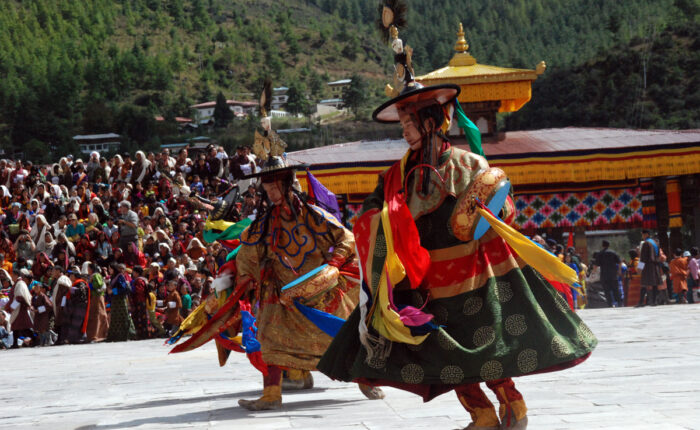
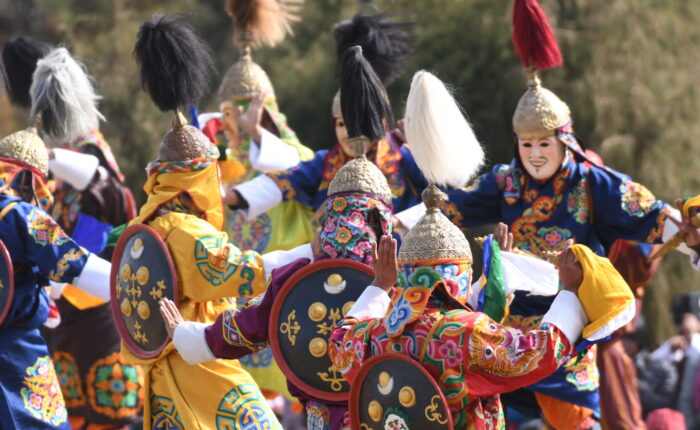
Tsechus have always been an integral aspect of Bhutanese culture. It attracts tourists and locals alike in the hordes. Yet not many understand how these festivals originated and what they signify. So, we hereby present you with a brief history of the Tshechu, along with how and where it all began.
The great scholar Padmasambhava of the school of Nyingmapa (the oldest of the four major schools of Tibetan Buddhism) visited Tibet and Bhutan in the 8th and 9th century. As bon practices and animist rituals were rampant then, he converted opponents of the Dharma by reciting mantras, performing rites and dancing to subjugate local spirits.
His visit to Bhutan had been to aid the dying king Sindhu Raja. Padmasambhava performed a series of dances in the Bumthang valley which miraculously restored the king’s health. The king in return helped him spread Buddhism in Bhutan. So, Padmasambhava organized the first tshechu in Bumthang where the eight manifestations of Guru Rinpoche (Padmasambhava being the human form) were presented through eight forms of dances. These dances or Chams depicted the glory of Buddhism and were composed mainly to convey messages of the Buddha to the people. While some of the Chams were composed by Guru Rinpoche, others were created by Tertoen Pema Lingpa, Zhabdrung and other great saints.
During the mask dances, the deities of the tantric teachings are invoked and through their power and blessings, misfortunes are removed. The dances are believed to suppress all evil spirits and demons that prevent the spread of Chhoe – the doctrine.
The eleven-day annual Lhamoi Drubchen – a rite performed to appease the protecting deity Pelden Lhamo (Mahakali) – is held in September. Pelden Lhamo whose name translates into Glorious Goddess is the only female Dharma protector common to all four schools of Buddhism. She is one of the three main protecting deities of Bhutan.
Although the Thimphu Tshechu was introduced in 1670, the Drubchen was instituted sometime between 1705 and 1709 by Kuenga Gyaltshen, the first reincarnation of Jampel Dorji – the son of Zhabdrung Ngawang Namgyal. According to legend, Pelden Lhamo appeared before him while he was meditating and performed dances. And based on the dances, Kuenga Gyaltshen initiated the Drubchen.
Paro Tshechu is the most popular pageantry in Bhutan with the unfurling of the world’s biggest Thangka or Thongdrel ceremony. The mask dances commemorate the deeds of the great saint Guru Rinpoche. The locals attend the colorful festival to gain merit.
The event inside Paro Rinpung Dzong commences with monks performing the Shingje Yab Yum – the dance of the lord of death (Shingje) and his consort. It is followed by Durdag – the dance of the lords of the cremation grounds, after which, the dance of the black hats, Shanag, and the dance of the drums from Drametse (Drametse Ngacham) are performed.
The Punakha Drubchen was introduced by Zhabdrung to commemorate the victories over the Tibetans. During the festival, the Pazaps or local militia men dress in battle gear and showcase a battle scene from the distant past. In the absence of a standing army, men from the eight Tshogchens of Thimphu and Punakha valley came forward and managed to expel the Tibetan forces from Bhutan. As for the Punakha Tshechu, it was started by the 70th Je Khenpo Trulku Jigme Choedra.
The Thongdrel unveiled during the festival is of great significance. Measuring 83ft by 93ft, it is composed entirely of appliqué on 6,000 meters of silk brocade that took 51 artists two years to complete. The top half of the Thongdrel is devoted to the 11 manifestations of Zhabdrung’s lineage. The bottom half depicts Bhutan’s spiritual leaders including the current Je Khenpo.
The Trashigang Tshechu takes place in the winter months. What attracts tourist to this festival is the nomadic people from Merak and Sakten with their unique costumes and attires. The Kholong Tshechu in Trashigang, which begins in Yonphu towards the end of November, also draws a huge crowd not only because it is the oldest Tshechu in Eastern Bhutan but because of its name. Kholong – translated in Sharchopkha means a fight. So, a precise interpretation would be ‘the fighting tshechu’.
These circumambulations of the Chortens by the Dakpas (people of Tawang District of Arunachal Pradesh in India) and Drukpas (Bhutanese) are held in the first lunar month and are attended by people from all over the eastern region in Bhutan and from India.
A popular belief is that when the stupa was constructed, a pious dakini princess from Arunachal Pradesh entombed herself within, as the Yeshe Semba, to meditate on behalf of all beings. Hence, devotees from Tawang in Arunachal Pradesh, India, joined the Bhutanese counterparts in the Namgang Kora – one of eastern Bhutan’s oldest festivals which is held annually at the Chorten Kora in Trashiyangtse Dzongkhag.
Trongsa Tshechu, the oldest festival in Bhutan, is held annually inside the vast Trongsa Dzong. It is believed that the Tshechus began to spread in Bhutan from Trongsa. During the three-day festival, locals and monks perform mask dances, and traditional folk songs and dances are showcased as offerings to Guru Padmasambhava and local deities.
This festival is held for dual reasons; to commemorate the establishment of the Jambey Lhakhang (temple) in the 7th century and to honor Guru Rinpoche who introduced tantric Buddhism in Bhutan.
This festival is one of the most important in Bhutan and the highlight is the Mewang – the fire ceremony – and the Tercham – a religious dance. The fire dance is supposed to bless infertile women so that they may bear children.
The Domkhar festival in Chumey valley in Bumthang was initiated by a preeminent scholar of Dranang in Tibet, Lam Kuenkhen Longchen Rabjam, in the 16th century. He promoted the special teaching of Dzongpo Chenpo (great perfection) and founded eight monasteries throughout the country. The festival held every year in April at the Domkhar temple is in his honor.
This festival is held within the walls of Jakar Dzong to honor the Guru Rinpoche (Padmasambhava) who brought Tantric Buddhism to Bhutan during 8th century. The festival lasts for three days in mid-October during the ninth month of the Bhutanese lunar calendar.
| Sl.No | Festival | Place | 2027 | 2026 |
| 1 | Lhamoi Dromchhen | Trongsa Dzong, Trongsa | 11th – 13th February | 22nd-24th February |
| 2 | Lhuentse Tsechu | Lhuentse Dzong, Lhuentse | 5th – 9th January 2028 | 08th-10th January |
| 3 | Punakha Dromchoe | Punakha Dzong, Punakha | 13th – 15th February | 24th-26th February |
| 4 | Punakha Tshechu | Punakha Dzong, Punakha | 16th – 18th February | 27st February – 1st March |
| 5 | Tharpaling Thongdrol | Tharpaling Lhakhang, Chummi, Bumthang | 20th February | 03rd March |
| 6 | Gomphu Kora | Gom Kora Lhakhang, Trashigang | 16th – 18th March | 26th-28th March |
| 7 | Talo Tshechu | Talo Gonpa, Punakha | 16th – 18th March | 26th-28th March |
| 8 | Gasa Tshechu | Gasa Dzong, Gasa | 16th – 18th March | 26th-28th March |
| 9 | Zhemgang Tshechu | Zhemgang | 16th – 18th March | 26th-28th March |
| 10 | Paro Tshechu | Rinpung Dzong, Paro | 18th – 22nd March | 29th March -02nd April |
| 11 | Haa Spring Festival | Yangthang Ground, Haa | 07th -09th April | |
| 12 | Domkhar Tsechu | Domkhar, Chummi, Bumthang | 16th – 18th April | 26th-28th April |
| 13 | Ura Yakchoe | Ura Lhakhang, Bumthang | 18th – 22nd April | 28th April – 02nd May |
| 14 | Nimalung Tsechu | Nimalung Dratshang, Chummi, Bumthang | 12th – 14th June | 22nd -24th June |
| 15 | Kurjey Tsechu | Kurjey Lhakhang, Choekhor, Bumthang | 14th June | 24th June |
| 16 | Mushroom Festival | Genekha, Geneyzam, Thimphu | 15th – 16th August | |
| 17 | Tour of the Dragon (Bicycle Race) | Bumthang to Thimphu | 5th September | 05th September |
| 18 | Thimphu Drubchen | Tashi Chhodzong, Thimphu | 5th October | 17th September |
| 19 | Wangdue Tsechu | Wangduephodrang | 8th – 10th October | 19th– 21st September |
| 20 | Thimphu Tsechu | Tashi Chhodzong, Thimphu | 10th – 12th October | 21st – 23rd September |
| 21 | Tamshing Phala Chhoepa | Tamshing Lhakhang, Choekhor, Bumthang | 10th – 12th October |
21st – 23rd September |
| 22 | Gangtey Tsechu | Gangtey Gonpa, Phobjikha, Wangduephodrang | 13th – 15th October | 24th-26th September |
| 23 | Thangbi Mani | Tangbi Lhakhang, Choekor, Bumthang | 26th-27th September | |
| 24 | Chhukha Tsechu | Chhukha Dzong, Chhukha | 6th – 8th November | 19th-21st October |
| 25 | Jakar Tsechu | Jakar Dzong, Choekhor, Bumthang | 6th – 9th November | 18th-21st October |
| 26 | Jambay Lhakhang Drup | Jambay Lhakhang, Choekhor, Bumthang | 14th – 17th November | 26th-29th October |
| 27 | Prakar Duchhoed | Prakar Lhakhang, Chummi, Bumthang | 15th – 17th November | 27th-29th October |
| 28 | Black Necked Crane Festival | Gangtey Gonpa, Phobjikha, Wangduephodrang | 11th November | 11th November |
| 29 | Mongar Tsechu | Mongar Dzong, Mongar | 6th – 8th December | 17th-19th November |
| 30 | Trashigang Tsechu | Trashigang Dzong, Trashigang | 7th – 9th December | 18th-20th November |
| 31 | Jambay Lhakhang Singye Cham | Jambay Lhakhang, Choekhor, Bumthang | 13th December | 24th November |
| 32 | Nalakhar Tsechu | Ngaa Lhakhang, Choekhor, Bumthang | 13th – 15th December | 24th-26th November |
| 33 | Druk Wangyel Tsechu | Dochula, Thimphu | 13th December | 13th December |
| 34 | Trongsa Tshechu | Trongsa Dzong, Trongsa |
5th – 9th January 2028 | |
| 35 | Samdrupjongkhar Tshechu |
Samdrupjongkhar | 10th – 12th January 2028 | |
| 36 | Nabji Lhakhang Drup | Nabji Lhakhang, Nabji, Trongsa |
12th – 14th January 2028 | |
| 37 | Tangsibi Mani | Tangsibi Lhakhang, Ura Bumthang |
22nd – 24th February | |
| 38 | Chhorten Kora | Chorten Kora, Trashiyangtshe |
20th February & 8th March | |
| 39 | Rhododendron Week | Shetemey,Merak,Trashigang | 3rd -9th April | |
| 40 | Rhododendron Festival |
Lamperi Botanical Park, Thimphu |
22nd – 23rd April | |
| 41 | Haa Tshechu | Lhakhang Karpo, Haa | 6th – 8th Novemberl | |
| 42 | Jhomolhari Mountain Festival |
Dangochong, Thimphu | 14th -15th October | |
| 43 | Thangbi Mewang | Thangbi Lhakhang, Choekor, Bumthang |
15th – 16th October | |
| 44 | Pemagatshel Tshechu | Pemagatshel Dzong, Pemagatshel. |
6th – 9th November | |
| 45 | Dechenphu Tshechu | Dechenphu Lhakhang, Thimphu |
8th November | |
| 46 | Goenpai Drupchen | Trongsa Dzong, Trongsa | 3rd – 5th December | |
| 47 | Phuntsholing Tshechu |
Phuntsholing, Chhukha | 6th – 8th December |