
Ruins of Zhongar Dzong
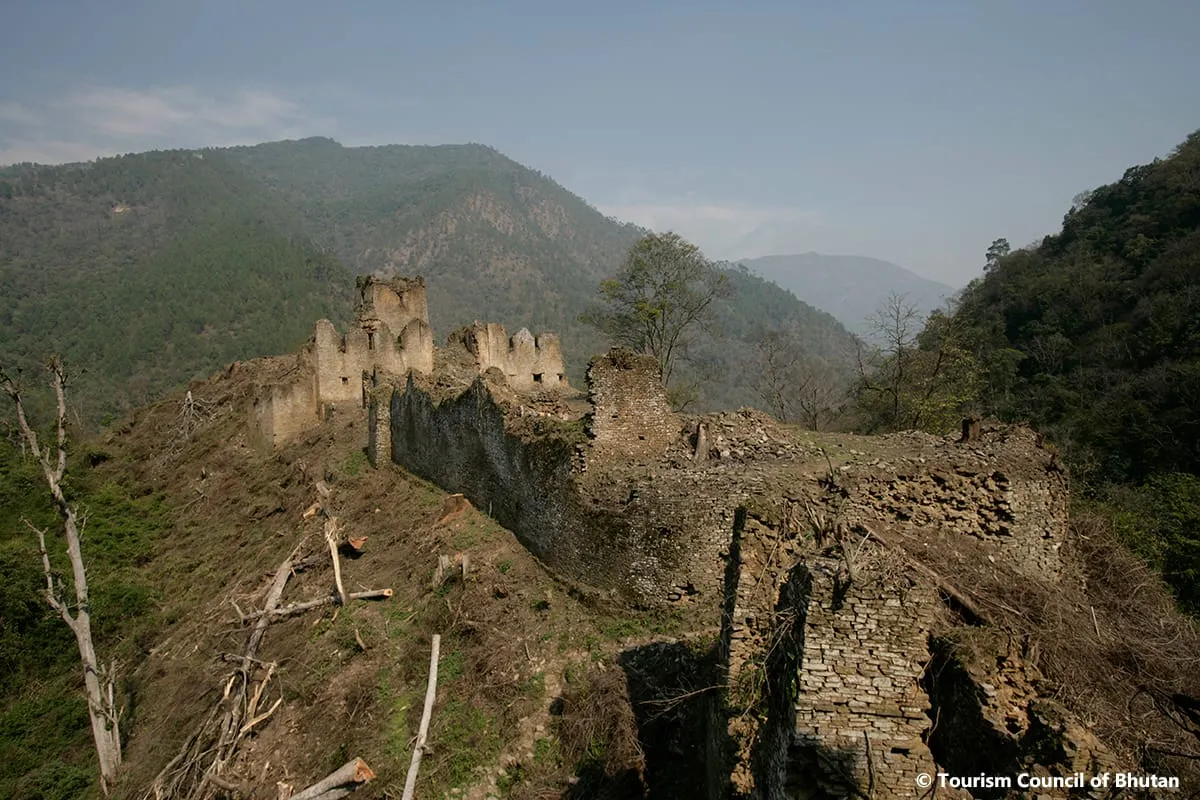
Zhongar Dzong is the fortress this district was named after before it was called Mongar, and it has been a ruin for well over a century. It stands on a hilltop above Thridangbi, west of Mongar town — roughly twenty kilometres by road, then about half an hour on foot uphill. Allow an hour and a half to two hours for the whole thing.
What is actually there?
A collapsed fortress in the forest, on a hilltop nobody has any other reason to climb.
It was built of white stone quarried from the Kuri Chhu in the valley below, and it covered about four acres — in its day one of the largest fortresses in Bhutan. The name comes from the stone: zhong is a bowl and kar is white, so Zhongkar, the white bowl. The district carried that name before it carried Mongar’s.
How much of it is still standing, nobody publishes — every account we can find says “ruins” and stops there, without saying whether that means walls, the tower or foundations. It is an unmanaged site on a hillside, so ask us what to expect and what is safe to walk into rather than take a guess from us or from anyone else.
Who built it, and what happened to him?
A master architect from Paro, whose name is spelled several ways in the retellings — Zow Balip, Zowo Balip, Zochhen Bala, or simply Bala. He is said to have chosen the site after finding a bowl-shaped white stone on it.
Then the part everybody here tells you. When the fortress was finished, the ruler who had commissioned it held a feast for the architect — and cut off his hand at it, so that he could never build anything finer somewhere else.
The Trans Bhutan Trail’s own account of this place supplies the other half of the story: locally, the dzong’s destruction is held to be the architect’s curse coming back on it. The two halves come from different sources and neither one tells both, which is why they are worth putting side by side. Whatever you make of it, it is what the ruin means to the people who live under it.
When did it fall?
Nobody who has written it down agrees, so we are not going to pretend.
Fire took it, and then an earthquake finished the job — that much is consistent. The dates are not: one account puts the fire in the late eighteenth century, another says the dzong has been in ruins since 1889, a third names a dzongpon from Drametse and puts the fire in the late 1880s. The same encyclopaedia carries two of those answers in two different articles.
What is not in doubt is the consequence. When the administration needed a seat again, it did not rebuild here — it built Mongar Dzong, twenty kilometres east and a few hundred metres higher, and that is where the district has been run from ever since.
Is it worth the walk?
If you like ruins, yes, and specifically because of how it compares with everything else you will see in Bhutan. Bhutanese dzongs are working buildings — monks, offices, courtyards full of people. This is the one where you get the opposite: a fortress that stopped, in a forest, with nobody at the door.
The walk up is about half an hour on a footpath. It is not a hike, but it is not a car-door-to-monument stop either, which is worth knowing before you commit an afternoon to it. Ask us about the drive — the road distance is published and the drive time is not, and we would rather tell you what it actually takes than repeat a guess.
Tours that visit Mongar


Frequently asked questions
What is left of Zhongar Dzong?
A ruin on a hilltop above Thridangbi, between Lingmethang and Mongar town. It was built of white stone quarried from the Kuri Chhu below it and covered about four acres, which made it one of the largest fortresses in the country in its day. Fire and then an earthquake brought it down — no source we trust agrees on when.
Why is it called Zhongar?
Zhong is a bowl and kar is white — "white bowl", for the stone it was built from and, in the local telling, for the bowl-shaped white stone the architect found when he chose the site. The district was called Zhongar before it was called Mongar.
How do you get to the ruins of Zhongar Dzong?
Drive west from Mongar town — about 10.5 km in a straight line and roughly 20 km by road — then walk about half an hour uphill from the nearest road point. No reliable drive time is published, so ask us rather than budget one. The Trans Bhutan Trail also passes the ruins on its way down to Lingmethang.
How long do you need at Zhongar Dzong?
An hour and a half to two hours, which is mostly the walk. The point of the place is arriving on foot at a 17th-century fortress that has been left to the forest — but how much of it is still standing, and what is safe to walk into, is not published anywhere, so ask us what to expect before you commit the afternoon.
Tailor-made travel
Begin your journey to the Last Shangri-La
Every Little Bhutan itinerary is private and tailor-made. Tell us what draws you to Bhutan — festivals, treks, monasteries, food — and we will design the journey around it.