
Mongar Dzong
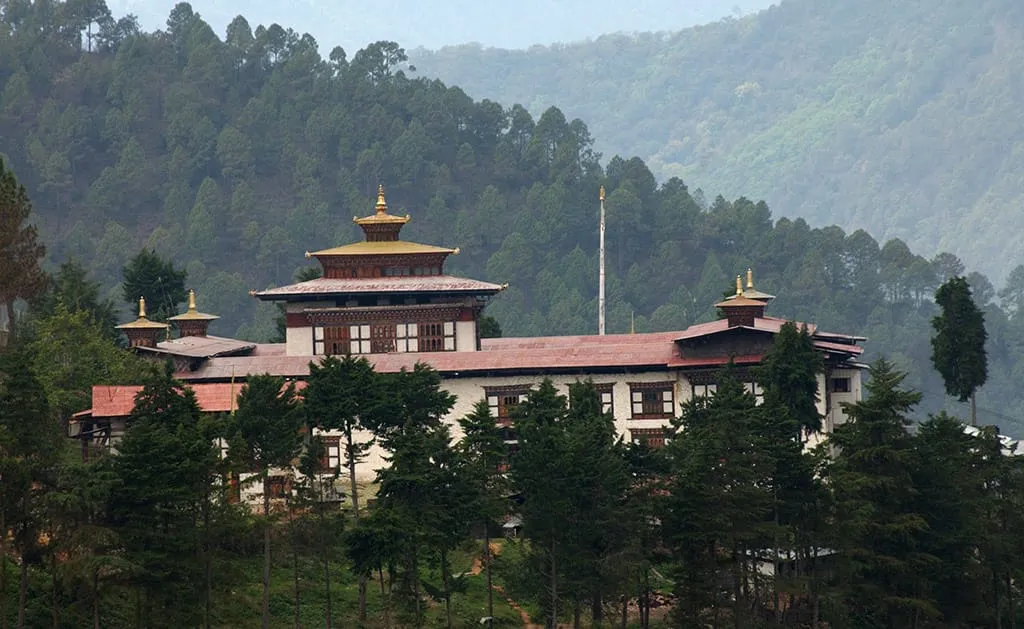
Mongar Dzong stands above the town and is the seat of both the district administration and its monastic body — in one shared courtyard, which is unusual. Allow forty-five minutes to an hour. There is road access to the door, and steps once you are inside.
What is unusual about it?
Two things, and both are architectural rather than historical.
It has two entrances. Almost every dzong in Bhutan has one, for the same reason a fortress has one gate.
And the monks and the civil servants share a single courtyard. At Paro or Punakha the monastic and administrative halves are walled into courtyards of their own and you pass from one to the other. Here there is one space and both bodies use it, with the utse — the central tower — standing in the middle of it.
The third thing worth knowing is how it was built. This is a twentieth-century building put up by the old method — no nails and no drawings — which makes it a useful thing to stand in after you have seen the seventeenth-century ones. It is the same craft, done within living memory.
So when was it built?
Two answers circulate, and we are not going to pick one for you.
Some accounts give 1930, in the reign of the Second King, Jigme Wangchuck. Others say the dzong you see today was rebuilt in 1953, under the Third King, Jigme Dorji Wangchuck.
What you can safely ignore is the version that has travelled furthest — “built in 1930 by the Third King”. The Third King was born in 1928 or 1929 — sources give both — so he was an infant either way, and came to the throne in 1952. That is what makes the 1953 account internally consistent and the fused one impossible. It is a good reminder that a date and a name can each be right and still be wrong together.
Why is there a dzong here at all?
Because the one before it burned.
Zhongar Dzong, twenty kilometres west and several hundred metres lower, was the seat of this district for as long as it stood — the district was called Zhongar in its day. Fire and then an earthquake finished it, and rather than rebuild on a hilltop above the Kuri Chhu, the administration moved up here.
The two are the obvious pair on a day in Mongar: the fortress that stopped, and the fortress that replaced it.
When is the tshechu, and is it worth timing for?
Three days, in November or December — the dates move with the lunar calendar, and the festival calendar carries the current ones.
It is a genuinely local festival. People come in from Trashigang, Trashi Yangtse and Lhuentse, and the courtyard fills. The dances include the eight manifestations of Guru Rinpoche and the Drametse Ngacham — the drum dance from Drametse, which is this district’s own and is on UNESCO’s list of the intangible cultural heritage of humanity.
The last morning is the one to be there for. The Guru Tshengye thongdrel — a giant appliqué scroll — is unfurled at about four in the morning and taken down before the sun reaches it. Seeing it is held to cleanse the sins of a lifetime, which is why people who skip the dances still turn up in the dark for that.
The dzongkhag counted the 2025 festival as the sixty-third, which puts the first at around 1963. So it is not an ancient festival, and it does not need to be. What it is, is local: the crowd here comes in from the district and the districts next door, where the crowd at Paro — which is far bigger — is a crowd Bhutan shares with the rest of the world.
Getting there
The dzong is in Mongar town, a few minutes above the centre, with road access to the door. It is a working building rather than a museum, so what is open depends on the day and no hours are published anywhere — ask us before you go up.
See things to do in Mongar for how it fits with the rest of the district.
Tours that visit Mongar


Frequently asked questions
When was Mongar Dzong built?
Sources give two answers — 1930 and 1953 — and we do not know which one is the building standing today. What can be ruled out is the version most often republished, which pairs 1930 with the Third King, Jigme Dorji Wangchuck: he was born in 1928 or 1929 — sources give both — and came to the throne in 1952. A 1930 dzong belongs to his father's reign; a 1953 one belongs to his.
What is unusual about Mongar Dzong?
When is the Mongar Tshechu?
Three days in November or December — 17–19 November 2026 and 6–8 December 2027. It moves with the lunar calendar, so check the festival calendar for the current year. The Guru Tshengye thongdrel is unfurled at about four in the morning on the last day, which is what most people actually come for.
Can you go inside Mongar Dzong?
It is a working dzong with the district administration in it, so what is open depends on the day and on what the courtyard is being used for. Nobody publishes hours — ask us beforehand rather than at the gate.
Tailor-made travel
Begin your journey to the Last Shangri-La
Every Little Bhutan itinerary is private and tailor-made. Tell us what draws you to Bhutan — festivals, treks, monasteries, food — and we will design the journey around it.