
Paro Rinpung Dzong
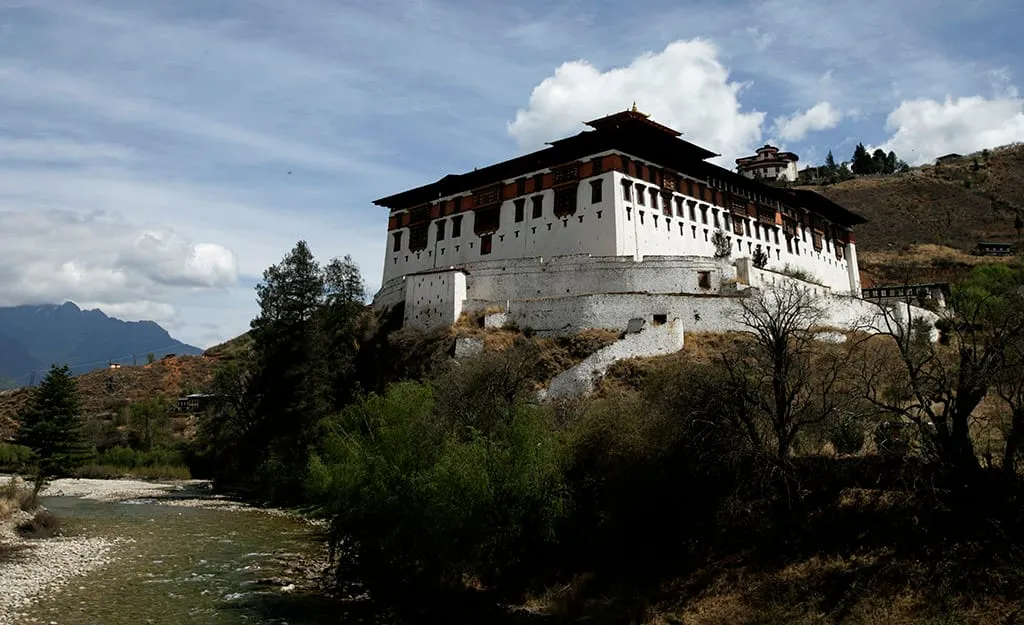
Rinpung Dzong is the fortress-monastery above Paro town, reached across the roofed cantilever bridge Nyamai Zam. It has run the Paro valley since 1646 and still does — district administration, court and monastic body under one roof. Allow an hour to an hour and a half. There is no entry fee: Rinpung is one of the dzongs the Department of Tourism names explicitly as charging nothing.
What the visit is actually like
You start below it. The dzong sits on a spur above the Pa Chhu, and the approach — across Nyamai Zam, then up — gives you a sense of scale that no photograph from the road manages. The walls lean inward as they rise, which is a dzong’s defining trick and the reason the building looks heavier at the bottom than the arithmetic says it should.
Inside, it works on several levels. A dzong is two institutions sharing a courtyard wall — the administration on one side, the monk body on the other — and the stairways between them are steep, worn and deliberately awkward. There are fourteen shrines and chapels in all. Which ones you enter depends on the day; your guide picks the route.
The thing to look up at is the timber: galleries, brackets and window frames built without nails, painted and repainted for four centuries. The thing to look out at is the valley — from the upper courtyard the paddies run north towards the head of the valley, and the National Museum sits on the ridge directly above you, which is where most people go next.
When to go, and how it fits your day
Morning, if you have the choice. The dzong faces the valley, the light comes across it early, and the courtyards are quieter before the day’s arrivals work their way up from town.
March to May and September to November are the comfortable months. March or April brings the Paro Tshechu, which is a different proposition entirely — see below.
We do not publish opening hours. Nothing official does, the times circulating online contradict each other, and this is a working government building whose access can shift. Your guide confirms the day you go. Duller than a schedule, and considerably more reliable than a wrong one.
For how it sits with everything else in the valley, see things to do in Paro. The short version: this and the museum are a comfortable half-day together, and they are what most people do on the day before or after Tiger’s Nest.
What to wear, and what you can photograph
Shoulders and knees covered. This is an active monastic and administrative site, not a monument, and it is enforced. Shoes come off before you enter a chapel.
Photograph the courtyards, not the chapel interiors. The same rule applies at nearly every temple in Bhutan, for the same reason: the images inside are objects of practice, not exhibits.
There are steep stairways between courtyards and no step-free route through the building. If that matters for anyone in your group, tell us while we are planning — the approach and the lower courtyard stand on their own, and the view from them is most of what people come for.
The Paro Tshechu, and why the dzong empties for it
Once a year the dzong stops being the venue and becomes the backdrop. The Paro Tshechu runs from the eleventh to the fifteenth day of the second Bhutanese month — late March or April, moving with the lunar calendar — and the mask dances take place on the Deyangkha ground beside the dzong, not in its courtyard.
The moment everyone comes for is the last one. On the final morning, before sunrise, the giant appliqué Guru Thongdrel is unfurled against the hillside and rolled away again before the sun touches it. People are there in the dark for it.
Dates move every year, so check with us before building a trip around one. The current ones are in the Bhutan festival calendar, the Paro Tshechu guide covers how attending actually works, and the Paro Festival tour is built around it.
A little history
The site was a fortress before it was this one. A five-storey building called Hungrel Dzong stood here in the 15th century, built by Lama Drung Drung Gyal; his descendants later offered the site to Zhabdrung Ngawang Namgyal, who laid new foundations in 1644 and founded the dzong you see in 1646. Three years later the watchtower went up on the ridge above it — that is Ta Dzong, now the National Museum, built by the same governor.
Then it burned. In the years around the enthronement of Bhutan’s first King in 1907, under Penlop Dawa Penjor, fire took most of the dzong’s relics and statues. One thing survived: the twenty-metre thongdrel — the same appliqué unfurled at dawn every Tshechu. Dawa Penjor rebuilt afterwards, which is why what you walk through is early-20th-century work on a 17th-century plan.
That is worth knowing while you are standing in the courtyard. The building is a reconstruction. The cloth is the original.
Tours that visit Paro


Frequently asked questions
How long do you need at Rinpung Dzong?
An hour to an hour and a half. That covers the walk across Nyamai Zam, the courtyards and the chapels your guide takes you into. It is the centrepiece of a Paro town morning, and it pairs with the National Museum on the ridge directly above it.
What does Rinpung Dzong mean?
Its full name is Rinchen Pung Dzong, "fortress on a heap of jewels". By tradition the rock it stands on was named Ringpung by Guru Rinpoche in the 8th century — the name is older than the building by nine hundred years.
When was Paro Dzong built?
Zhabdrung Ngawang Namgyal laid the foundations in 1644 and the dzong was founded in 1646, on a site offered to him by the descendants of Lama Drung Drung Gyal, who had built a five-storey fortress here in the 15th century.
Is Rinpung Dzong still in use?
Yes, and that is the point of it. It holds the Paro district administration, the district court and the district monastic body. You are visiting a working building, which is why parts of it are closed and why your guide leads the route.
Can you go inside Paro Dzong?
Yes, with your guide. Shoulders and knees covered, shoes off inside the chapels, photography in the courtyards but not in them. We time the visit rather than publishing hours: no official schedule exists, the published ones contradict each other, and a wrong one would cost you a morning.
Was Little Buddha filmed at Paro Dzong?
Yes. Bernardo Bertolucci shot the ceremonial climax of Little Buddha (1993) here — the courtyard is why the dzong looks familiar to people who have never been to Bhutan.
How many chapels are there in Rinpung Dzong?
Fourteen shrines and chapels. You will not see all of them — nobody does. Which ones are open varies with the day and with what the monk body is doing, and your guide picks the route accordingly.
Tailor-made travel
Begin your journey to the Last Shangri-La
Every Little Bhutan itinerary is private and tailor-made. Tell us what draws you to Bhutan — festivals, treks, monasteries, food — and we will design the journey around it.