
Paro Ta-Dzong (National Museum)
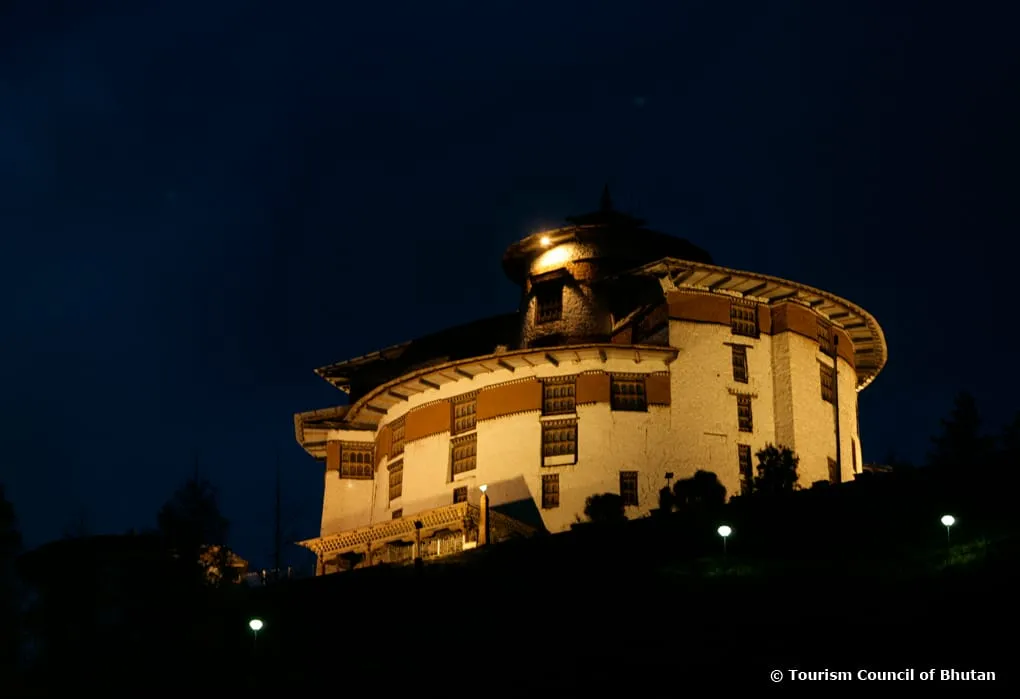
The National Museum of Bhutan occupies Ta Dzong, the round watchtower built in 1649 to guard Rinpung Dzong on the spur below. It holds over 3,000 works spanning 1,500 years, and it reopened in 2020 after the 2011 earthquake shut it for eight years. Daily, 9 am – 5 pm. Allow an hour to an hour and a half; entry is included in your tour.
Why the building is half the visit
Ta Dzong is circular, seven storeys, with walls 2.5 metres thick — built as a watchtower and outpost against Tibetan invasion, not as a gallery. That shape is the reason a visit here does not feel like other museums: you go up rather than along, the rooms are the shape the defence needed them to be, and the windows were cut for watching the valley rather than lighting exhibits.
Look out of one of them. You are directly above the dzong, and from up here the whole layout of Paro town, the river and the paddies makes sense in a way it does not from the valley floor.
What’s inside
Galleries of thangkas, bronzes, weaponry and natural history, and across all of them more than 3,000 works covering over 1,500 years of Bhutanese art.
The sleeper is the stamp gallery. Bhutan only established a postal system in 1962, and then spent a decade issuing the strangest stamps in the world: printed on silk, made of steel foil, laminated in 3D, and — in April 1973 — a set of seven playable phonograph records, one-sided vinyl discs with adhesive backs that you could stick on a letter or put on a turntable, carrying folk songs and the national anthem. Within five years stamps were the country’s largest source of revenue. Guests who arrive indifferent to philately spend longer here than they expect.
Photography rules are not published, and they vary by gallery. Ask at the desk, or let your guide ask.
The eight years it was shut
This matters because it dates almost everything written about the place.
The 2011 earthquake damaged Ta Dzong badly — collapsed wall sections and stress cracks — and the tower closed. Restoration began in 2014, funded by the Government of India and carried out in traditional masonry, and the museum reopened on 24 June 2020.
So: descriptions of the interior published before 2011 describe a building that has since been taken apart and put back together, and a lot of them are still online. Ours was one of them until this rewrite.
When to go, and how it fits your day
Year-round, and it is the answer to a wet afternoon in Paro — the one thing in the valley that does not care what the sky is doing.
The natural pairing is with Rinpung Dzong immediately below it: the dzong first, then up to the museum, which is a comfortable half-day and the standard Paro town morning. It works either side of a Tiger’s Nest day.
See things to do in Paro for how everything compares.
Getting up there is a short steep climb from the dzong or a few minutes’ drive. Once inside it is seven levels, and there is no way round that — if stairs are a problem for anyone in your group, tell us while we are planning the day.
A little history
Ta Dzong was built in 1649 by La Ngonpa Tenzin Drugdra, the first governor of Paro — the same year and the same governor as Drugyel Dzong at the head of the valley — and completed in 1651. Ta dzong simply means watchtower; every major dzong had one, and this is the one that survived best.
It became a museum in stages. The Third King, Jigme Dorji Wangchuck, decreed the conversion in 1960; it opened in 1965 to guests of the Royal Family, dignitaries and officials; and it opened to the public in 1968.
Our own page said 1967 for years, which is not a date anybody gives. It is a small correction and exactly the sort that compounds — a wrong year on an operator’s page is the kind of thing an answer engine quotes back at you with confidence.
Tours that visit Paro


Frequently asked questions
Is the National Museum of Bhutan open?
Yes. It was closed for more than eight years after the 2011 earthquake damaged the tower, and reopened on 24 June 2020 following a restoration funded by the Government of India. A lot of what is written about the interior online predates that closure.
What are the National Museum's opening hours?
Daily, 9 am to 5 pm, which is the museum's own published schedule — one of the few opening times in Bhutan that comes from the institution rather than from an aggregator. Your guide still confirms on public holidays.
How long do you need at the National Museum?
An hour to an hour and a half. It is seven levels of a round tower, and the building is as much of the visit as the collection — you climb it the way it was meant to be climbed.
What's in the National Museum of Bhutan?
Over 3,000 works spanning more than 1,500 years, across galleries of thangkas, bronzes, weaponry, natural history and — a genuine draw — Bhutan's stamps, which are among the most collected in the world.
Why is the National Museum round?
Because it was not built as a museum. Ta Dzong is the watchtower that guarded Rinpung Dzong below it, built in 1649 — circular, seven storeys, walls 2.5 metres thick. The shape is defensive, and it is why the galleries spiral rather than run in a line.
Tailor-made travel
Begin your journey to the Last Shangri-La
Every Little Bhutan itinerary is private and tailor-made. Tell us what draws you to Bhutan — festivals, treks, monasteries, food — and we will design the journey around it.