
Punakha Dzong

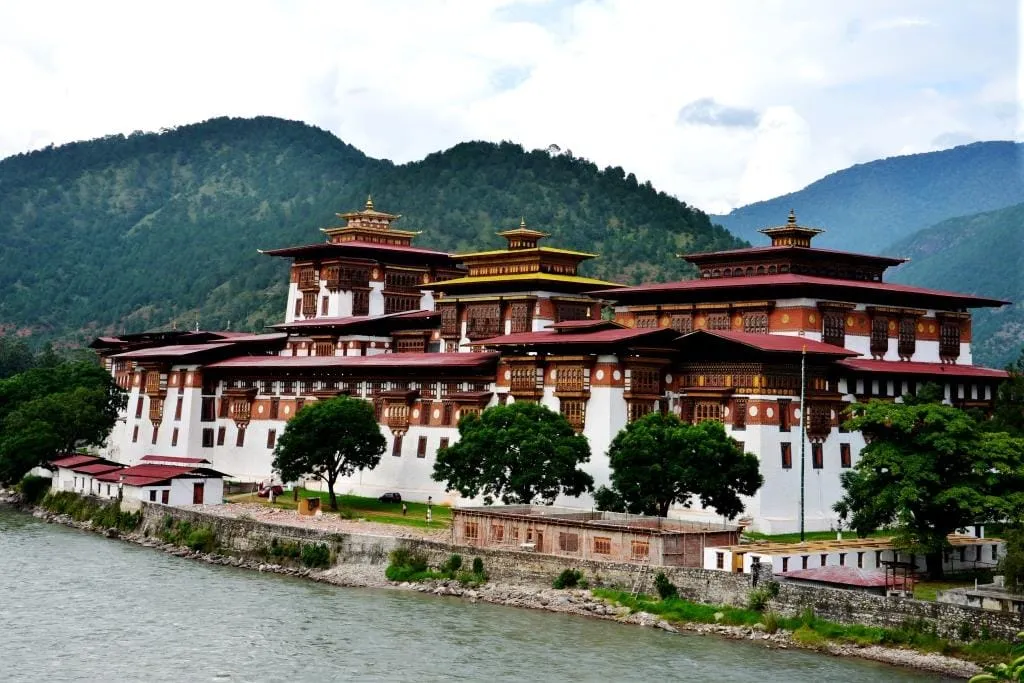
Punakha Dzong is Bhutan’s most beautiful fortress-monastery, standing on the tongue of land where the Pho Chhu and Mo Chhu rivers meet. You cross a covered wooden bridge to reach it, then climb into three rising courtyards. Allow 1–1.5 hours. The entry fee is Nu 500, and it is included in your tour.
What it’s like to walk in
You leave the car and cross the Bazam, a covered wooden cantilever bridge over the Mo Chhu — no cables, no piers in the water, just timber reaching out from both banks to meet in the middle. It sets the tone for everything inside.
Then comes a steep wooden stairway, historically a drawbridge pulled up at night behind a heavy door, and you’re into the first courtyard. From there the dzong climbs in three stages: the district administration first, then the monks’ quarters, then the Kuenrey, the great assembly hall where Ugyen Wangchuck was crowned Bhutan’s first king in 1907.
The woodwork is why people call this the finest building in the country. Carved and painted timber runs the whole length of the galleries, deep-shadowed and gold-tipped against the whitewash, and the craftsmanship in the Kuenrey is in a class of its own. Your guide will slow you down here, and should.
A few practicalities shape the visit. Dress covers shoulders and knees, sleeves are long, hats and sunglasses come off in the precincts, and shoes come off at each temple door. Photography is welcome in the courtyards and not permitted inside the temples. And this is a working building — the district government works here, monks live here — so opening hours shift with the season and with what’s on that day. Your guide checks before you leave the hotel, which is the only reliable way to handle it.
When to go, and what time of day
Two windows stand out.
February and March bring the Punakha Drubchen and Tshechu into the main courtyard — the Drubchen re-enacts the defeat of a Tibetan invasion in 1639, with the pazap militia dance filling the flagstones. Late spring brings the jacaranda into flower along the approach, purple against the white walls, which is the photograph people fly in for.
October and November are the other sweet spot: rice harvest in the valley, clear post-monsoon skies, everything green.
Winter is underrated. At 1,250 m Punakha is the warm valley of western Bhutan, mild in January when Thimphu and Paro are cold. It’s also when the Je Khenpo and the Central Monastic Body move down here for the season, so the dzong is busier with monastic life — and how much of the interior visitors get to see varies with what’s happening that day. Your guide checks before you set out.
Whatever the month, mornings are better. The light comes across the confluence rather than into your lens, and the courtyards are quiet before the day’s coaches arrive.
Getting there from Thimphu
About 74 km and two to two and a half hours’ drive, over the Dochu La pass at 3,100 m. Everyone breaks the journey at the pass for the 108 chortens and — on a clear morning — a Himalayan skyline that makes the early start worth it. Road-widening work beyond the pass has been slowing the second half, so plan it as a morning out, not a transfer.
The descent from Dochu La is the good part: you drop through cloud forest and rhododendron into a valley that is suddenly, obviously warmer.
How it fits into your day in Punakha
The dzong is the anchor. Pair it with Chimi Lhakhang a short drive down the valley and the suspension bridge a quarter-hour’s walk upstream, and you have a full, well-paced day.
With a second night, add the uphill hike to Khamsum Yulley Namgyal Chorten or a morning rafting the Mo Chhu, which finishes on the beach right below these walls — the best view of the dzong there is.
See things to do in Punakha for how it all compares, or the Bhutan 7-day itinerary for where the valley sits in a first trip.
A little history, because this one earns it
Zhabdrung Ngawang Namgyal — the lama who unified Bhutan — built the dzong in 1637–38 and named it Pungthang Dewachen Phodrang, the palace of great bliss. It runs 180 m long by 72 m wide and is the country’s second oldest and second largest.
It’s also where modern Bhutan starts. Ugyen Wangchuck was crowned here in 1907, ending two and a half centuries of rule by regents, and in October 2011 the fifth king married Jetsun Pema in the same building. Punakha was Bhutan’s capital until 1955. The Machey Lhakhang holds the embalmed remains of the Zhabdrung himself; it isn’t open to visitors.
And the river has taken its share. In 1994 a glacial lake burst high above the valley and sent a wall of water down the Pho Chhu, killing around 21 people, wrecking some 90 houses, damaging the dzong and carrying off the Bazam. The bridge you crossed on the way in is its replacement, rebuilt in traditional style with a 55 m free span and finished in 2008 — worth a thought on the way back across.
Tours that visit Punakha


Frequently asked questions
How long do you need at Punakha Dzong?
Allow 1–1.5 hours inside the walls. There are three courtyards on different levels, the assembly hall where the first king was crowned, and the long approach over the cantilever bridge — an hour covers it, and the extra half-hour is what makes it worth the drive.
Is there an entry fee for Punakha Dzong?
The published fee is Nu 500 per adult — the rate the Department of Tourism set with effect from 15 March 2023, when monument fees were halved and the list of charging sites cut to seven. Children aged 6–18 pay half, and children of five and under go free. You won't hand it over at the gate, though: entrance fees are included in every tour we run, arranged along with your Sustainable Development Fee, visa and permits before you arrive. Both halves matter — a lot of the web still quotes the superseded Nu 1,000 from 2022, and a lot of the rest says the dzong is simply free.
What should I wear to Punakha Dzong?
Shoulders and knees covered, long sleeves rather than a collarless T-shirt, and no shorts. Hats and sunglasses come off inside the precincts, and shoes come off before you enter a temple. It's a working religious and government building, and Bhutanese visitors dress formally for it.
Can you take photos inside Punakha Dzong?
In the courtyards, yes — including the classic shot of the whitewashed walls against the rivers. Inside the temples and chapels, no. That rule holds across Bhutan's dzongs, and your guide will tell you where the line falls at each doorway.
Can you visit Punakha Dzong in winter?
Winter is one of the nicest times to be in Punakha — the valley sits at 1,200 m and stays mild while Thimphu and Paro are cold. Access to the dzong itself is a different question: it is the winter home of Bhutan's Central Monastic Body, so from roughly November to March much of it is in active religious use and how much of the interior visitors see varies. Your guide checks the day's access before you set out, and the exterior and the confluence are worth the drive regardless.
How far is Punakha Dzong from Thimphu?
About 74 km, and two to two and a half hours' drive over the Dochu La pass at 3,100 m — longer when there's road work on the far side, which there has been recently. Nobody drives it without stopping at the pass, so treat it as a morning out rather than a transfer.
Why is Punakha Dzong called the most beautiful dzong in Bhutan?
Position, mostly. It stands on the spit of land where the Pho Chhu and Mo Chhu meet, so it's surrounded by water on two sides and framed by hills on both banks, with jacaranda flowering purple along the approach in late spring. The woodwork inside is also held to be the finest in the country.
Tailor-made travel
Begin your journey to the Last Shangri-La
Every Little Bhutan itinerary is private and tailor-made. Tell us what draws you to Bhutan — festivals, treks, monasteries, food — and we will design the journey around it.