
Bhutan 7-Day Itinerary (2026): Day-by-Day Guide
Last updated:
Seven days is the sweet spot for a first trip to Bhutan, and the loop on this page — Paro, Thimphu, Punakha and back, with the Tiger’s Nest saved for the final full day — is the route we drive every week. This is the exact shape we give it as a private tour: your own guide, your own vehicle, and every day below adjustable to how you actually travel. Here it is day by day, with the real drive times and the real numbers.
- The loop: Paro → Thimphu → Punakha → Paro, Tiger’s Nest on day 6.
- 6 nights means an SDF of USD 600 at the USD 100/night rate (confirmed through 31 August 2027).
- All-in cost: USD 250–450 per person, per day, from our published prices.
- Best months: October first, then May and November — though the loop runs year-round.
- Fully private and fully customisable — every tour we run starts from a conversation, not a fixed seat.
The route at a glance
| Day | Route | Drive | Sleep in |
|---|---|---|---|
| 1 | Arrive Paro, drive to Thimphu | 47 km, 1–1.5 h | Thimphu |
| 2 | Thimphu | Local only | Thimphu |
| 3 | Thimphu → Punakha over Dochula Pass | 74 km, 2–2.5 h | Punakha |
| 4 | Punakha valley | Local only | Punakha |
| 5 | Punakha → Paro | 115 km, 3.5–4 h via Dochula | Paro |
| 6 | Tiger’s Nest hike | Local only | Paro |
| 7 | Depart Paro | — | — |
Distances mislead in Bhutan — the roads climb and wind, so we plan by hours. The good news: this loop’s total driving is six and a half to eight hours for the whole week, and the longest leg crosses a Himalayan pass you’d stop at anyway.
What “private” actually means here
When we say private, we mean the whole apparatus is yours: a licensed English-speaking guide for the full week, a vehicle and driver who stay with you, and no strangers in the car — the itinerary flexes daily around weather, energy and curiosity. Linger an extra hour in a dzong courtyard and nothing downstream breaks; skip a museum for a farmhouse lunch and your guide simply re-plots the afternoon. It also means the days below are a template, not a contract — every trip we build starts from your dates and interests, and the variants flagged under days 4 and 5 are just the two swaps guests ask for most. The published tour closest to this page is our Western Bhutan Explorer — 7 Days, which runs this loop with a Gangtey extension folded in.
Day 1 — Arrive Paro, drive to Thimphu
Your guide meets you at Paro airport and the trip starts gently: the drive to Thimphu is 47 km along the river, one to one and a half hours, and it delivers you to the capital in time for lunch. The afternoon eases you in at valley altitude — the National Memorial Chorten, where Thimphu residents circumambulate at all hours, then a walk through the town itself: a capital with no traffic lights, where white-gloved police still direct the cars from a pavilion. Evening is yours — Thimphu has Bhutan’s best cafés and its liveliest streets, which is not saying much, and that’s rather the point.
Day 2 — Thimphu
A full day in the capital, no driving beyond the valley. The morning belongs to Buddha Dordenma — the enormous golden Buddha seated above the city, with the whole Thimphu valley spread below — and then the day shapes itself to what interests you. The Takin Preservation Centre in upper Thimphu keeps Bhutan’s improbable national animal, which legend says the Divine Madman conjured from a goat’s head and a cow’s body; the weekend Centenary Farmers’ Market, open Friday to Sunday, fills with produce arriving from every valley; and at the school of the thirteen traditional arts you watch students learn painting, weaving and woodcarving the slow way, over years. We keep the fortress-monastery of Tashichho Dzong, seat of the King’s throne room, for dusk — the whitewashed walls hold the last light, and the courtyards are at their quietest. If you’d rather walk than tour, the ridge hikes above the city start twenty minutes from your hotel; this is the kind of swap a private day absorbs without a second thought.
Day 3 — Thimphu to Punakha over Dochula Pass
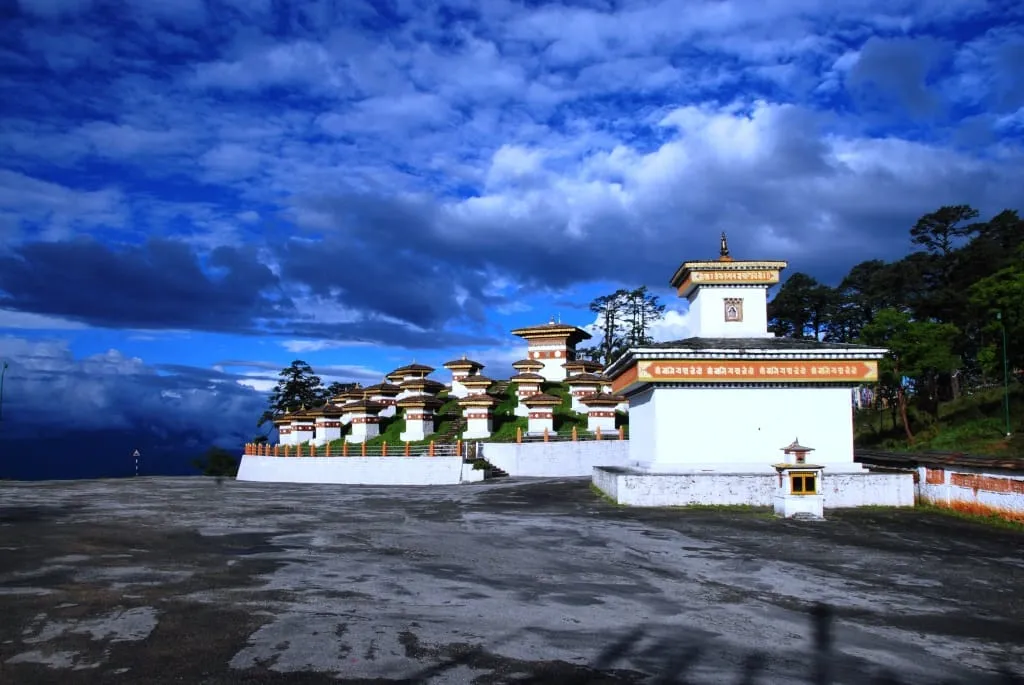
The best drive of the week: 74 km, about two to two and a half hours, and it crosses Dochula Pass at 3,100 m, where 108 memorial chortens stand against a panorama of the eastern Himalaya — on a clear morning the snow peaks line the whole horizon, which is why we leave Thimphu early and take tea at the pass. (Come in mid-December and the pass hosts its own festival, the Druk Wangyel Tshechu, danced among the chortens with the Himalaya as backdrop.) From there the road drops a full 1,800 vertical metres into the subtropical Punakha valley (~1,250 m) — you leave pine forest and arrive among banana trees and rice paddies, two climates in one afternoon.
The afternoon is Punakha Dzong, and we’ll say it plainly: this is the most beautiful building in Bhutan. The seat of government from 1637 until 1955, the fortress stands at the confluence of two rivers, the Pho Chhu and the Mo Chhu, its courtyards shaded by jacaranda trees that turn the whole dzong lavender in spring. If seven days is more than you have, the shorter version of this loop — our Essential Western Bhutan — 6 Days — compresses days 3 and 4 into one.
Day 4 — Punakha valley
A slow day in the warmest valley on the route. Walk through rice terraces to Chimi Lhakhang, the fertility temple of the sixteenth-century “Divine Madman” Drukpa Kunley — your guide will tell the stories; they are not printable here — then cross the long suspension bridge over the Pho Chhu, strung with prayer flags above glacial water. The afternoon is yours to shape: a walk up to the Khamsum Yueling monastery above the rice paddies, rafting on the Mo Chhu past the dzong, a riverside picnic — or simply nothing at all in a hotel garden a thousand metres lower and several degrees warmer than the capital.
Variant: travellers with an eye for wildlife swap this day (or add a night) for the glacial Phobjikha valley at Gangtey — winter home of the black-necked cranes from late October to mid-February. Our Western Bhutan in Depth — 8 Days runs exactly that shape, with Gangtey and Haa both folded in.
Day 5 — Punakha back to Paro
The return leg: 115 km and about three and a half to four hours via Dochula, this time with the pass’s morning views behind you and Paro’s broad valley ahead. You’re in Paro by lunch, which leaves the afternoon for Rinpung Dzong — the fortress above the ground where the famous Paro Tshechu unfolds each spring, five days of masked dance ending with a giant sacred thongdrel unfurled in the small hours of the final morning — then the National Museum in the round Ta Dzong watchtower above it, and Paro town’s single, handsome main street of wooden shopfronts, the best place all week for textiles and souvenirs. An early night matters today; tomorrow is the hike.
Variant: return instead through the Haa valley and over Chelela Pass, Bhutan’s highest road pass, with views of sacred Jhomolhari and meadows of the white poppy found nowhere else on earth — the quietest corner of western Bhutan. Within seven days that means trimming Punakha to a day excursion — the shape of our Haa & Western Bhutan — 7 Days — or add an eighth day and keep both valleys in full. Travelling in early April, the set-date Haa Spring Festival Journey — 7 Days (USD 1,650–2,300) builds the whole week around the valley’s spring festival.
Day 6 — The Tiger’s Nest hike
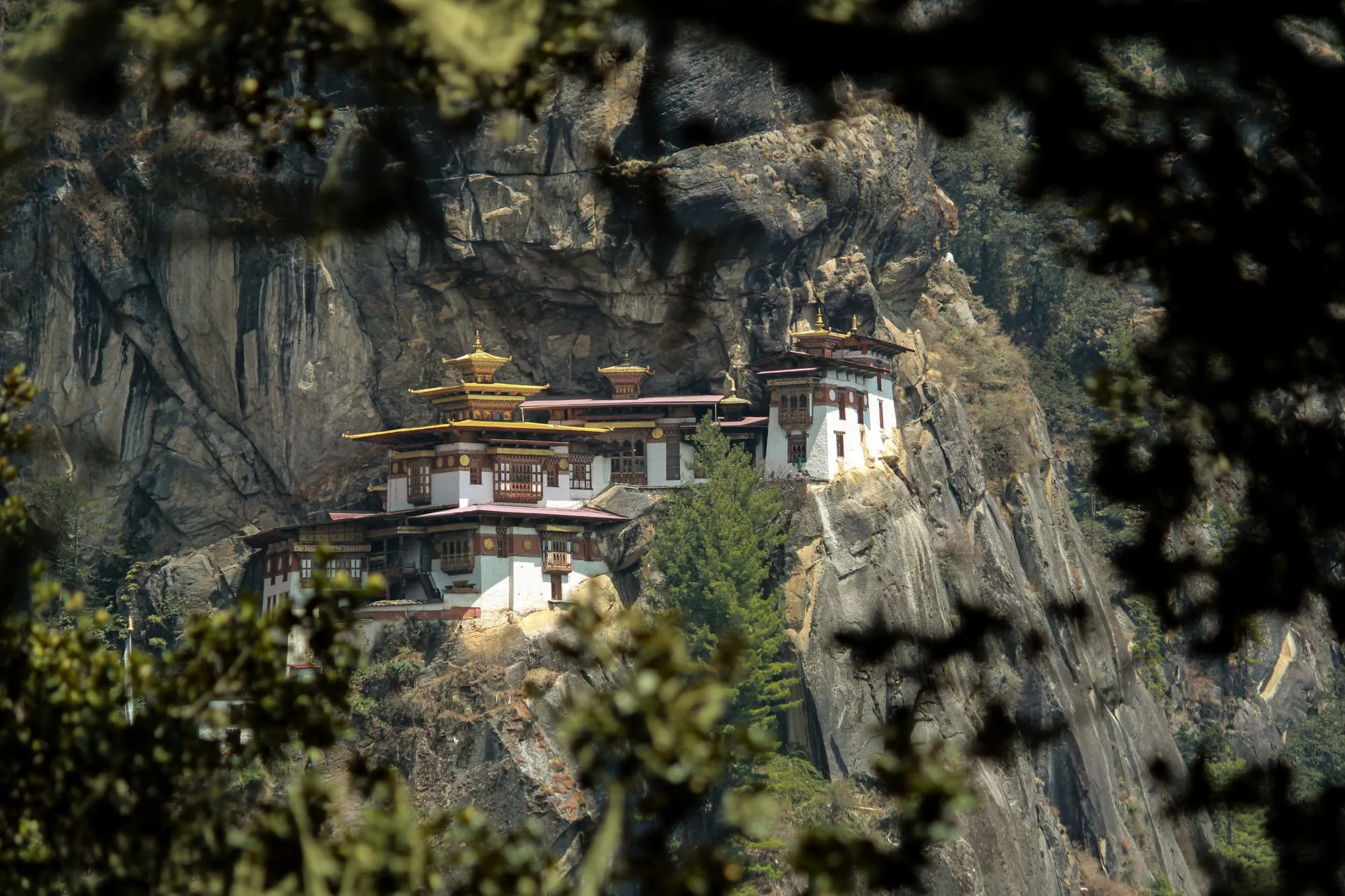
The day the whole week has been building toward. Paro Taktsang — the Tiger’s Nest — clings to a cliff face at 3,120 m, hanging about 900 m above the Paro valley floor — though the trail starts from a trailhead partway up, so the climb on foot is less than the full drop: roughly 6 km round trip, 5–6 hours with time inside the monastery. We start early, in the cool of the morning, through blue-pine forest hung with prayer flags to the cafeteria viewpoint about halfway — the classic first photograph of the monastery across the gorge — then on to the stone steps that drop into the gorge and rise again to the entrance. Ponies can carry you as far as the halfway point on the way up (ascent only — the horse service is pre-booked, so tell us ahead); from there everyone walks. Your guide sets an easy pace with plenty of rests — by day six you’ve had five nights at altitude, which is exactly why this hike sits at the end of the week and not the start. The full trail brief, legend and packing list are in our Tiger’s Nest guide.
Back in the valley by mid-afternoon, there’s time for Kyichu Lhakhang — one of Bhutan’s oldest temples — and a farewell dinner. If your legs have opinions, a hot-stone bath at a farmhouse is the traditional Bhutanese answer, and it works.
Day 7 — Departure
Breakfast, and the short drive to Paro airport, where your guide and driver see you through to the gate — the same two people who met you on day one, which is how a week in Bhutan tends to end: with goodbyes that feel personal. Morning departures are the reliable ones out of Paro — worth remembering when you book flights, and another reason we handle the tickets.
When to go
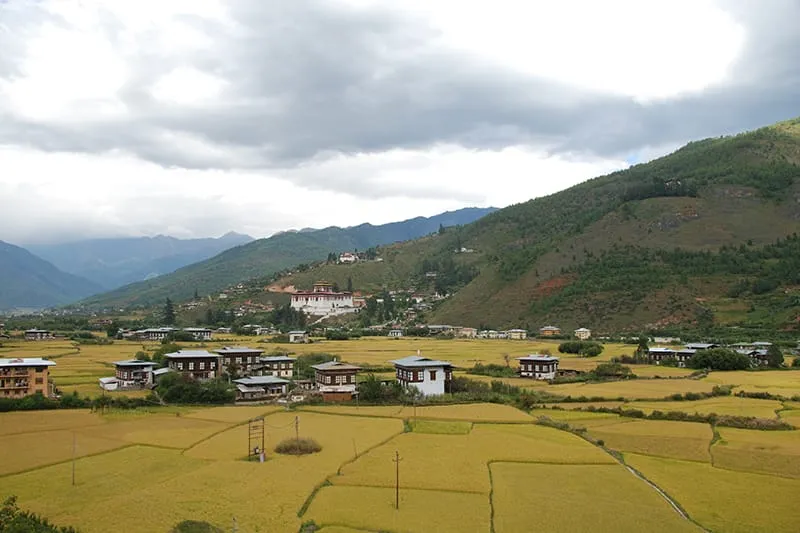
October is the best month for this loop — the year’s clearest mountain views and stable weather, at the price of company; book flights three to six months out. May and November are the insider picks: near-peak weather, quieter valleys, and in November the black-necked cranes for anyone taking the Phobjikha variant. The monsoon (June–August) is better than its reputation for a cultural circuit like this one — rain comes in afternoon bursts and the paddies glow — and winter works beautifully because the route sleeps low: Punakha stays mild all year. The full month-by-month picture is in our best time to visit guide, and published festival dates — worth reconfirming before you pick your week — are in the festival calendar.
What 7 days costs
Seven days means six nights in Bhutan, and the numbers are refreshingly knowable:
| What | Figure |
|---|---|
| Sustainable Development Fee, 6 nights × USD 100 | USD 600 |
| Visa (one-off) | USD 40 |
| All-in daily benchmark, private trip | USD 250–450 per person, per day |
| Essential Western Bhutan — 6 days, published price | USD 1,400–1,900 per person |
| Western Bhutan in Depth — 8 days, published price | USD 1,950–2,650 per person |
A private 7-day trip sits between those two published prices, and both already include the SDF and visa — children under 6 pay no SDF, ages 6–11 pay half. When we quote you, the figure is all-in: SDF, visa, guide, private vehicle and driver, hotels (minimum 3-star, upgradable), all meals and entry fees. Outside it sit international flights, travel insurance — recommended, though Bhutan dropped the blanket requirement in April 2024 — and personal extras like drinks, laundry and tips. Where you land in the range depends mostly on hotel standard and group size: two travellers sharing pay more per person than a family of four, and moving from good 3-star hotels to heritage or luxury properties moves the daily figure fastest — the government fees never change. The full breakdown, with worked examples priced end to end, is in what a Bhutan trip costs.
Getting there and the visa
Only two airlines fly to Bhutan — Drukair and Bhutan Airlines — and every international flight lands at Paro, with daily connections from Bangkok, Delhi and Kathmandu. Fares are largely fixed year-round, so booking early buys a seat, not a discount; we book the tickets as part of your tour. The visa is a one-off USD 40 — we apply on your behalf once the trip is confirmed, approval normally takes 5–6 working days, and your passport needs six months’ validity. Routes and fares are in our getting to Bhutan guide; the paperwork detail is in travel requirements.
Make it yours
This page is the skeleton; your trip is the version of it we build around your dates, your pace and your interests — that’s the entire point of travelling privately. Browse our tours to see the published shapes, or tell us your dates and we’ll send a real, all-in price from Thimphu. For everything else — seasons, festivals, paperwork — head back to the Bhutan Travel Guide.
Plan the trip
Private tours that pair with this guide


Frequently asked questions
Is 7 days enough for Bhutan?
For a first visit, yes — comfortably. Seven days covers the classic western loop of Paro, Thimphu and Punakha at an unhurried pace, with a full day for the Tiger's Nest hike and room for a valley walk or a farmhouse lunch. Central and eastern Bhutan need more time, but they reward a second trip rather than a rushed first one.
Is this a private tour or will I join a group?
Private. You travel with your own licensed guide, your own vehicle and your own driver from arrival to departure — every tour in our catalogue is private. The itinerary on this page is the starting point we adapt around you, not a fixed timetable.
Can I customise the itinerary?
Yes — every day of it. Swap Punakha's second day for the Phobjikha valley, route back to Paro through Haa and Chelela Pass, add a night, slow a day down. Because the trip is private, a swap costs nothing but a conversation; adding nights or upgrading hotels changes the price, and you see the revised all-in figure before you commit to anything.
How much does a 7-day trip to Bhutan cost?
Plan on USD 250–450 per person, per day all-in, including the USD 100 per night Sustainable Development Fee. Our published prices bracket it: the 6-day Essential Western Bhutan tour is USD 1,400–1,900 per person and the 8-day Western Bhutan in Depth is USD 1,950–2,650 — a private 7-day trip sits between them. Flights are quoted separately.
How does payment work — how can I trust you?
We're a locally owned, government-licensed operator based in Thimphu, arranging journeys since 2011. Once your trip is confirmed we invoice one amount — tour, SDF and visa together — payable by international bank transfer, with the government fees itemised separately so you can see exactly where they go. Your visa approval comes back before you travel, so you arrive with everything already settled.
Are there hidden fees on top of the quote?
No. The price we send includes the SDF, visa, licensed guide, private vehicle and driver, hotels, all meals and monument entry fees. What sits outside it is the same for everyone: international flights, travel insurance (recommended, though no longer mandatory), and personal extras like drinks, laundry and tips.
How fit do I need to be for Tiger's Nest?
Reasonably fit is enough. The monastery sits at 3,120 m, about 900 m above the Paro valley floor — though the trail starts from a trailhead partway up, so you climb less than that full drop over the roughly 6 km round trip. Allow 5–6 hours with time inside. A pre-booked pony can carry you to the halfway cafeteria on the way up (ascent only — ask us ahead and we arrange it), and your guide sets an easy pace with plenty of rests.
Do I need a visa and how do I get one?
Yes — it's a one-off USD 40 per person, and we apply on your behalf through Bhutan's immigration portal once your trip is confirmed. Approval normally takes 5–6 working days; your passport needs six months' validity from your departure date.
When is the best time to do this itinerary?
October is the single best month — the clearest skies of the year. May and November are the insider picks, with near-peak weather and quieter valleys. The loop itself runs year-round: winter days are sunny and crisp with mild Punakha as a warm refuge, and the summer monsoon works fine for a cultural circuit.
How much driving is there?
Six and a half to eight hours across the whole week, split over three days: one to one and a half hours Paro to Thimphu, two to two and a half hours Thimphu to Punakha over Dochula Pass, and three and a half to four hours back to Paro. The longest leg crosses a 3,100 m Himalayan pass ringed by 108 chortens — the drives here are sightseeing, not transit.
Can I add Haa or Phobjikha to this route?
Easily — they're the two classic extensions. Phobjikha (Gangtey) fits inside seven days by taking Punakha's second day, and is home to wintering black-necked cranes from late October to mid-February. Haa needs more room: within seven days it means trimming Punakha to a day trip, the shape of our Haa & Western Bhutan tour; add an eighth day and you keep both valleys in full.
Tailor-made travel
Begin your journey to the Last Shangri-La
Every Little Bhutan itinerary is private and tailor-made. Tell us what draws you to Bhutan — festivals, treks, monasteries, food — and we will design the journey around it.