
Best Time to Visit Bhutan (2026): Month-by-Month Guide
Last updated:
Every second enquiry we receive starts the same way: when should we come? The honest answer from Thimphu: October is the single best all-round month — and May and November are the insider picks, with near-peak weather and none of the peak-season squeeze.
- Best overall: October — clearest skies, best treks, biggest festivals.
- Best value-for-weather: May and November — the shoulder sweet spots.
- Greenest and quietest: June–August, monsoon season — better than its reputation for cultural trips.
- Crispest light, fewest visitors: December–February — sunny winter days, cold nights, mild Punakha.
- Spring (March–May) and autumn (September–November) are peak; book flights three to six months ahead for those windows.
Bhutan’s secret is altitude, not latitude. Paro and Thimphu sit at ~2,200–2,300 m, Punakha a full thousand metres lower — so most itineraries pass through two climates in a single afternoon, and there is no month in which the whole country is “closed.”
How Bhutan’s climate actually works
One country, three climate bands, stacked by altitude. The southern foothills along the Indian border are subtropical; the mid-altitude valleys where nearly all travel happens — Paro, Thimphu, Punakha, Bumthang — are temperate; and above 4,000 m the high Himalaya keeps its own alpine rules. The weather that matters to your trip is the middle band’s, and it follows one simple rhythm: bone-dry, sunny winters and a summer monsoon, with the two gorgeous shoulder seasons in between.
Two practical consequences follow. First, rain in Bhutan is a when, not an if-you’re-unlucky — from November to February it essentially doesn’t rain, and from late June to early September it rains most days (mostly in afternoon and overnight bursts). Second, because Punakha sits at 1,250 m against Thimphu’s 2,250–2,650 m, a standard western circuit always has a warm refuge: in January you thaw out in Punakha; in July you cool off in the high valleys. We sequence itineraries around exactly this.
Bhutan’s seasons at a glance
| Month | Paro & Thimphu (day / night °C) | Rain | Crowds | What’s on |
|---|---|---|---|---|
| January | 9–14 / below 0 | Dry | Low | Winter light, mild Punakha |
| February | 12–15 / ~0 | Dry | Low | Punakha Dromchoe & Tshechu |
| March | 17–19 / 4 | Dry | High | Paro Tshechu begins late March |
| April | 20–22 / 8 | Light | High | Rhododendron bloom, Haa Spring Festival |
| May | 22–25 / 12 | Light | Medium | Warm valleys, quiet trails |
| June | 24–27 / 15 | Building | Low | Nimalung & Kurjey Tshechus |
| July | 24–27 / 16 | Monsoon | Low | Greenest valleys, alpine flowers |
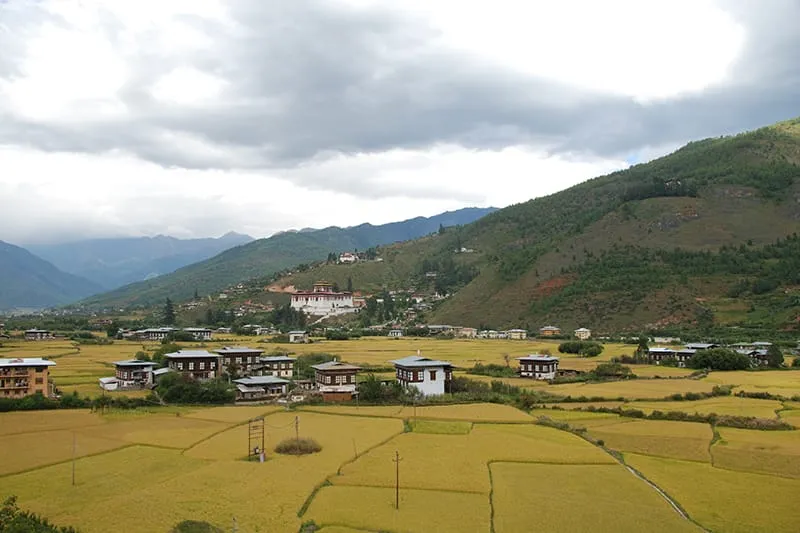
| August | 24–27 / 16 | Monsoon | Low | Rice paddies at their brightest |
| September | 23–26 / 14 | Easing | High | Thimphu Tshechu, festival season opens |
| October | 20–24 / 9 | Light | Highest | Peak treks, Jakar Tshechu, Royal Highland Festival |
| November | 17–20 / 3 | Dry | Medium | Black-necked cranes, Crane Festival 11 Nov |
| December | 14–17 / below 0 | Dry | Low | Druk Wangyel Tshechu at Dochula |
Punakha runs roughly 6–7°C warmer than Paro and Thimphu in every month — mild even in January, hot by June. Exact festival dates move with the lunar calendar; the confirmed schedule lives in our festival calendar.
Planning ahead for 2027? The month-by-month picture on this page holds year to year — Bhutan’s seasons don’t move, only the festival dates do. Our festival calendar already lists the published 2027 dates, and if you’re travelling after August 2027, note the SDF rate question worth asking before you budget.
January — winter light and empty dzongs
Cold nights, bright blue days. Thimphu and Paro sit around 9–14°C by day with hard frosts after dark, while Punakha stays springlike — our winter itineraries simply sleep low and sightsee high. You’ll share the dzongs with monks rather than tour groups, and mountain views are stunningly sharp. A Paro–Thimphu–Punakha circuit works beautifully in January.
February — Punakha’s festival, spring’s first hints
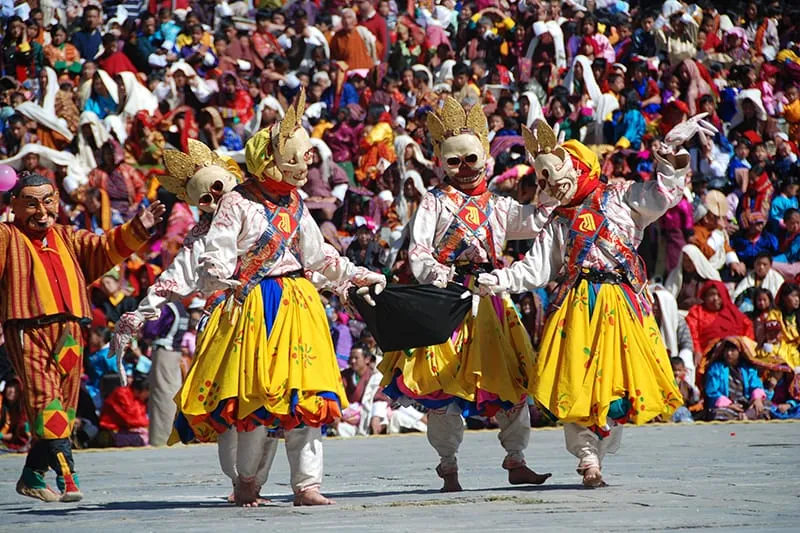
Still winter in the high valleys, but Punakha (1,250 m) is already mild — and it hosts the year’s first great festival pairing, the Punakha Dromchoe and Tshechu, a re-enactment of the 17th-century battles that unified Bhutan. Our Punakha Festival tour is built around it.
March — Paro Tshechu opens the high season
Spring arrives: 17–19°C days, dry trails, and at the end of the month the Paro Tshechu — Bhutan’s most famous festival, five days of masked dance beside Rinpung Dzong closing with a giant sacred thongdrel unfurled in the small hours of the final morning. Our Paro Festival tour sells out earliest of anything we run; this is the month to have booked in autumn.
April — rhododendrons and the Haa spring festival
The hillsides go extravagant — rhododendron forests bloom from mid-March through April, Thimphu holds a Rhododendron Festival, and the little-visited Haa valley celebrates spring at the Haa Spring Festival — three days at Yangthang, 25–27 April in 2027, with a festival journey built around it. Trekking season opens properly: April and May are the classic windows for the Jomolhari trek and Druk Path.
May — the first insider month
Warm valleys (Thimphu ~25°C), blossom lingering at altitude, and the spring crowds already thinning — May gives you 80% of April’s weather with half the company. Haze builds ahead of the monsoon, so the very biggest mountain panoramas are better in autumn; everything else about May is a quiet win.
June — early monsoon, early festivals
Rain starts building, mostly in afternoon and overnight showers. Bumthang holds the Nimalung and Kurjey Tshechus in late June — our Nimalung journey pairs them — and the countryside starts its transformation into the deep green that summer visitors never expect.
July — the green season
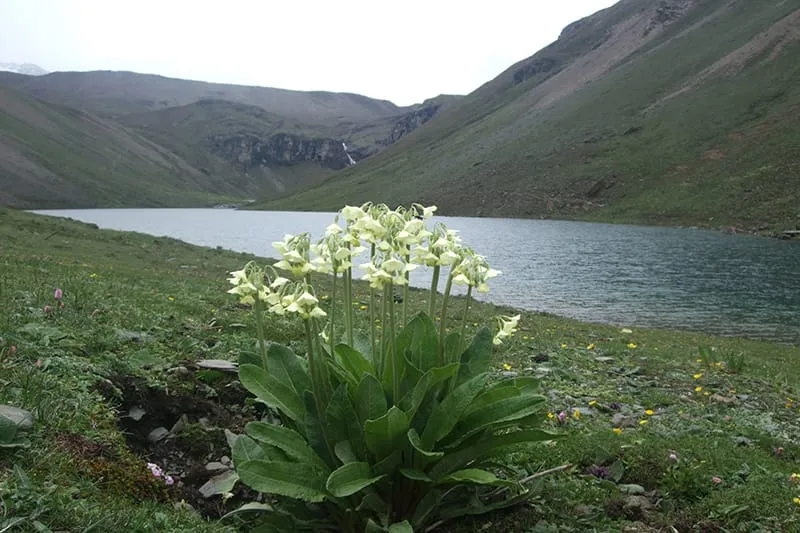
The wettest month, and the most misunderstood. Mornings are often clear, rain arrives in bursts rather than all-day drizzle, wildflowers peak in the high meadows, and the paddies glow. Cultural touring works fine with an umbrella; high treks are off. Hotels are at their most relaxed — this is the month for travellers who want Bhutan to themselves.
August — paddy season
Monsoon continues, gradually easing late in the month. Photographers get the year’s most saturated landscapes. Note that Haa’s summer festival no longer exists under that name — the dzongkhag moved it to April in 2024 and renamed it the Haa Spring Festival, so some travel sites still advertise a July date that will not happen. If you’re flying via Kathmandu, the Drukair summer return discount applies — see how seasons change what you pay.
September — the festival season opens
The skies rinse clean, and Bhutan’s biggest festival cluster begins: Thimphu Tshechu (with the Drubchen before it), Wangdue Tshechu, and the Gangtey Tshechu in Phobjikha within days of each other. Our Thimphu Festival tour and Gangtey/Phobjikha Festival tour cover the cluster. Book far ahead — flights sell out around these dates.
October — the best month, and the busiest
Everything aligns: the year’s clearest mountain views, stable trekking weather on every route from the Druk Path to the Snowman (October is the Snowman’s one reliable window), the Jakar Tshechu in Bumthang and the Royal Highland Festival in high Gasa — a journey we love running. The trade-off is company: October is Bhutan’s busiest month. Book three to six months out.
November — the other insider month
October’s weather quietly continues — dry air, sharp light, near-zero rain — while the crowds go home. The black-necked cranes settle into Phobjikha from late October and stay until mid-February — 640 of them in the winter of 2024–25, wintering on a glacial valley floor at 3,000 m, and celebrated with the Crane Festival in the courtyard of Gangtey Goenpa every 11 November. Meanwhile eastern Bhutan holds the Trashigang and Mongar Tshechus, the heart of our eastern festival journeys — festivals where you may be the only foreign visitors in the courtyard. If we’re choosing our own holiday: November.
December — Dochula’s festival and winter’s start
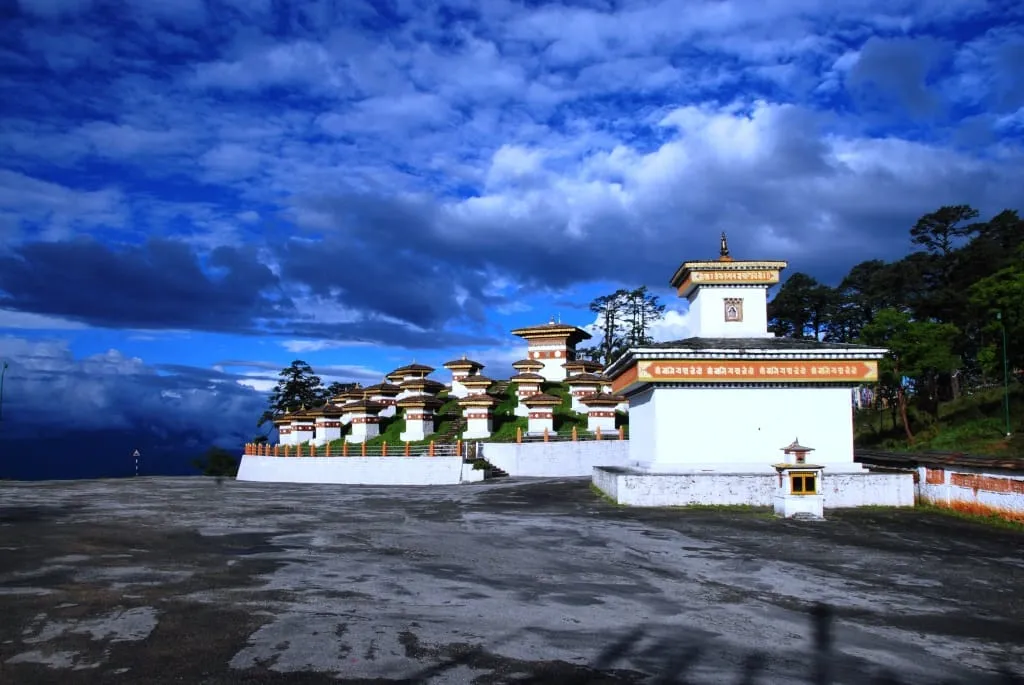
Crisp, dry and calm. The Druk Wangyel Tshechu on 13 December takes place among the 108 chortens of Dochula Pass with the whole eastern Himalaya as a backdrop — the most scenically-set festival in Bhutan, and the centre of our Dochula Festival tour. High passes to the east may close with snow; western circuits run happily all winter.
Choosing by what you love
- Festivals: late September–October for the biggest cluster; late March for Paro Tshechu; February for Punakha. Dates move with the lunar calendar — check the confirmed calendar before booking anything else.
- Trekking: October for certainty, April–May for flowers; the Druk Path has the longest season, the Snowman the shortest — its 5,000 m passes are reliably open only in October, which is why it books out a year ahead.
- Photography: October–December for mountain clarity; July–August for green saturation; November for cranes.
- Solitude and value: June–August and December–February — same country, quieter valleys, and the flight discount months via Kathmandu.
A word on booking lead times
Bhutan’s capacity is deliberately small — two airlines, modest aircraft, and valley towns with a finite number of good hotels. For October and the late-March festival window, book three to six months ahead; flights sell out on seats (fares are fixed, so prices don’t spike — planes just fill). For May, November and winter, a month or two is usually comfortable, and last-minute trips are genuinely possible. Whenever you book, the visa itself is quick — 5–6 working days once we apply.
Whenever you come, we build the itinerary around what that month does best — browse our tours or ask us directly: we live here, and we’ll tell you honestly what your dates will be like.
Plan the trip
Private tours that pair with this guide


Frequently asked questions
What is the single best month to visit Bhutan?
October — clear post-monsoon skies, the best mountain views, ideal trekking weather and a packed festival calendar. It's also the busiest month, so book flights and hotels three to six months ahead.
When is the best time to visit Bhutan without the crowds?
May and November. Both sit right next to the peak months with nearly the same weather — November in particular keeps October's clear skies, adds the black-necked cranes in Phobjikha, and the valleys are noticeably quieter.
Is the monsoon (June–August) a bad time to visit Bhutan?
Not for cultural travel. Rain falls mostly in afternoon and overnight bursts, the valleys are at their greenest, and hotels are at their quietest. Trekking is the one thing to avoid — trails get muddy and leech-prone, and the high passes disappear into cloud.
How cold does Bhutan get in winter?
Colder at night than by day. Thimphu and Paro winter days are usually sunny and around 9–14°C, but nights drop below freezing. Punakha, a thousand metres lower, stays mild all winter — which is why our winter itineraries lean on it.
What is the cheapest time to visit Bhutan?
The government fees never change, but summer (June–August) and deep winter (December–February) bring quieter hotels, easier availability and a 25% Drukair return discount from Kathmandu in those exact months through December 2026.
When can I see the black-necked cranes in Phobjikha?
The cranes arrive from the Tibetan plateau in late October and stay until mid-February. The Black-Necked Crane Festival is held every 11 November in the courtyard of Gangtey Goenpa.
Why do Bhutan's festival dates keep changing between websites?
Tshechu dates follow the Bhutanese lunar calendar and can shift by several weeks from one year to the next. Many sites publish projections that later move. We maintain a festival calendar with the current published dates, taken from ABTO's tentative schedule. Always reconfirm with us before booking travel.
Can I hike to Tiger's Nest year-round?
Yes. The trail is open in every season — crisp and clear in winter, rhododendron-lined in spring. The main considerations are afternoon clouds in the monsoon and icy patches on the top steps in deep winter; we simply time the hike for the best window of your trip.
Tailor-made travel
Begin your journey to the Last Shangri-La
Every Little Bhutan itinerary is private and tailor-made. Tell us what draws you to Bhutan — festivals, treks, monasteries, food — and we will design the journey around it.