
Kyichu Lhakhang
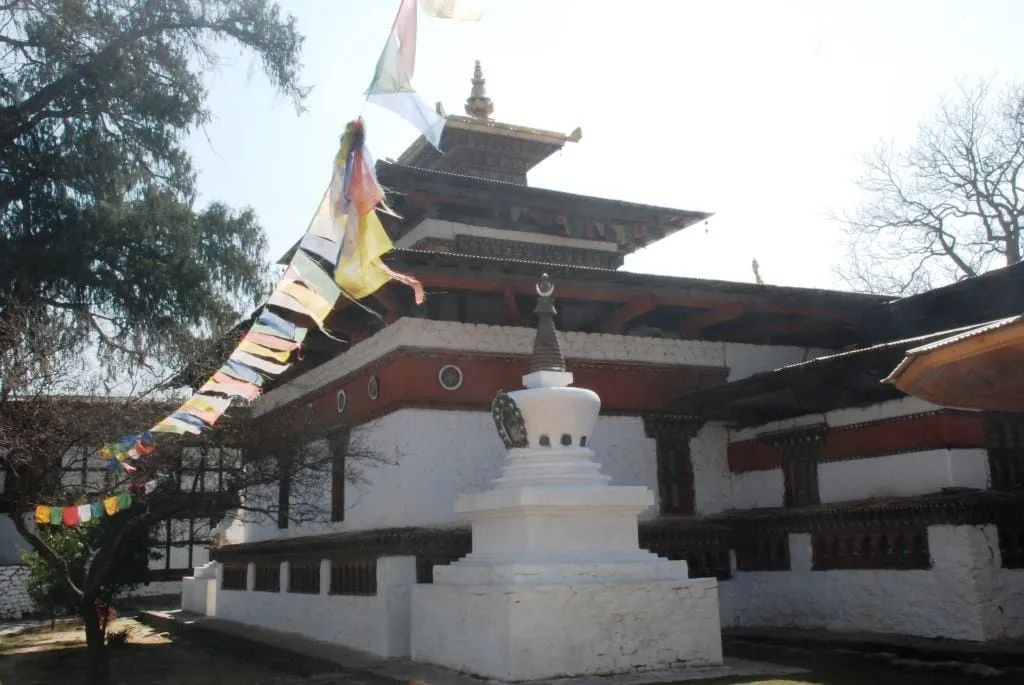
Kyichu Lhakhang is one of the two oldest temples in Bhutan, ten minutes north-west of Paro town. Tradition has it built in the 7th century to pin down the left foot of a demoness. Two temples share one small walled courtyard. Allow 30–45 minutes. The entry fee is Nu 500, and it is included in your tour.
What you’re looking at
Two buildings, one courtyard, thirteen centuries apart.
The older one is the Jowo Lhakhang. Inside is the Jowo Jampa, an image of the Buddha attributed to Songtsen Gampo’s own 7th-century foundation — the same lineage of statue as the famous Jowo of the Jokhang in Lhasa, which is where the name comes from. The floorboards in front of it are worn into hollows by prostrations. That is the detail people remember: not the age as a number, but the wood.
Beside it stands the Guru Lhakhang, built in the twentieth century by Ashi Kesang Choden Wangchuck — queen of the Third King, and today the Royal Grandmother — and consecrated by Dilgo Khyentse Rinpoche, one of the great teachers of the last century. A chorten holding his ashes stands beside the Guru Rinpoche statue.
And in the courtyard between them, two orange trees, which are said to fruit all year round.
The demoness, and why this temple is here at all
Songtsen Gampo, the 7th-century Tibetan emperor, is said to have built 108 temples across Tibet and the Himalaya on a single day, each pinning down part of a vast demoness lying across the landscape and obstructing the spread of Buddhism.
Kyichu holds down her left foot. Jampey Lhakhang in Bumthang is another of the 108 — the other contender for the oldest temple in Bhutan and, by the same tradition, built on the same day. That is why we say “one of the two oldest” and not “the oldest”, whatever the signage anywhere in Bhutan tells you.
Two more, if you follow Bhutanese tradition rather than the outside literature: Lhakhang Karpo and Lhakhang Nagpo in Haa are usually counted among the 108 as well, which makes four in this country and settles the argument in the same direction. Nobody built on a single day can be first.
It is a good story, and it is also a map: the whole 108-temple scheme is a way of describing a Buddhist world laid over a pre-Buddhist one, with the older thing still underneath, still needing to be held down.
When to go, and how it fits your day
Early morning is best, when local people are walking the circuit and turning the prayer wheels. There is no season that changes it — this is a year-round, any-weather half-hour.
It sits about ten minutes from Paro town on the road towards Drugyel Dzong, which makes it an easy pairing with either. Most commonly it goes with Rinpung Dzong and the National Museum as a Paro town morning.
The other placement is better: the afternoon of the day you climb Tiger’s Nest. You come down off the mountain with your legs gone and half an hour of daylight left, and this is the right size and the right temperature of thing to end on. Our Tiger’s Nest guide already sends people here for exactly that reason.
See things to do in Paro for how everything in the valley compares.
What to wear, and what you can photograph
Shoulders and knees covered, shoes off inside. This is a working temple with a steady stream of local worshippers, not a museum.
No photography inside the temples. The courtyard, the trees and the outer walls are fine. Walk the circuit clockwise.
The courtyard is level and easy. There are a few steps up into each of the two temples, and no way round them.
A little history
The founding is 659, or “the 7th century” if you prefer your dates the way the sources actually hold them. Pema Lingpa (1450–1521) uncovered and restored the temple; Zhabdrung Ngawang Namgyal took it over in 1644.
In the 1830s the 25th Je Khenpo, Sherab Gyaltshen, restored and re-consecrated it and added the golden roof and further buildings — the work of the penlop of Paro alongside him. Sources put that restoration at 1836–38 and the roof at 1839, which is almost certainly one project described from two ends.
The Guru Lhakhang followed in the twentieth century. Our own page carried 1968 for years; Wikipedia says 1971. Same queen, same building, three years apart, and nothing found settles it — so this page credits the people and not the year. It is a small thing, but a date nobody can defend is exactly what an answer engine will repeat forever.
Tours that visit Paro


Frequently asked questions
How old is Kyichu Lhakhang?
It is one of the two oldest temples in Bhutan, founded by the Tibetan emperor Songtsen Gampo in the 7th century — 659 is the year most often given. The other is Jampey Lhakhang in Bumthang, and tradition has both built on the same day, which is why neither can honestly claim to be the older.
What is the demoness legend behind Kyichu Lhakhang?
Songtsen Gampo is said to have built 108 temples across Tibet and the Himalaya on a single day, each one pinning down part of a giant demoness who was obstructing the spread of Buddhism. Kyichu stands on her left foot. Jampey Lhakhang in Bumthang is another of the 108, said to have been built the same day — and Bhutanese tradition also counts Lhakhang Karpo and Nagpo in Haa, which would make four in this country.
How long do you need at Kyichu Lhakhang?
Thirty to forty-five minutes. There are two temples in one small walled courtyard and the circuit is short — this is a place you slow down in rather than work through, and it pairs naturally with Rinpung Dzong on the same morning.
What is inside Kyichu Lhakhang?
The old Jowo Lhakhang holds the Jowo Jampa, a 7th-century image of the Buddha attributed to Songtsen Gampo's own foundation — the same lineage of statue as the Jowo of the Jokhang in Lhasa, which is where the name comes from. The newer Guru Lhakhang beside it holds a large Guru Rinpoche, with a chorten containing the ashes of Dilgo Khyentse Rinpoche alongside.
What are the orange trees at Kyichu Lhakhang?
Two orange trees stand in the courtyard, and the belief is that they bear fruit all year round rather than in season. It is the detail everyone who has been remembers, and it is repeated by every source — none of whom say they checked.
Is there an entry fee for Kyichu Lhakhang?
The published fee is Nu 500 per adult — the rate the Department of Tourism set for Kyichu with effect from 15 March 2023, when monument fees were halved. Children aged 6–18 pay half, and children of five and under go free. You won't hand it over at the gate, though: entrance fees are included in every tour we run, arranged along with your Sustainable Development Fee, visa and permits before you arrive.
Is Kyichu Lhakhang worth visiting?
Yes, and it is the natural counterpoint to Tiger's Nest — small, level, quiet and very old, where the hike is none of those things. A lot of our guests come here in the afternoon of the day they climb.
Tailor-made travel
Begin your journey to the Last Shangri-La
Every Little Bhutan itinerary is private and tailor-made. Tell us what draws you to Bhutan — festivals, treks, monasteries, food — and we will design the journey around it.