
Jampey Lhakhang
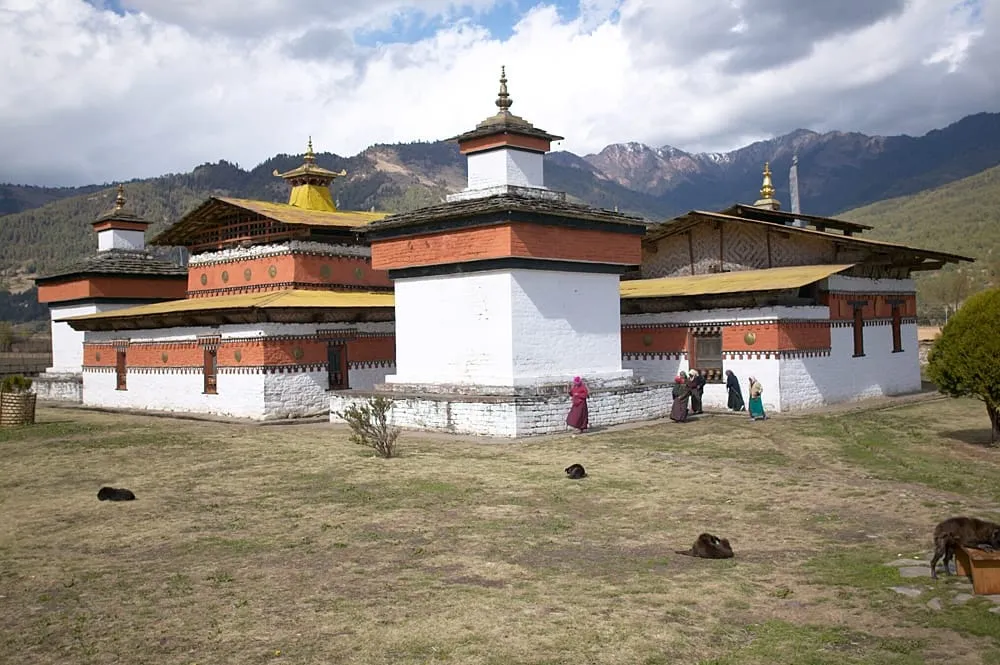
Jampey Lhakhang is one of the two oldest temples in Bhutan, a few minutes north of Chamkhar on the Choekor valley road. Tradition has it founded by the Tibetan emperor Songtsen Gampo in 659 CE — on the same day as Kyichu Lhakhang in Paro. Allow 30–45 minutes. There is no entry fee: Jambay is one of the temples the Department of Tourism names explicitly as charging nothing.
Why it can’t be called the oldest
Songtsen Gampo is said to have built 108 temples across Tibet, Bhutan and the borderlands on a single day, each one pinning down part of a giant demoness lying across the landscape and obstructing the spread of Buddhism.
Jampey is one of them. So is Kyichu, in Paro — and Bhutanese tradition counts Lhakhang Karpo and Nagpo in Haa as well, which would make four in this country. Same emperor, same year, same day — which means that whichever temple you are standing in, and whatever you are told there, it cannot be the older. Our Kyichu page says exactly the same thing from the other end of the country, and that consistency is deliberate. It is one of the few claims in Bhutanese tourism where the honest answer is “there is more than one”.
What the story is really describing is a Buddhist world laid over a pre-Buddhist one, with the older thing still underneath and still needing to be held down. That is a more interesting idea than a date.
What you’re looking at
A small walled temple, named for Jampa — Maitreya, the Buddha of the future — and holding representations of the three Buddhas: past, present and future. The building has been repaired and rebuilt many times across thirteen centuries, which is what happens to a temple that has never stopped being used.
Guru Rinpoche came here. He consecrated the temple, and he is the reason it is at the centre of Bumthang’s religious geography: it was King Sindhu Raja, restored to life by the Guru at what is now Kurjey, who then restored this temple.
When to go, and how it fits your day
Year-round, and any time of day. It is a thirty-minute stop on the road up the Choekor valley, and the natural order is Jampey first, then Kurjey two and a half kilometres further on, then Tamshing across the river. That is a comfortable half-day and it is most of what people come to Bumthang for. See things to do in Bumthang for the rest.
Shoulders and knees covered, shoes off inside, and no photographs in the temple.
The Jambay Lhakhang Drup
For a few days each autumn this small temple hosts one of the best-known festivals in Bhutan. 26–29 October 2026; 14–17 November 2027 — lunar dates, which is why they move three weeks between those two years. If you have read “every October” anywhere, including on this page until recently, that is why it is worth checking.
Two things make the Drup famous.
The mewang, the fire blessing. A gate of burning grass is built and the crowd runs through it, for purification. It happens after dark and it is as dramatic as it sounds.
The tercham. At midnight, masked dancers perform wearing nothing else. It is attributed to the terton Dorje Lingpa, who is said to have introduced the dance to distract demons who were pulling down a monastery every night as fast as it was built. It is a serious religious event, it is not a spectacle laid on for visitors, and it is worth knowing about before you are standing in the dark watching it.
Dates move every year, so check with us before building a trip around one. The current dates are in the Bhutan festival calendar, and the Bumthang festivals tour is built around this part of the calendar.
Note also that Jakar Tshechu usually falls within a week or two of the Drup. Late October and early November is the busiest fortnight of the Bumthang year, and worth booking early.
There is a second, smaller event here — the Jambay Lhakhang Singye Cham, the lion dance, in late November or December. It is a local occasion rather than a visitor one, and it is in the festival calendar if your dates happen to land on it.
A little history
Thirteen centuries is a long time for a small temple, and Jampey has not spent them untouched. It has been repaired and rebuilt many times, which is what happens to a building that has never once stopped being used — unlike a monument, which survives precisely because nobody needs it any more.
That is worth holding onto while you are inside. The claim here is not that these particular timbers date from 659. It is that there has been a temple on this spot, continuously, for thirteen centuries — and that people have been walking in and lighting lamps in it the whole time.
The other thing to know is who came after Songtsen Gampo. Guru Rinpoche consecrated this temple, on the same visit to Bumthang that saw him heal King Sindhu Raja at Kurjey — and the king, restored, is credited with restoring Jampey in turn. So the two ends of Bumthang’s founding story meet here: the temple that was already old when the Guru arrived, and the king whose life he gave back.
Tours that visit Bumthang


Frequently asked questions
Is Jampey Lhakhang the oldest temple in Bhutan?
It is among the oldest, and it cannot honestly claim to be the oldest. Tradition has it founded by the Tibetan emperor Songtsen Gampo in 659 CE, on the same day as Kyichu Lhakhang in Paro — both among the 108 temples he is said to have built in a single day, and Bhutanese tradition counts Haa's white and black temples among them too. Temples built the same day cannot have a winner, whatever the signage at any of them says.
How long do you need at Jampey Lhakhang?
Thirty to forty-five minutes. It is a small walled temple on the Choekor valley road and it pairs naturally with Kurjey Lhakhang, a couple of kilometres further up.
What is Jampey Lhakhang named after?
Jampa — Maitreya, the Buddha of the future. The temple holds representations of the three Buddhas: past, present and future.
When is the Jambay Lhakhang Drup?
26–29 October 2026 and 14–17 November 2027. The dates are lunar and move every year — three weeks between those two — so check the festival calendar rather than assuming October.
What is the fire ceremony at Jambay Lhakhang?
The mewang, a fire blessing: a gate of burning grass that the crowd runs through for purification. It is one of the two things the Drup is famous for. The other is the tercham, a masked dance performed at midnight by dancers wearing nothing but their masks — attributed to the terton Dorje Lingpa, who is said to have introduced it to distract demons who were undoing a monastery's construction each night.
Is there an entry fee at Jampey Lhakhang?
No. Jambay Lhakhang is one of the sites the Department of Tourism names explicitly as charging no monument entry fee.
Tailor-made travel
Begin your journey to the Last Shangri-La
Every Little Bhutan itinerary is private and tailor-made. Tell us what draws you to Bhutan — festivals, treks, monasteries, food — and we will design the journey around it.