
Jakar Dzong
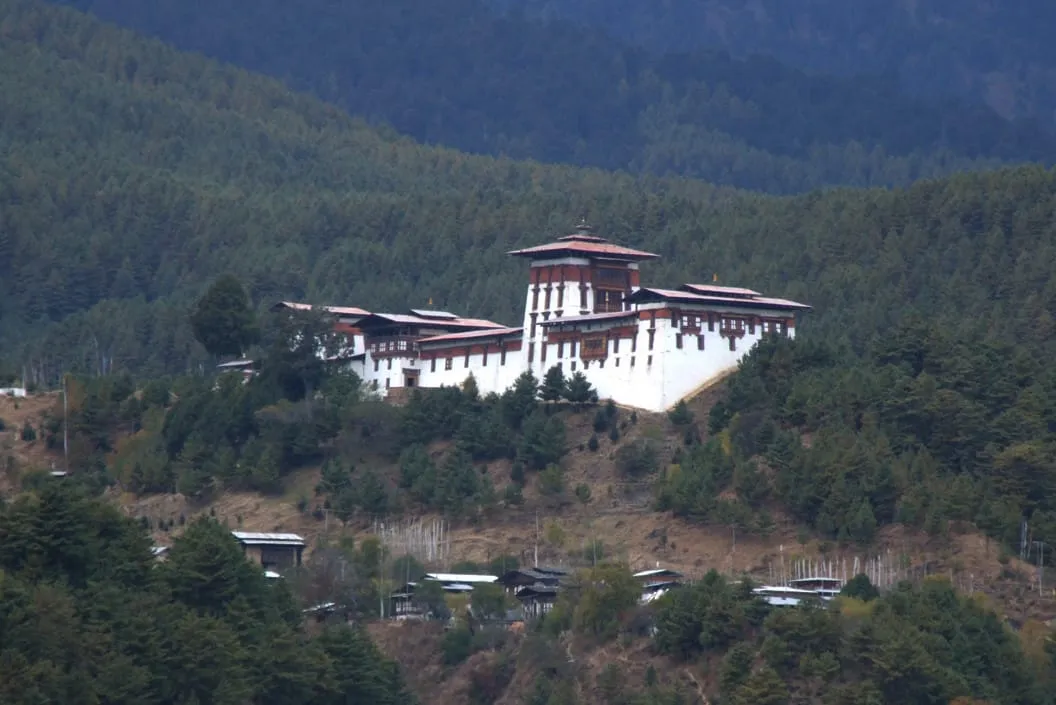
Jakar Dzong is the fortress on the ridge above Chamkhar town, and it has run Bumthang since 1549. Its walls run more than 1,500 metres around — the longest published for any dzong in Bhutan, though the largest dzong itself is Trongsa. Allow 45 minutes to an hour. There is no entry fee: Jakar is one of the dzongs the Department of Tourism names explicitly as charging nothing.
What the visit is actually like
You arrive above the town, which is the wrong way round for a fortress and exactly right for a view. The dzong sits on a spur with the Chamkhar valley laid out below it, and the first thing to do is turn round and look at where you have come from.
Inside it works the way every dzong does: two institutions sharing a wall — the district administration on one side, the regional monk body on the other — with steep, worn stairways between the levels. What Jakar has that most do not is the Utse, a tall central tower standing against the eastern wall rather than in the middle of a courtyard, and a protected water supply — a covered passage running down to a spring inside the defences.
That passage is the best thing here and almost nobody points at it. A dzong on a ridge can be besieged; a besieged dzong with its own water can wait. It is the entire argument for building on this spur, in one piece of masonry.
When to go, and how it fits your day
Morning. The dzong faces down the valley, the light comes across it early, and it is the obvious first thing of a Bumthang day before you drive north to the temples.
March to May and September to November are the comfortable months. October or November brings the Jakar Tshechu — see below.
The dzong is open for visits through the year, but we do not publish opening hours. Nothing official does, this is a working dzongkhag administration, and which parts you can enter shifts with what the offices and the monk body are doing that day. Your guide confirms on the day and picks the route. Duller than a schedule, and a great deal more reliable than a wrong one.
For how it fits with the rest of the district, see things to do in Bumthang. The short version: the dzong and Wangduechhoeling Palace in the town below make a comfortable half-day, and the temples up the Choekor valley — Jampey, Kurjey and Tamshing — are the other half.
What to wear, and what you can photograph
Shoulders and knees covered. This is an active administrative and monastic site, not a monument, and it is enforced. Shoes come off before you enter a chapel.
Photograph the courtyards, not the chapel interiors. The same rule applies at nearly every temple in Bhutan, for the same reason: what is inside is an object of practice, not an exhibit.
There are steep stairways between levels and no step-free route through the building. If that matters for anyone in your group, tell us while we are planning — the approach and the view from outside the walls stand on their own.
The Jakar Tshechu
Once a year the dzong stops being an office and becomes a venue. The Jakar Tshechu runs four days, 6–9 November in 2027, with mask dances in the dzong’s own grounds.
The dates move with the lunar calendar, by as much as three weeks from one year to the next. Check with us before building a trip around one. The current dates are in the Bhutan festival calendar, and the Jakar Tshechu tour is built around it.
Bumthang has more festivals than any other district in Bhutan, and Jakar’s is only one of them. The Jambay Lhakhang Drup falls within a week or two of it most years, which is why late October is the busiest fortnight of the Bumthang year — and why it is worth deciding early which one you are coming for.
A little history
A Tibetan lama, Ngagi Wangchuk (1517–1554), came to Bumthang to spread the Drukpa Kagyu teaching and founded a temple on this spur. In 1549 the lamas gathered to settle where a monastery should stand and — the story goes — a white bird rose suddenly and settled here. That was taken as the answer, and it is where the name comes from: bjakhab, white bird.
The dzong’s formal name, Yuelay Namgyal Dzong, commemorates a victory over the troops of the Tibetan ruler Phuntsho Namgyal — one of the 17th-century invasions that damaged the building and forced its rebuilding. The Trongsa Penlop renovated it afterwards, and it was sanctified in 1679 by Tenzin Rabgay.
It has been the seat of Bumthang’s administration ever since, which is rarer than it sounds. Most of Bhutan’s great dzongs have burned down, been rebuilt or moved. This one has simply carried on.
Tours that visit Bumthang


Frequently asked questions
How long do you need at Jakar Dzong?
Forty-five minutes to an hour. That covers the approach, the courtyards and the chapels your guide takes you into. It is the natural first stop of a Bumthang morning, and it pairs with Wangduechhoeling Palace in the town below.
What does Jakar mean?
White bird, from bjakhab. The legend is that when the site for a monastery was being chosen, a white bird rose and settled on this spur, and that was taken as the answer. The dzong's formal name is Yuelay Namgyal Dzong.
When was Jakar Dzong built?
1549, by the Tibetan lama Ngagi Wangchuk (1517–1554), on the site of a temple he had already founded here. It was damaged in the Tibetan invasions of the 17th century, rebuilt, and sanctified in 1679.
Is Jakar Dzong the biggest dzong in Bhutan?
It has the longest walls. They run more than 1,500 metres around, which is the largest published figure of its kind for any dzong in Bhutan — and that is what the claim rests on, rather than floor area. The largest dzong itself is Trongsa, on its own district administration's account and everyone else's. Two claims, two different measurements. Standing under Jakar's walls, its version is easy to believe.
Can you go inside Jakar Dzong?
Yes, with your guide — the dzong is open for visits through the year. Shoulders and knees covered, shoes off in the chapels, photography in the courtyards but not in them. Which parts are open varies: this is a working district administration and a working monastic body, so we time the visit and let your guide pick the route rather than publishing hours nobody official publishes.
Is there an entry fee at Jakar Dzong?
No. Jakar is one of the sites the Department of Tourism names explicitly as charging no monument entry fee, and the March 2023 fee schedule listed only seven charging monuments in the whole country — none of them in Bumthang. That list has grown since (Dungtse Lhakhang in Paro joined it at the start of 2026), so treat it as a floor rather than a fixed set; Jakar's own no-charge status is named in the circular itself. Museums are administered separately and can charge their own admission; the fee schedule covers monuments.
Tailor-made travel
Begin your journey to the Last Shangri-La
Every Little Bhutan itinerary is private and tailor-made. Tell us what draws you to Bhutan — festivals, treks, monasteries, food — and we will design the journey around it.