
Kila Goenpa
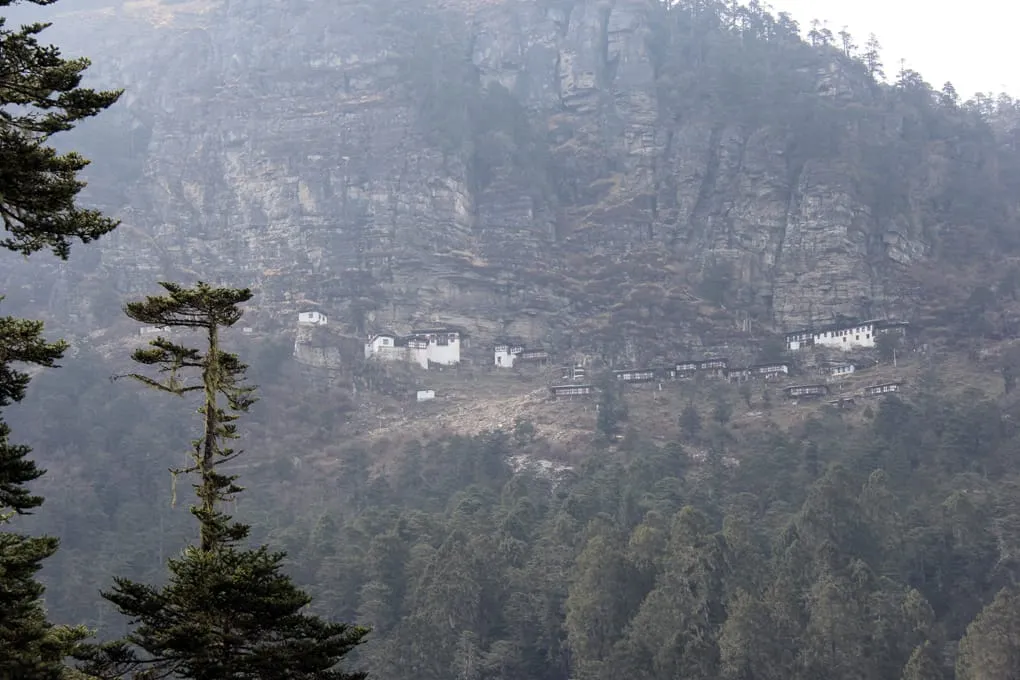
Kila Goenpa is a nunnery of seven small temples and retreat huts built into a cliff below Chele La, the pass between Paro and Haa. You reach it on foot from the pass — downhill first, uphill on the way back. Allow 2–3 hours round trip; entry is included in your tour.
The walk, and the thing nobody tells you about it
Almost every description of this hike says “an hour”. That is roughly true one way and it is the wrong thing to measure.
The goenpa is below the pass. So the walk starts with a descent through fir and rhododendron — easy, fast, deceptively pleasant — and finishes with the same ground in reverse, climbing, at close to 3,900 m, after you have already spent an hour and a half in a car getting up here.
That is not a warning, it is a plan: allow 2–3 hours, start it early, and treat the way back as the walk rather than the afterthought. Done in that order it is one of the best short hikes in western Bhutan.
Chele La itself is published as 3,988 m — over 13,000 feet, and higher than most people have been standing before. (Elevation models put the road a little under 3,800 m; the pass page has the detail.) Either way, if you flew in yesterday, this is not the day for it.
What’s there when you arrive
Seven small temples and a set of retreat huts, pressed against the cliff on ledges and stacked on props — which is why people call them tree houses. A small community of nuns lives here, some of them in long retreat.
It is quiet in a way that is different from a temple visit. Nobody is running a programme, there is no ticket desk, and you are walking through somewhere people have chosen to live in isolation. Shoulders and knees covered. Ask before you photograph — this is a home, not a viewpoint.
The view back down over the Paro valley on the return climb is the best in the district and the compensation for the last twenty minutes.
When to go
March to May and September to November. The pass is high and exposed and can hold snow into spring; through the monsoon the ridge is usually in cloud and the path is greasy.
The drive up from the valley floor is about an hour and a half each way, which makes this a half-day at minimum and realistically most of a day once you have stopped at the pass for the prayer flags. See things to do in Paro for how that fits with everything else.
If anyone in your group would rather not do it, say so early — Dzongdrakha is a cliff-temple walk at a fraction of the effort and altitude, and Bhutan for seniors & less-mobile travellers covers the rest of that thinking.
What we don’t publish about it
More than we would like. There is no Wikipedia article, no Wikidata entry and no government page for Kila Goenpa — every description online traces back to a tour operator, and they do not agree with each other.
So: we give no founding date, no founder, and no number of nuns, because the published figures run from thirty to seventy and none of them cite anything. It is widely described as Bhutan’s oldest nunnery and it may well be. We are not going to be the tenth site to assert it without a source.
What we can tell you is the shape of the walk, the altitude you start it at, and which half hurts — which is what you actually need.
Tours that visit Paro


Frequently asked questions
How hard is the Kila Goenpa hike?
Harder than it sounds, for a reason nobody mentions: you walk downhill first and uphill on the way back, because the goenpa sits below Chele La. The climb is at the end, on tired legs, at close to 3,900 m. Allow 2–3 hours round trip from the pass. It is not a long walk; it is a walk that saves its work for last.
Where is Kila Goenpa?
On a cliff below Chele La, the pass between Paro and Haa, about an hour and a half up from the Paro valley floor. It is also written Kila Gompa, and — as our own page has always noted — Chele Gompa, after the pass.
What is Kila Goenpa?
A nunnery: seven small temples and a scatter of retreat huts built onto the cliff face, with a small resident community. It is widely described as Bhutan's oldest nunnery, though we have not found a source we would stake that on.
What does "kila" mean?
The kila — phurba in Tibetan — is the three-sided ritual dagger of Vajrayana practice, used to pin down and subdue obstructive forces. The same idea runs through half the sites in this valley, including Kyichu, which pins a demoness.
Is Kila Goenpa worth the walk?
If you want one high-mountain walk in Paro that is not Tiger's Nest, yes — the cliff siting is genuinely startling and the ridge views on the way back are the best in the district. If you have already committed to the Taktsang climb, be honest with yourself about doing both in the same few days.
Tailor-made travel
Begin your journey to the Last Shangri-La
Every Little Bhutan itinerary is private and tailor-made. Tell us what draws you to Bhutan — festivals, treks, monasteries, food — and we will design the journey around it.