
Buddha Dordenma, Kuensel Phodrang (Buddha Point)

The Buddha Dordenma is a 54-metre gilded bronze Buddha seated on the hill above Thimphu at Kuensel Phodrang — the place every driver calls Buddha Point. Inside it are 125,000 smaller Buddhas. Allow 45 minutes to an hour, and come towards sunset.
What it’s like up there
You drive to a wide stone plaza and the statue is simply there, far larger than photographs prepare you for, gold against whatever the sky is doing. Broad steps lead up to the throne it sits on, which is a building in its own right — three storeys of chapels — and the whole thing faces north, down the length of the Thimphu valley, so the city is spread out below you the entire time.
Inside the body and the throne are 125,000 gilded bronze Buddhas: one hundred thousand at eight inches, twenty-five thousand at twelve. That is not a decorative flourish. The statue was built hollow to hold them.
The plaza is large, open and wind-exposed, and there is a great deal of paving to cross. It is also one of the few places in Thimphu where Bhutanese come simply to be outdoors — the road up is used for running and cycling in the evenings, and the surrounding Kuensel Phodrang Nature Park, opened in 2011 across 943 acres, has walking trails through it.
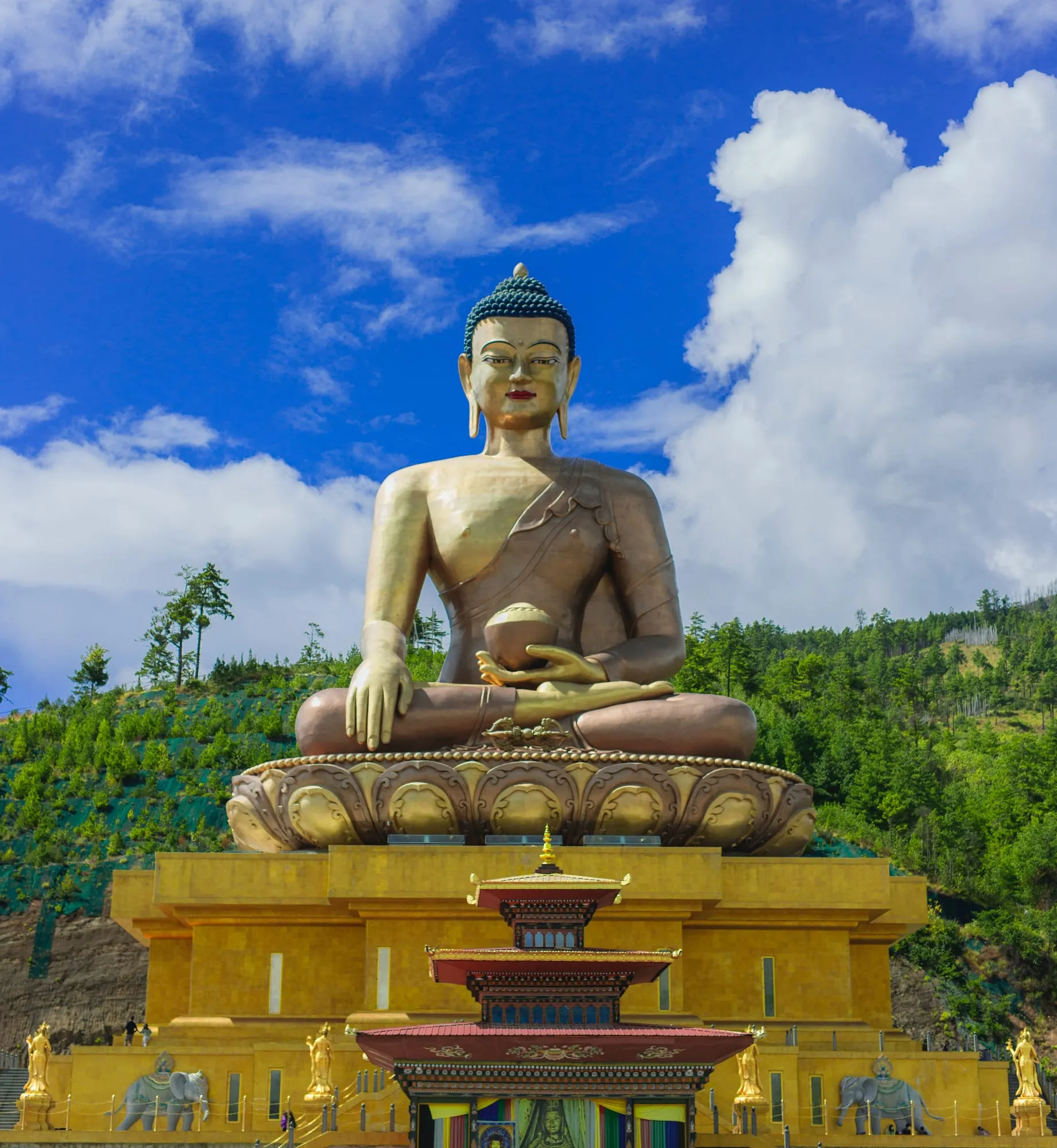
How tall is it, really?
54 metres (177 feet) — and this is one of the few facts on this site where we are correcting ourselves in public.
Almost every travel page, and our own page until this rewrite, says 51.5 m. The Thimphu Dzongkhag Administration and Wikipedia both publish 54 m. Our best reading is that 51.5 m measures the statue without part of the throne, and that the smaller number stuck because it was copied more often than it was checked.
What is not in dispute is that it is one of the largest seated Buddha rupas anywhere, and comfortably the largest statue in Bhutan. The claim that it is the largest Buddha statue in the world — which you will also read — is not true; several are taller.
When to go
Late afternoon into sunset is the answer, and it isn’t close. The statue faces north, so evening light runs along the gold instead of flaring into your lens, the heat has gone out of the paving, and Thimphu’s lights come up below you as the sky darkens. Guests who plan for thirty minutes routinely stay an hour.
Mornings are quieter and the air is often clearer, which suits photographers who want the valley sharp rather than the statue glowing. October to February gives the cleanest long view down the valley; the monsoon months trade that for green hills and a lot of cloud.
There is no season when this is a bad stop. It is the one Thimphu sight that works in any weather, which makes it useful when a plan falls apart.
Getting there, and what it costs
Fifteen to twenty minutes up a good paved road from Thimphu town. Vehicles reach the plaza, so there is no walk in — but there are broad steps up to the statue platform and a lot of open ground, which is worth knowing if anyone in your party tires easily.
Nothing to pay. Entrance fees are included in every tour we run, and Buddha Dordenma is in any case named on the Department of Tourism’s monument circular as a site with no entry charge — one of the very few sites in Bhutan the circular lists that way.
How it fits a day in Thimphu
It is the natural last stop. A standard Thimphu day runs Tashichho Dzong or the Memorial Chorten in the morning, the museums and the takin preserve through the middle of the day, and Buddha Point at the end — because nothing else you could do afterwards would follow it well.
See things to do in Thimphu for how the whole capital compares.
A little history
The statue fulfils a prophecy: an eighth-century terma teaching of Padmasambhava, recovered by the terton Pema Lingpa, and restated in the 20th century by the yogi Sonam Zangpo, held that a large statue of Buddha Dordenma here would bestow blessings and peace on the world.
Construction began in 2006 and was meant to finish in October 2010. It was finally consecrated on 25 September 2015. The bronze was cast by the Aerosun Corporation of Nanjing and shipped in, at a construction cost of about US$47 million against a total project cost put at well over US$100 million — funded not by the Bhutanese state but by private sponsors, Rinchen Peter Teo of Singapore and Danny Wong, a Malaysian businessman based in Hong Kong.
So: an eighth-century prophecy, a 21st-century Chinese foundry and private money from Southeast Asia. Bhutan is less sealed off than the brochures suggest.
Tours that visit Thimphu


Frequently asked questions
How tall is the Buddha Dordenma statue?
54 metres (177 ft). You will see 51.5 m quoted almost everywhere, including on our own page until this rewrite — but the Thimphu Dzongkhag Administration and Wikipedia both give 54 m, and the lower figure looks like the statue measured without part of its throne. Either way it is one of the largest seated Buddha statues in the world.
How many Buddha statues are inside the Buddha Dordenma?
125,000 — one hundred thousand eight-inch bronzes and twenty-five thousand twelve-inch ones, each gilded, filling the body of the statue and the meditation hall in its throne. They are the reason the structure is hollow.
Is there an entry fee for Buddha Point?
No, on two counts. Entrance fees are included in every tour we run, and the Department of Tourism's own monument circular names Buddha Dordenma as a site with no entry charge. Nothing to pay, nothing to queue for.
How long do you need at Buddha Point?
Forty-five minutes to an hour covers the statue, the plaza and the view. If you're going for sunset, allow longer and expect to stay past it — the city lights coming on below you are the better half of the visit.
When was the Buddha Dordenma built?
Construction began in 2006 and the statue was consecrated on 25 September 2015 — so it is younger than most visitors assume. It was cast in Nanjing, shipped in sections, and paid for by private sponsors from Singapore and Malaysia rather than by the Bhutanese state.
What is the best time of day to visit Buddha Point?
Late afternoon into sunset. The statue faces north down the valley, so the evening light falls along it rather than into your lens, and Thimphu comes on below you as the sky goes. Mornings are quieter but flatter.
Tailor-made travel
Begin your journey to the Last Shangri-La
Every Little Bhutan itinerary is private and tailor-made. Tell us what draws you to Bhutan — festivals, treks, monasteries, food — and we will design the journey around it.