
The Folk Heritage Museum
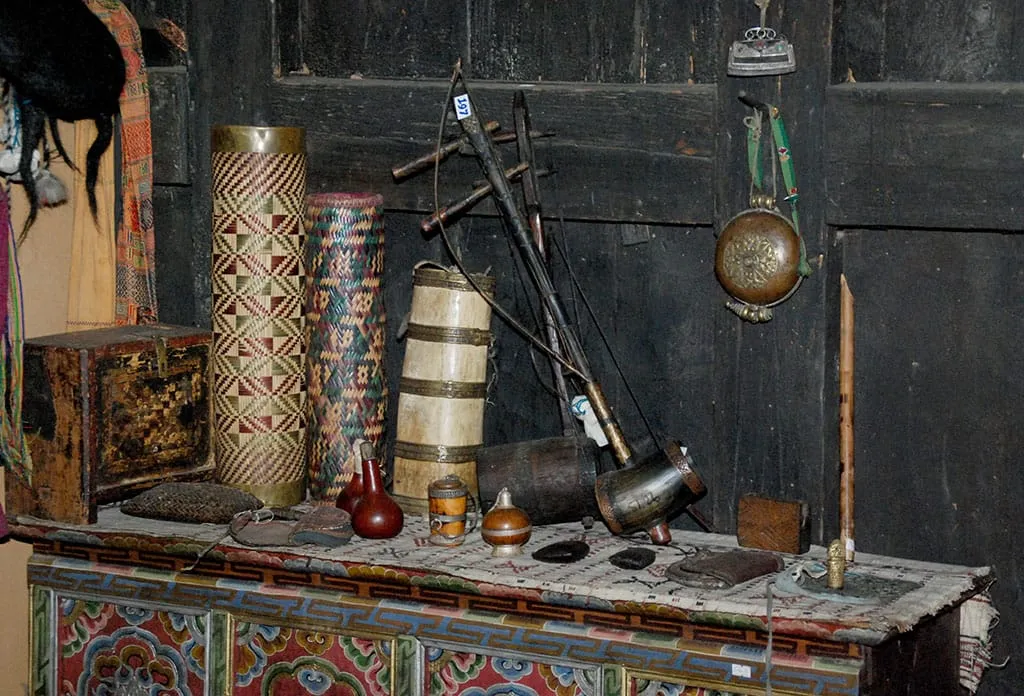
The Folk Heritage Museum is a rammed-earth farmhouse over 150 years old in Kawajangsa, kept furnished as a rural Bhutanese household of the mid-19th century. The building is the exhibit. Allow about an hour; entry is included in your tour.
What you’ll see
A house that four-fifths of Bhutan lived in until living memory, with the pots still on the shelves.
The building — also called Phelchey Toenkhyim — is three storeys of rammed mud and timber, built without cement and previously the home of a local chieftain, Kawang Mangkey. You climb through it in the traditional order:
- the Okhang on the ground floor, effectively a byre, where the animals were kept
- the Barthog above it, with the Phuna store room where the grain and the family’s wealth lived
- the Thabtshang at the top: the kitchen and living floor, where everyone ate, worked and slept around the hearth
The logic of that arrangement — animals below, stores in the middle, people warm at the top — is the single most useful thing you can learn about Bhutanese domestic architecture, and once you have it you will read every farmhouse you drive past for the rest of the trip.
Outside there is a watermill, kitchen gardens planted with what a household would actually have grown, and hot stone bath installations — the wooden tubs heated by river stones dropped in glowing from a fire.
There is a restaurant in the compound doing Bhutanese lunch, which is a genuinely good place to try the real thing in a country where hotel buffets tend to hedge.
About the stairs
This is the one thing to know before you commit. Bhutanese farmhouses are climbed by steep, narrow wooden stairs, and between some floors by a notched log used as a ladder. There is no alternative route and no lift, because it is a 19th-century farmhouse and altering it would defeat the point.
If stairs are difficult, the grounds, the watermill, the gardens and the restaurant are all level and still worth the stop.
When to go
Year-round; it is indoors, which makes it a useful answer to a wet afternoon. The kitchen garden is at its best in summer.
Published opening hours vary between sources — including on whether it opens on a Sunday — so your guide confirms rather than us printing a schedule we can’t stand behind.
How it fits your day
It’s in Kawajangsa, the museum quarter ten minutes above the town centre, a few hundred metres from the National Library, the Zorig Chusum arts school, the traditional medicine institute and the National Textile Museum. Doing three of the five in one morning is the standard Thimphu move, and it works.
See things to do in Thimphu for how everything compares.
Tours that visit Thimphu


Frequently asked questions
What is the Folk Heritage Museum?
A three-storey rammed-earth farmhouse over 150 years old, kept furnished as a rural Bhutanese household of the mid-19th century. It is not a museum in a building; the building is the exhibit. It opened on 28 July 2001 and is also known as Phelchey Toenkhyim.
How long do you need at the Folk Heritage Museum?
About an hour, including the grounds. That's three floors of house, the watermill, the kitchen garden and the hot stone bath outside — and long enough to have the layout explained, which is what makes it land.
Is the Folk Heritage Museum accessible?
Honestly, no. Bhutanese farmhouses are climbed by steep wooden stairs and, in places, a notched log serving as a ladder, and there is no alternative route through the building. The grounds, the watermill and the restaurant are level and are worth the stop on their own if the stairs are out.
Is the Folk Heritage Museum the same as Simply Bhutan?
No — they're two different places and travel sites mix them up constantly. This is the government farmhouse museum in Kawajangsa; Simply Bhutan is a separate privately-run living museum elsewhere in the city with its own hours and its own charm.
Tailor-made travel
Begin your journey to the Last Shangri-La
Every Little Bhutan itinerary is private and tailor-made. Tell us what draws you to Bhutan — festivals, treks, monasteries, food — and we will design the journey around it.