
The National Textile Museum
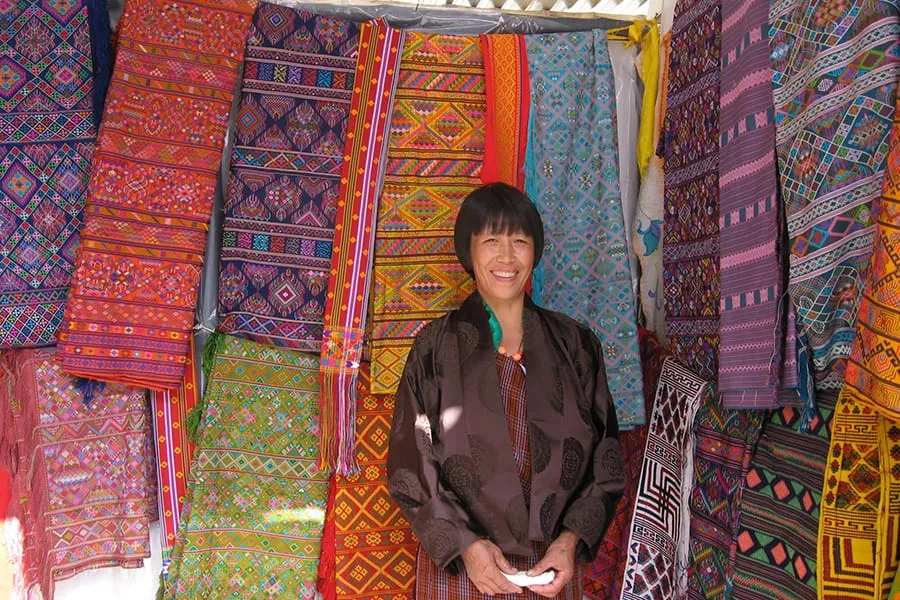
The National Textile Museum holds Bhutan’s national weaving collection, including the crowns of its kings, in six galleries near the centre of Thimphu. Weaving is Bhutan’s most developed craft and this is where it’s laid out end to end. Allow 45 minutes to an hour.
What to see
Start with the Royal Collection, because everything else makes more sense afterwards. It holds the crowns of Bhutan’s kings — including the first Raven Crown, the extraordinary object that became the emblem of the monarchy — the brocade uzhams of the first and second kings, royal namzas, the princess crown worn by Ashi Wangmo, the bedding of Shabdrung Jigme Dorji, and the pearl robe from Tsamdrak Goenpa.
The other five galleries take you through achievements in textile arts, textiles in religion, textiles from indigenous fibres, and then the two that matter technically: warp-pattern weaves and weft-pattern weaves. That distinction sounds academic until you’ve seen it, and then it is the thing you notice on every kira and gho for the rest of your trip — including the kushuthara, the silk-on-silk weave that takes months and costs accordingly.
On the ground floor there are demonstrations of spinning, dyeing, dressing a loom and working two sets of yarns. Across the courtyard, the Royal Textile Academy conservation centre usually has a small group of weavers at their looms, which is worth the extra ten minutes.
Photography is restricted in the galleries — ask at the desk.
Museum, academy, or both?
Both, and it confuses everyone.
The National Textile Museum was established in 2001, conceived by Queen Mother Ashi Sangay Choden Wangchuck and built with Danish assistance. The Royal Textile Academy was instituted separately in May 2005, under the same patron: a non-government body that trains weavers and conserves textiles, and which received the National Order of Merit in Gold in 2016.
They share a site. Travel pages routinely give the Academy’s founding date as the museum’s, or describe one and photograph the other. If you want the collection, go into the museum; if you want to watch someone weave, cross the courtyard.
When to go
Year-round. It is indoors and central, which makes it the standard answer to a wet Thimphu afternoon, and it takes under an hour.
Opening hours are not published anywhere we would rely on, so your guide confirms before you set off.
How it fits your day
It’s five minutes from the town centre and walkable from Norzin Lam, so it drops into any gap. It pairs naturally with the Folk Heritage Museum and the Zorig Chusum arts school up in Kawajangsa — the school teaches weaving as one of the thirteen crafts, so seeing the students and then the masterpieces in the same morning is the right order.
If the weaving takes hold, the kishuthara weavers of Khoma in Lhuentse are where the finest of it is actually made.
See things to do in Thimphu for how everything compares.
Tours that visit Thimphu


Frequently asked questions
What is in the National Textile Museum?
Six galleries: achievements in textile arts, textiles in religion, textiles from indigenous fibres, the Royal Collection, warp-pattern weaves and weft-pattern weaves. The Royal Collection is the reason to go — it holds the crowns of Bhutan's kings, including the first Raven Crown, royal namzas, the brocade uzhams of the first and second kings and the pearl robe from Tsamdrak Goenpa.
How long do you need at the Textile Museum?
Forty-five minutes to an hour, plus a little more if the weavers are working in the conservation centre across the courtyard. It's a small museum done well rather than a large one done thinly.
What is the difference between the Textile Museum and the Royal Textile Academy?
Two institutions on one site, and almost every travel page merges them. The National Textile Museum was established in 2001 to hold and display the collection. The Royal Textile Academy, instituted in May 2005, is a non-government body that teaches and conserves weaving — its conservation centre is across the courtyard, and that's where you'll see looms in use.
Can you take photographs in the Textile Museum?
Photography is restricted in the galleries and you should ask at the desk rather than assume. Reports of a blanket ban are common but we haven't found an official statement, so treat it as ask-first.
Tailor-made travel
Begin your journey to the Last Shangri-La
Every Little Bhutan itinerary is private and tailor-made. Tell us what draws you to Bhutan — festivals, treks, monasteries, food — and we will design the journey around it.