
Things to do in Trashi Yangtse
Trashi Yangtse — Yangtse for short — became a district in its own right in 1992, split off from Trashigang, and it is best done as a day excursion from Trashigang: 53 km, about two hours each way. What it has that nowhere else does is a stupa built in the style of Boudhanath in Kathmandu, the wood turning that Bhutanese bowls and cups come from, and the country's quieter black-necked crane valley.
Things to do in Trashi Yangtse, compared
| Attraction | Time needed | Legwork | Best season |
|---|---|---|---|
| Chorten Kora | 45 mins–1 hr | Level riverbank site; the circuit is a flat walk with nothing to climb | First lunar month for the two Koras; year-round otherwise |
| Zorig Chusum crafts college | 1–1.5 hrs | Workshops across several rooms and buildings, with steps between them | Term time — ask us |
| Trashiyangtse Dzong | 1–1.5 hrs for both | The new dzong is on the flat near the town; the old one is a separate trip, 3 km out | Mar–May, Sep–Nov |
| Bumdeling Wildlife Sanctuary | Half a day upwards | Level valley floor for the cranes; beyond the valley it is a trek — ask us | Nov–Feb for the black-necked cranes |
| Gom Kora | 45 mins–1 hr | 23–24 km and about an hour from Trashigang, which is how everyone arrives; the site is below the road, and the rock is a climb and the passage a crawl | Year-round |
Entrance fees are included in every tour we run, so there's no ticket window to queue at and no cash to carry at any of them.
Gom Kora is in this district, on the Chazam road at its southern end, even though it is reached from Trashigang and lives on that district's page. Our own festival calendar has always listed the Gomphukora tshechu under Trashi Yangtse, and the dzongkhag administration here counts the temple among its own institutions.
Chorten Kora, and the girl inside it
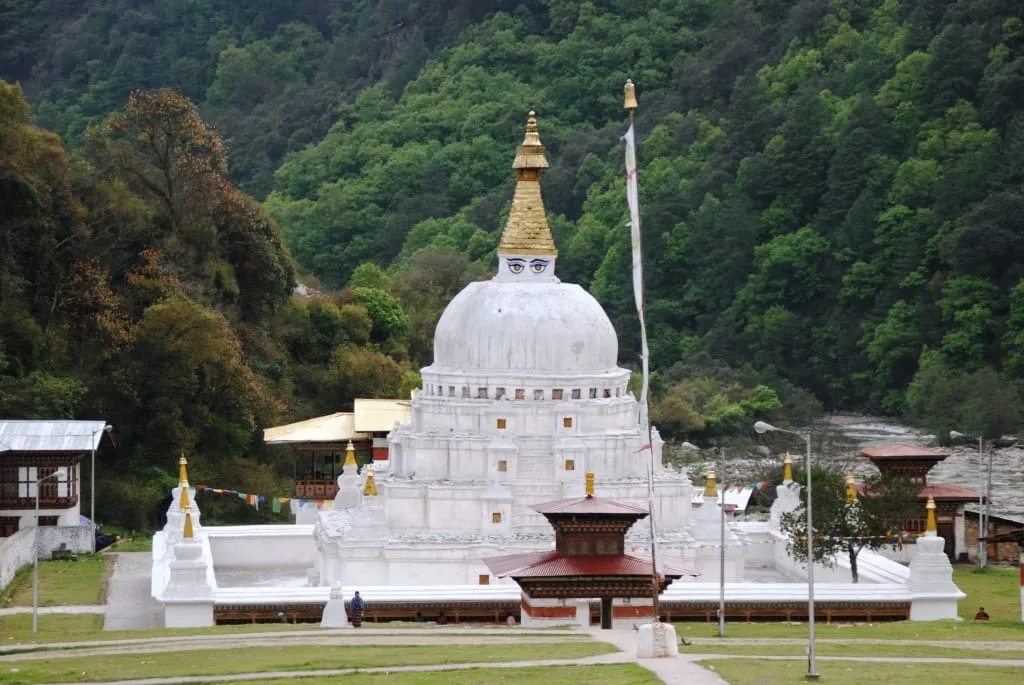
A whitewashed stupa on the riverbank three minutes below the town, built as a copy of Boudhanath in Kathmandu with eyes painted at the four cardinal points — which makes it look, in photographs, like it belongs three countries away. The district's own explanation for why the two are not identical is that the lama carried the model home carved out of a radish, and it shrank on the journey.
The story is the reason to stand in front of it. A girl from Tawang, over the border in Arunachal Pradesh, was walled into the stupa while it was being built, to meditate on behalf of all beings — and her people still cross to walk round her.
There are two Koras, a fortnight apart, both in the first Bhutanese month. The Dakpa Kora on the 15th day is the one the Dakpa community come over from Tawang for; the Drukpa Kora on the 30th is the Bhutanese one, walked on the anniversary of the stupa's consecration. It is one of very few genuinely cross-border festivals in Bhutan — another is the tshechu at Gom Kora, down the same road. See the festival calendar for the current dates.
The crafts, which are the district's real economy
Yangtse is where Bhutan's wooden bowls and cups come from. Shagzo — wood turning — is one of the thirteen traditional arts, and it is this district's: a dapa is a turned bowl, a dza phob a turned cup, and both come from zaa, burl — the knotted outgrowth on a tree rather than any particular species of tree. Local burl has run short enough that turners here now buy it in from Wangdue and Trongsa, halfway across the country. Yangtse also makes desho, the daphne-bark paper.
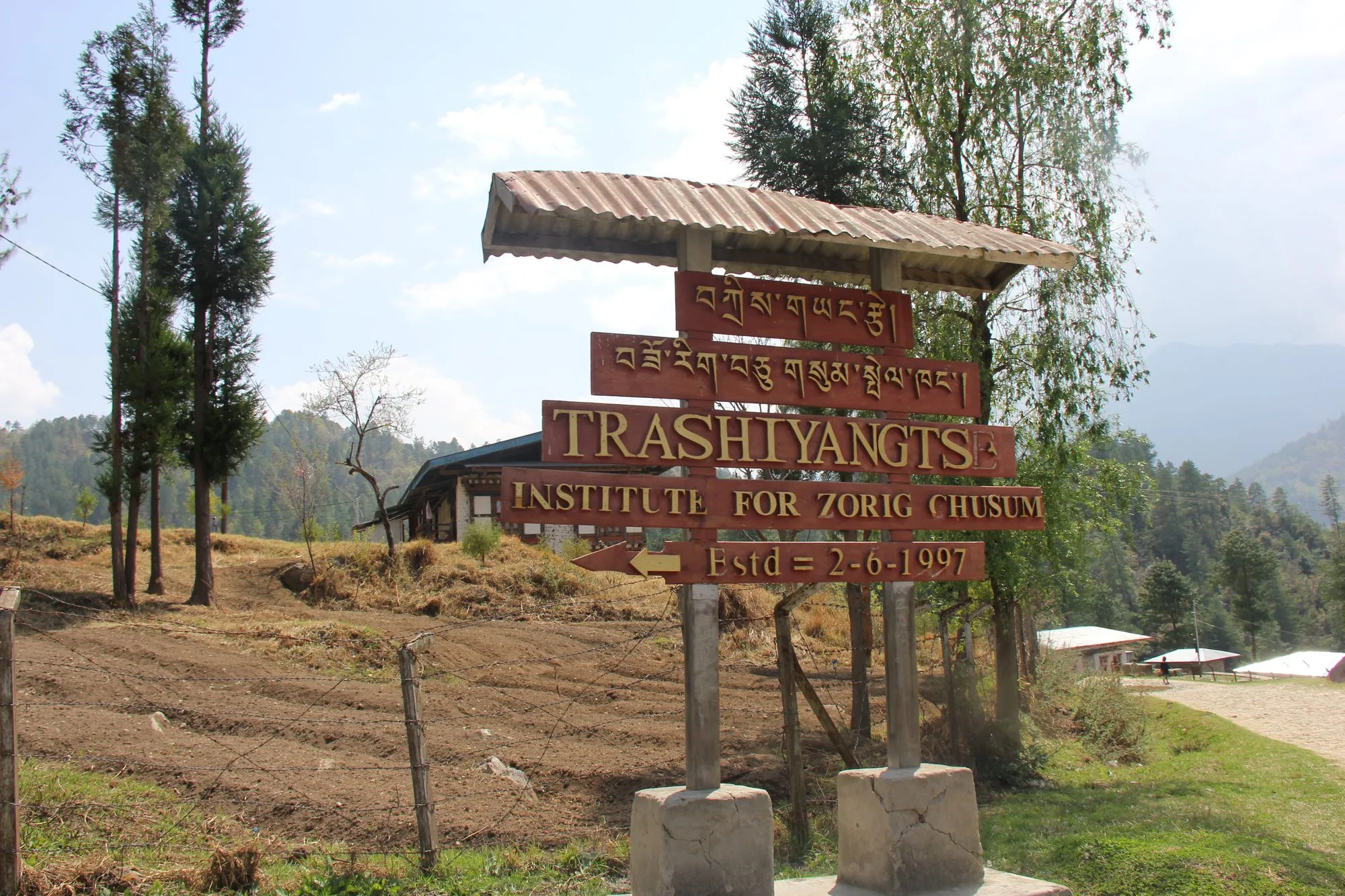
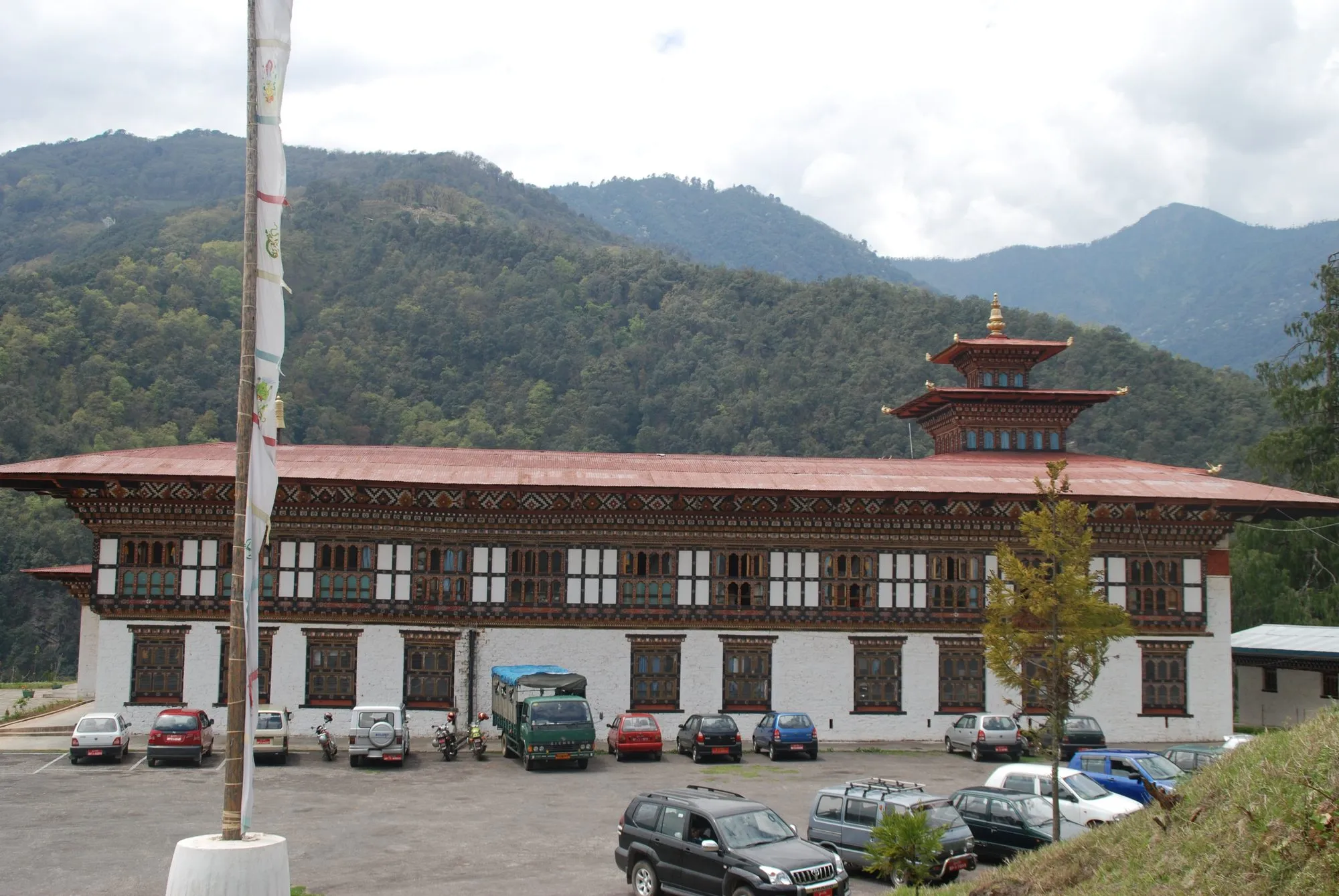
The Zorig Chusum college here is the only school of its kind in Bhutan besides the one in Thimphu — instructors move between the two. It opened in 1997. How many of the thirteen crafts are taught here is not reliably published and the counts that circulate contradict each other, so ask us what is running when you travel; wood turning is the safe expectation, and it is the one worth coming for.
It is a college, so term time matters — ask us.
Two dzongs, and a sanctuary
Yangtse has two dzongs and both still stand, which is unusual. The old one — Dongdi Dzong — is three kilometres from the town, houses the monastic body and looks more like a temple; the new one, inaugurated in 1997, sits on the flat near the town and is the working administrative seat. The district takes its name from the old dzong: Pema Lingpa rebuilt it in the 15th century and renamed it Trashiyangtse, "the fortress of auspicious fortune".
Bumdeling is the district's wild half: about 1,520 km² on UNESCO's tentative World Heritage list, running from 1,500 m to 6,000 m across three districts and bordering Tibet in the north. Black-necked cranes winter here — but this is the small eastern site, not the famous one. 52 birds came in 2024–25, against 640 in Phobjikha. Which is the honest reason to come: you will have them to yourself.
Where it is, and how to get there
Trashi Yangtse is 53 km and about two hours from Trashigang, on the road through Doksum. Four hours of driving leaves about six for the district, which covers three stops comfortably and not five. Our own eastern itinerary spends that day on Chorten Kora, the town, the wood turning and Gom Kora; swap in the crafts college or the dzongs if you would rather, but not on top. Bumdeling does not fit alongside them: half a day in the crane valley plus the drive is a day of its own, so ask us about staying the night rather than trying to do both. It borders Trashigang and Mongar to the south, Lhuentse to the west, Arunachal Pradesh (India) to the east and Tibet (China) to the north. The dzongkhag covers 1,437.9 km² across eight gewogs, running from 600 m to 5,400 m, and the 2017 census counted 17,300 people — Yangtseps, Tshanglas, Bramis from Tawang, Khengpas from Zhemgang and Kurtoeps from Lhuentse, which is a lot of peoples for a small district.
Attractions in Trashi Yangtse
Tailor-made travel
Begin your journey to the Last Shangri-La
Every Little Bhutan itinerary is private and tailor-made. Tell us what draws you to Bhutan — festivals, treks, monasteries, food — and we will design the journey around it.