
Gom Kora (Gomphu Kora)
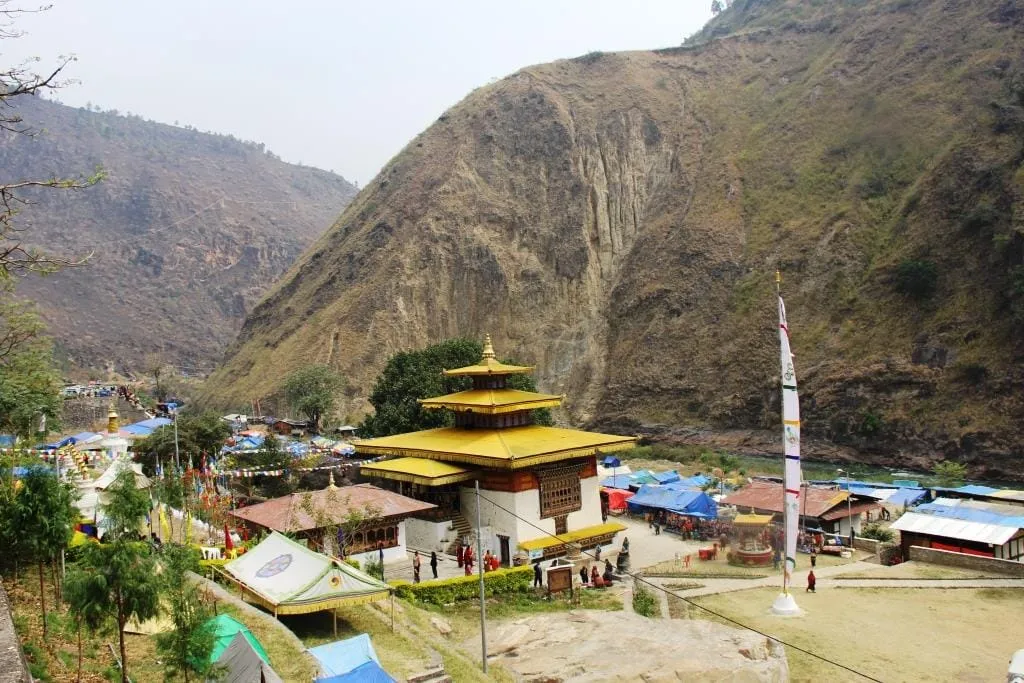
Gom Kora is a two-storey temple on a shelf of paddy above the Drangme Chhu, about an hour and 23–24 km from Trashigang, built around the rock Guru Rinpoche meditated under and subdued a demon in. Forty-five minutes to an hour; entry is included in your tour.
What you actually do here
You walk around the rock. Gomphu is a meditation cave, kora is circumambulation — the name tells you what the place is for, and the building is the smaller half of it.
The rock is said to hold the impression of the Guru’s body, the demon’s, and the Guru’s hat. Two things people do beyond the circuit: climb the steep face for blessings, and crawl through a narrow passage in the rock for cleansing. Both are listed by the district administration itself, and neither is a small ask of a stiff knee — mention it to your guide in the car, not at the rock.
Inside, among the relics, are a garuda egg and the surviving lengths of chain from the iron bridge at Doksum — Thangtong Gyalpo’s chains, and a real object rather than a story. Pilgrims also speak of the Tshebum, a vase of the water of immortality hidden in the rock, which sometimes trickles out for a visitor. That is what is said there; we are not in a position to promise it.
Which district is it in?
Trashi Yangtse, and almost nobody says so — including, until now, us.
You reach it from Trashigang, it is on every Trashigang itinerary including ours, and it appears in our table for that reason. But the Trashiyangtse dzongkhag administration lists it among its own institutions, the mapping data puts it in Tongmizhangsa gewog in that district, and our own festival calendar has always filed the Gomphukora tshechu under Trashi Yangtse. The boundary runs somewhere past the Chazam bridge, and the temple is on the far side of it.
It changes nothing about your day. It is the sort of detail we would rather have right than tidy.
The tshechu, and who comes to it
The 8th to the 11th day of the second Bhutanese month — March, most years; the festival calendar carries the dates as they land.
The reason to time a trip for it isn’t the dances. It is who turns up: highlanders down from Merak and Sakteng in full dress, and people from across the border in Arunachal Pradesh. The kora goes on through the night, and it is one of only two genuinely cross-border festivals in the country — the other being the Kora at Chorten Kora, further up the same road.
Who built it
Chogyal Minjur Tenpa, in the 17th century — the Trongsa Penlop who built Trashigang Dzong in 1659 on the Zhabdrung’s order. One man is behind two of the three things people come east for, which is worth knowing when you stand in the dzong the following morning.
We give no founding year. Every source repeats “17th century” and none documents it, and a century is the honest resolution.
Visiting
The site is below the road, and level once you are down. Shoulders and knees covered, long sleeves, shoes off inside; photograph the outside, not the interior.
Nobody publishes hours for a temple with a caretaker. Ask us and we will check before you drive out.
See things to do in Trashigang for how this fits the rest of the east, and Chorten Kora if you are carrying on up the valley — the two are the same afternoon.
Tours that visit Trashigang


Frequently asked questions
Where is Gom Kora?
On the road from Chazam to Trashi Yangtse, about 23–24 km and an hour from Trashigang town — 13 km beyond the Chazam bridge. It is reached from Trashigang and everyone treats it as a Trashigang stop, but administratively it sits in Trashi Yangtse dzongkhag, in Tongmizhangsa gewog.
What does "Gom Kora" mean?
Gomphu is a meditation cave and kora is circumambulation. The name is an instruction — the point of the place is the walk around the rock, not the building in front of it.
What is the rock at Gom Kora?
The rock Guru Rinpoche is said to have meditated under, and where he subdued a demon — named in Bhutanese sources as Myongkhapa, locally Sewang Nagpo. It is said to carry the impression of the Guru's body, of the demon's, and of his hat. There is a steep rock to climb for blessings and a narrow passage to crawl through for cleansing.
When is the Gom Kora festival?
The 8th to the 11th day of the second Bhutanese month, so it moves each year — see the festival calendar for the current dates. What makes it unlike other tshechus is who comes: highlanders from Merak and Sakteng, and people from across the border in Arunachal Pradesh, and the circumambulation runs through the night.
How long do you need at Gom Kora?
Forty-five minutes to an hour covers the kora and the interior. Longer if you are doing the rock climb, and much longer at the tshechu, which is the sort of thing you give an evening to rather than a slot.
Tailor-made travel
Begin your journey to the Last Shangri-La
Every Little Bhutan itinerary is private and tailor-made. Tell us what draws you to Bhutan — festivals, treks, monasteries, food — and we will design the journey around it.