
Trashigang Dzong
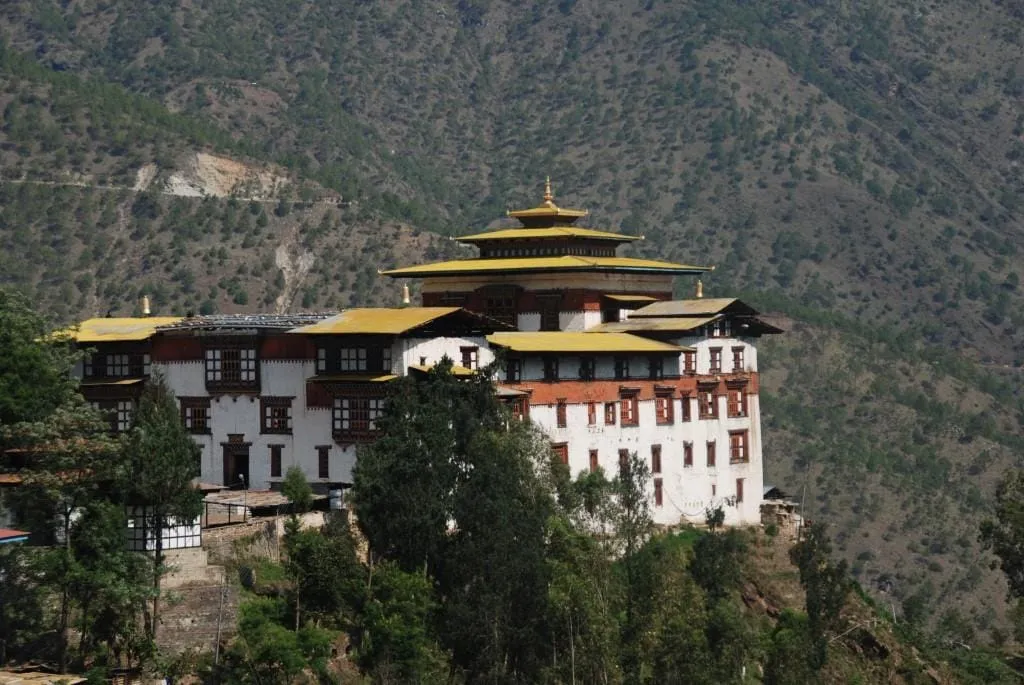
Trashigang Dzong — the Fortress of the Auspicious Hill — stands on a spur with cliffs on three sides, above the confluence of the Drangme Chhu and the Gamri Chhu, a few minutes above the town. It is the seat of the district administration and of Trashigang’s monk body. Allow an hour to an hour and a half; entry is included in your tour.
What to look at
One courtyard. That is the thing here, and it is easy to walk past.
Most Bhutanese dzongs run two courtyards, one for the administration and one for the monks — Punakha, Paro and Thimphu all separate them. At Trashigang the district offices and the dratshang face the same space. After four dzongs elsewhere in the country you will notice it immediately, and it is the detail worth carrying east with you.
Then the position. Three sides of this spur fall away. A fortress built in 1659 to hold the east did not choose that ground for the view, though the view is what you get: the two rivers meeting below and the hills of the far east behind them.
Who built it, and when
1659, by Trongsa Penlop Chhogyal Minjur Tenpa, on the order of Zhabdrung Ngawang Namgyal — who, in the dzongkhag’s own telling, prophesied its construction and sent Minjur Tenpa east to subdue the local chieftains first.
It grew twice after that: Gyalsey Tenzin Rabgye expanded it between 1680 and 1694, and Dzongpon Dopola expanded it again in 1936.
The same Minjur Tenpa is credited with Gom Kora in the same century. Two of the three things people come east for, one man.
The part our page used to leave out
This building was nearly lost. It went under renovation from around 2007, and by October 2011 was being reported as on the verge of collapse; the full works are reported complete in 2019.
Those dates come from published accounts rather than from the dzongkhag’s own history page, so we give them as reported. But it is the wrong thing to omit from a page about a 367-year-old fortress: what you walk into is a rescued building, and that is a better fact than any superlative about its size.
The tshechu
Trashigang Tshechu, 18–20 November 2026 and 7–9 December 2027, in the dzong.
The dances are the dances. What makes this one worth planning around is that the Brokpas of Merak and Sakteng come down for it, in the yak-hair and the spider-legged hats, out of the highlands and into the courtyard. The Trashigang Festival tour is built around it.
Dates move with the lunar calendar — see the festival calendar.
Visiting
Shoulders and knees covered, long sleeves. A working dzong is stricter than a village temple and the guards enforce it. Courtyards can be photographed; interiors cannot.
There is a road to the gate and then steps and high thresholds — dzongs are not built for step-free access and this one is on a cliff.
Nobody publishes opening hours, because it is an office as much as a monument, and what a visitor may see varies. Ask us and we will find out for the day you are there.
See things to do in Trashigang for how it fits the rest of the district.
Tours that visit Trashigang


Frequently asked questions
When was Trashigang Dzong built?
1659, by Trongsa Penlop Chhogyal Minjur Tenpa on the order of Zhabdrung Ngawang Namgyal, who is said to have prophesied it. It was enlarged by Gyalsey Tenzin Rabgye between 1680 and 1694 and again by Dzongpon Dopola in 1936.
What makes Trashigang Dzong unusual?
The administration and the monk body share one courtyard. Most dzongs separate them into two — Punakha, Paro and Thimphu all do. Here the district offices and the dratshang open onto the same space.
Why is it built where it is?
Because of the ground. It stands on a spur with cliffs on three sides, above the confluence of the Drangme Chhu and the Gamri Chhu, with one approach — it was built to hold the east against incursion from Tibet, and the position is the whole argument.
Was Trashigang Dzong restored?
Yes. It went under renovation from around 2007, was reported in 2011 to be close to collapse, and the works are reported complete in 2019. Those dates come from published accounts rather than from the dzongkhag's own history, so treat them as approximate — but the building you walk into is a restored one.
When is Trashigang Tshechu?
18–20 November 2026 and 7–9 December 2027, in the dzong. The reason to time a trip for it is that the Brokpas of Merak and Sakteng come down for it in full dress. See the festival calendar and the Trashigang Festival tour.
Tailor-made travel
Begin your journey to the Last Shangri-La
Every Little Bhutan itinerary is private and tailor-made. Tell us what draws you to Bhutan — festivals, treks, monasteries, food — and we will design the journey around it.