
Chorten Kora
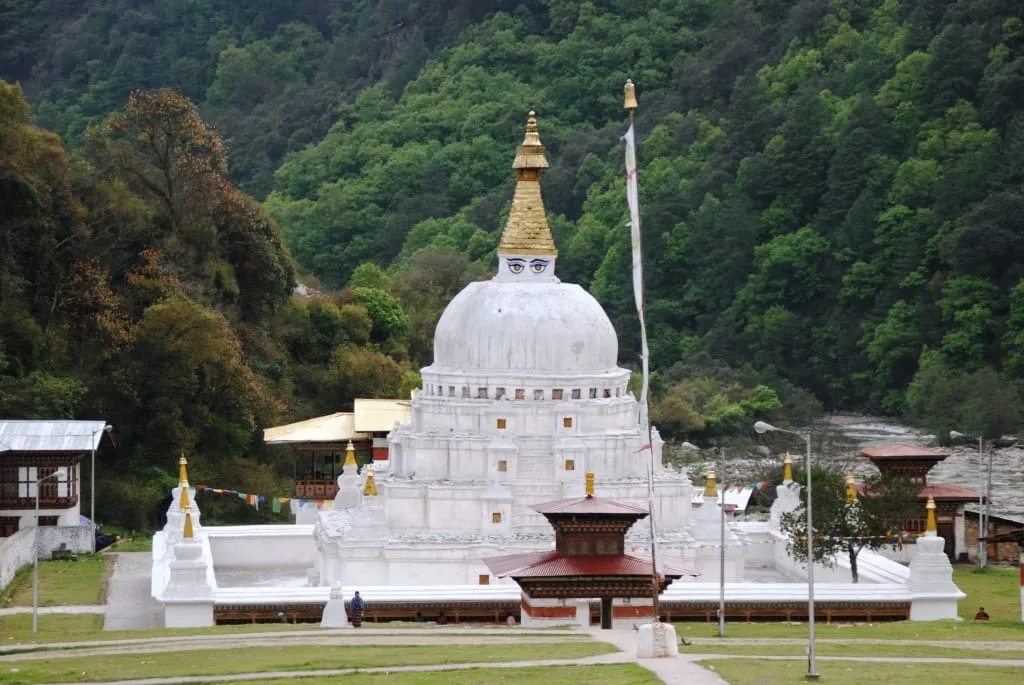
Chorten Kora is a whitewashed stupa on the riverbank below Trashi Yangtse town, built as a copy of Boudhanath in Kathmandu and walked twice a year — once by pilgrims who cross the border from India. Allow 45 minutes to an hour, and walk the circuit rather than stand and look at it.
What is there to see?
A big white dome with eyes painted at the four cardinal points, sitting on a flat shelf of ground beside the Kholong Chhu, three minutes below the town. If you have seen a photograph of Boudhanath you will recognise it immediately, which is the oddest thing about standing here: it looks like it belongs three countries away.
The name is an instruction. Kora is circumambulation, and the point of the place is the walk around it — clockwise, at the pace of the people already doing it. A lap takes a few minutes; go round more than once, because one feels abrupt.
Look for the old stone pinnacle on the ground beside the stupa. When the sixth lama of Rigsum Goenpa replaced it with a gilded one, the stone is said to have been lowered by dakinis rather than lifted down by workmen — and walking round the stone, people here will tell you, earns the same merit as walking round the chorten itself. It is a real object with a story attached, which is a fair description of the whole site.
When is the Kora, and what happens?
Twice a year, a fortnight apart, both in the first Bhutanese month — which lands in February or March.
- Dakpa Kora, on the 15th day. This is the one that makes Chorten Kora unusual: the Dakpa community come over from Tawang, in Arunachal Pradesh, to walk it. It is one of very few genuinely cross-border festivals in Bhutan — another is the tshechu at Gom Kora, down the same road.
- Drukpa Kora, also called Namgang Kora, on the 30th day — the Bhutanese one.
The 30th is not an arbitrary date. The stupa was consecrated on the 30th day of the first month, by the thirteenth Je Khenpo, and the Bhutanese kora has been walked on that anniversary ever since.
The dates shift every year with the lunar calendar, so we do not print them here — the festival calendar carries the current ones.
Who was the girl from Tawang?
The story everyone tells is that a girl from Tawang was walled into the stupa while it was being built, and stayed there to meditate on behalf of all beings.
The versions differ, and they differ in ways worth knowing before someone tells you one of them. The district administration’s own website gives her age as eight on one page and sixteen on another; in one telling she was offered by her people, in another she simply walked in and disappeared as the vase of the stupa was closed. Much of the internet calls her a princess. The district’s own pages do not.
What all of it agrees on is where she came from — and that is the part that still has consequences, because her people cross the border every year to walk round her.
Getting there, and what else is nearby
Chorten Kora is 53 km and about two hours from Trashigang, which is how almost everyone arrives — Trashi Yangtse is a day excursion on our own eastern itinerary. The road runs through Doksum and past Gom Kora, and the two make an obvious pair on one day: same road, same kind of story, both walked rather than entered.
The Zorig Chusum crafts college is 700 metres away, and the district’s two dzongs are within three kilometres. See things to do in Trashi Yangtse for how it all compares.
Who built it, and when?
Lam Ngawang Loday, the third lama of Rigsum Goenpa, built it over twelve years from about 1740 — to subdue demons, at the request of the people living along the Kholong Chhu.
He modelled it on Boudhanath — and the district’s own account of how is the best line anyone has about this stupa. He carved the model out of a radish and carried it home over the mountains. The radish shrank on the way. That, the dzongkhag says, is why Chorten Kora and the stupa it copies are not quite the same shape.
Tours that visit Trashi Yangtse
Frequently asked questions
When is the Chorten Kora festival?
There are two, a fortnight apart, both in the first Bhutanese month — usually February or March. The Dakpa Kora falls on the 15th day and is walked by the Dakpa people who cross from Tawang in Arunachal Pradesh; the Drukpa Kora, also called Namgang Kora, falls on the 30th and is the Bhutanese one. See the festival calendar for this year's dates — they move with the lunar calendar.
Why does Chorten Kora look Nepalese?
Because it is a deliberate copy. Lam Ngawang Loday modelled it on the Boudhanath stupa in Kathmandu, and the district's own account is that he carried the model home carved out of a radish — which shrank on the journey, and is why the two are not identical.
Who is inside Chorten Kora?
A girl from Tawang, walled into the stupa while it was being built. The versions differ — the district administration's own website gives her age as eight on one page and sixteen on another, and disagrees with itself over whether she was offered or went in willingly. What everyone agrees on is that she came from over the border, which is why her people still cross to walk round it.
How long do you need at Chorten Kora?
45 minutes to an hour. It is a flat riverbank site three minutes below Trashi Yangtse town, and the point of it is to walk the circuit rather than stand and look — kora means the walk around.
Tailor-made travel
Begin your journey to the Last Shangri-La
Every Little Bhutan itinerary is private and tailor-made. Tell us what draws you to Bhutan — festivals, treks, monasteries, food — and we will design the journey around it.