
Kuenga Rabten Palace
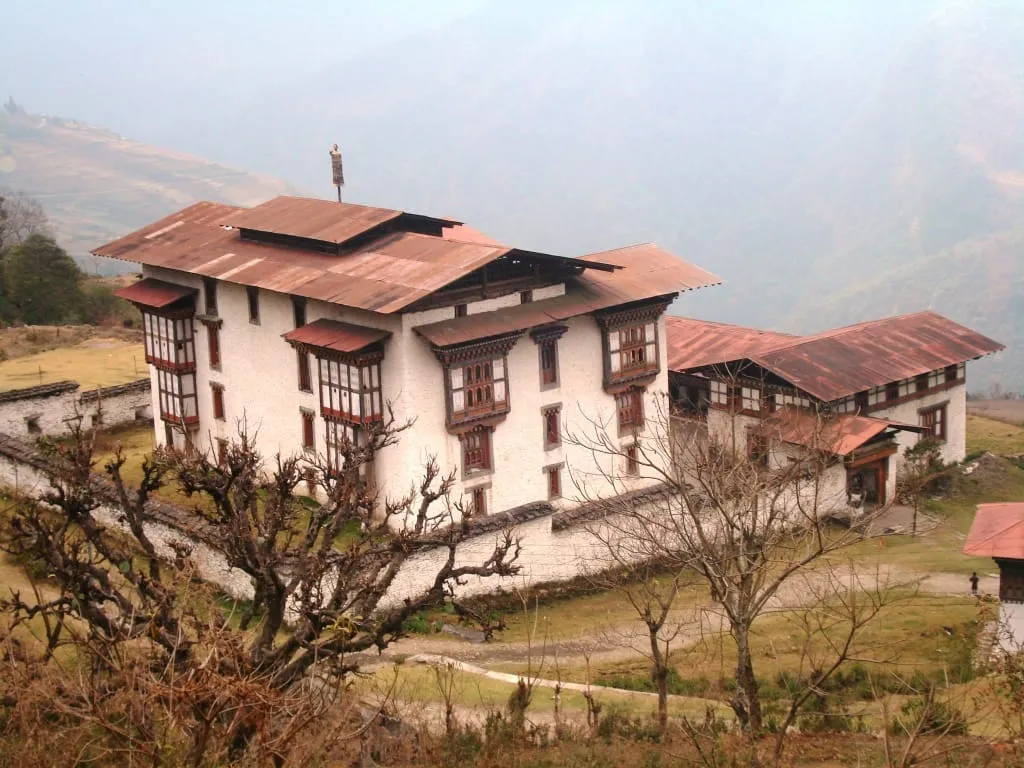
Kuenga Rabten was the winter residence of Bhutan’s second King, 23 km south of Trongsa down the Zhemgang road. Allow half a day with the drive — about an hour each way through rice meadows and past waterfalls, on one of the better roads in central Bhutan.
Why is the royal winter house down here?
Because it is warm. Trongsa town sits near 2,120 m on its ridge; the palace is near 1,790 m, three hundred and thirty metres further down into the Mangde Chhu valley. The second King, Jigme Wangchuck, ruled the country from the dzong above and came down here for the cold months with his senior Queen, Ashi Phuntsho Choden.
Our own photograph of the palace was taken in winter, and it shows the point: bare fruit trees, dry grass, haze on the far side of the valley, and not a flake of snow.
Who built it, and when?
1929, under the supervision of Dasho Jamyang, lord of the Chumey valley in Bumthang — who was also the Queen’s father. It is a white three-storey house on a shelf of hillside, and its form is domestic rather than defensive, which is the difference between a palace and a dzong.
What is it now?
A monastery, in effect. It is looked after and lived in by monks of the central monastic body in Trongsa — around fifty of them, two of whom are teachers.
That matters more than it sounds. It is a working building with a resident community rather than a monument arranged for visitors, and what a visitor sees depends on the day and on what the monks are doing. Nobody publishes opening hours. Ask us before you set off rather than at the gate.
We are also not going to list what is in the rooms. Several accounts describe statues, paintings and a library in identical words and none of them says where the description came from — and the one item in it that can be checked against the record is misnamed. When our guides confirm what is actually there, it goes on this page.
Is it the third King’s birthplace?
No. That is Thruepang Palace, up in Trongsa town — still a royal residence, and not somewhere we can take you.
The confusion is worth a sentence because you will meet it: the same pages that call Kuenga Rabten his birthplace also date the palace to 1929 and his birth to the year before. A house cannot be the birthplace of someone born before it was built.
Getting there
23 km south of Trongsa on the road to Zhemgang, about an hour each way. It is a real excursion rather than a stop — our own eastern itinerary picks it up on the way down toward Zhemgang, which is the efficient way to do it if your route runs that way.
If you are only in Trongsa for a day, the dzong and the Royal Heritage Museum come first. See things to do in Trongsa for how the district fits together.
Tours that visit Trongsa


Frequently asked questions
What is Kuenga Rabten Palace?
The winter residence of Bhutan's second King, Jigme Wangchuck, and of his senior Queen, Ashi Phuntsho Choden. It was built in 1929 under the supervision of Dasho Jamyang, lord of the Chumey valley in Bumthang and the Queen's father. It is 23 km south of Trongsa, down in the Mangde Chhu valley.
Why did the King winter here rather than in Trongsa?
Because it is about 330 metres lower. Trongsa town sits near 2,120 m and the palace near 1,790 m, down where the valley is warmer. Our own photograph of it was taken in winter — bare fruit trees, dry grass, and the air still soft.
Who lives in the palace now?
Monks of the central monastic body in Trongsa — around fifty of them, including two teachers. It is a lived-in building rather than a museum, which is worth knowing before you arrive: what a visitor sees depends on the day, and nobody publishes hours.
Was the third King born at Kuenga Rabten?
No — he was born at Thruepang Palace in Trongsa town. You will see Kuenga Rabten named as his birthplace, but the same sources date this palace to 1929 and his birth to the year before, which cannot both be true. Thruepang is still a royal residence — the present King's winter palace — and we do not take guests in.
Tailor-made travel
Begin your journey to the Last Shangri-La
Every Little Bhutan itinerary is private and tailor-made. Tell us what draws you to Bhutan — festivals, treks, monasteries, food — and we will design the journey around it.