
Things to do in Trongsa
Trongsa is where the Bhutanese monarchy comes from. Every King of Bhutan has held the title of Trongsa Penlop before taking the throne, and the first two ruled the country from the dzong here. It is a small town on a ridge above the Mangde Chhu, looking across at the Black Mountains, and the geographic centre of Bhutan falls inside this district.
The dzong and the museum above it are one of the best half-days in the country. Everything else here is either on the drive in or a separate excursion — see the table.
Things to do in Trongsa, compared
| Attraction | Time needed | Legwork | Best season |
|---|---|---|---|
| Trongsa Dzong | 1.5–2 hrs | The largest dzong in Bhutan — levels, long stone stairs and narrow corridors down a ridge | Dec or Jan for the tshechu; Mar–May, Sep–Nov |
| Tower of Trongsa (Royal Heritage Museum) | 1.5–2 hrs | A converted watchtower 130 m above the dzong — stairs between galleries | Year-round; Mon–Fri, plus Saturdays only in Mar–May and Oct–Dec; closed public holidays |
| Chendebji Chorten | 20–30 mins | Roadside stop 41 km west, below Pele La — flat ground, a short uneven circuit | Year-round |
| Willing Waterfall | 20–30 mins | Roadside stop 5 km west of town — flat, a few steps through a garden | Year-round; fullest Jun–Aug |
| Kuenga Rabten Palace | Half a day with the drive | 23 km south, about an hour each way; stairs inside a lived-in building | Mar–May, Sep–Nov |
Entrance fees are included in every tour we run, so there's no ticket window to queue at and no cash to carry at any of them. Two of these differ in a way worth knowing: the dzong is one of the sites the Department of Tourism names as charging nothing at all, while the museum in the tower above it does charge, on its own administration's authority.
What actually fits in a day?
Add the column up and it does not all fit. The dzong and the museum are four hours between them and belong together; Chendebji and Willing are both on the highway west, so you collect them on the way in without spending a day on them. Kuenga Rabten is a half-day excursion of its own — an hour down, an hour back — and it needs either a second day in Trongsa or a route that continues south toward Zhemgang, which is how our own eastern itinerary picks it up.
The dzong, and the museum above it
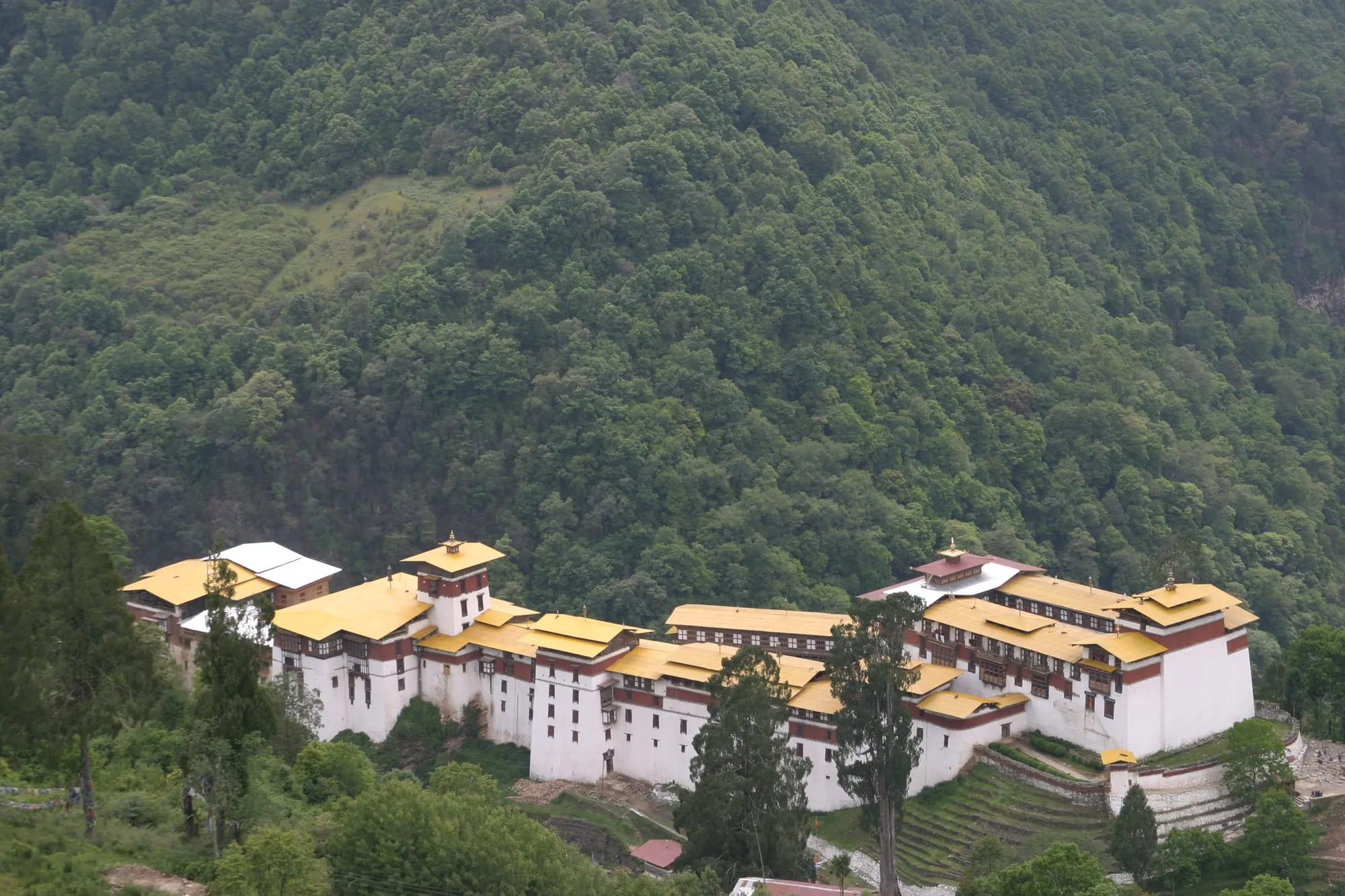
Trongsa Dzong is the largest dzong in Bhutan, running down a spur above the Mangde Chhu in a chain of courtyards rather than standing in one block.
Its position is the reason the monarchy exists. The old east–west route through the country ran straight through the building — the restored version of it, the Trans Bhutan Trail, still passes the dzong — so whoever held Trongsa held all traffic between the two halves of Bhutan. That is not a metaphor for how the monarchy started; it is the mechanism.
Sources give three founding years — 1644, 1647 and 1648 — and we do not pick one. What is agreed is the sequence: a temple here in 1543, the dzong in the 1640s, and an enlargement in 1652 by Chogyal Minjur Tempa, the first Trongsa Penlop.
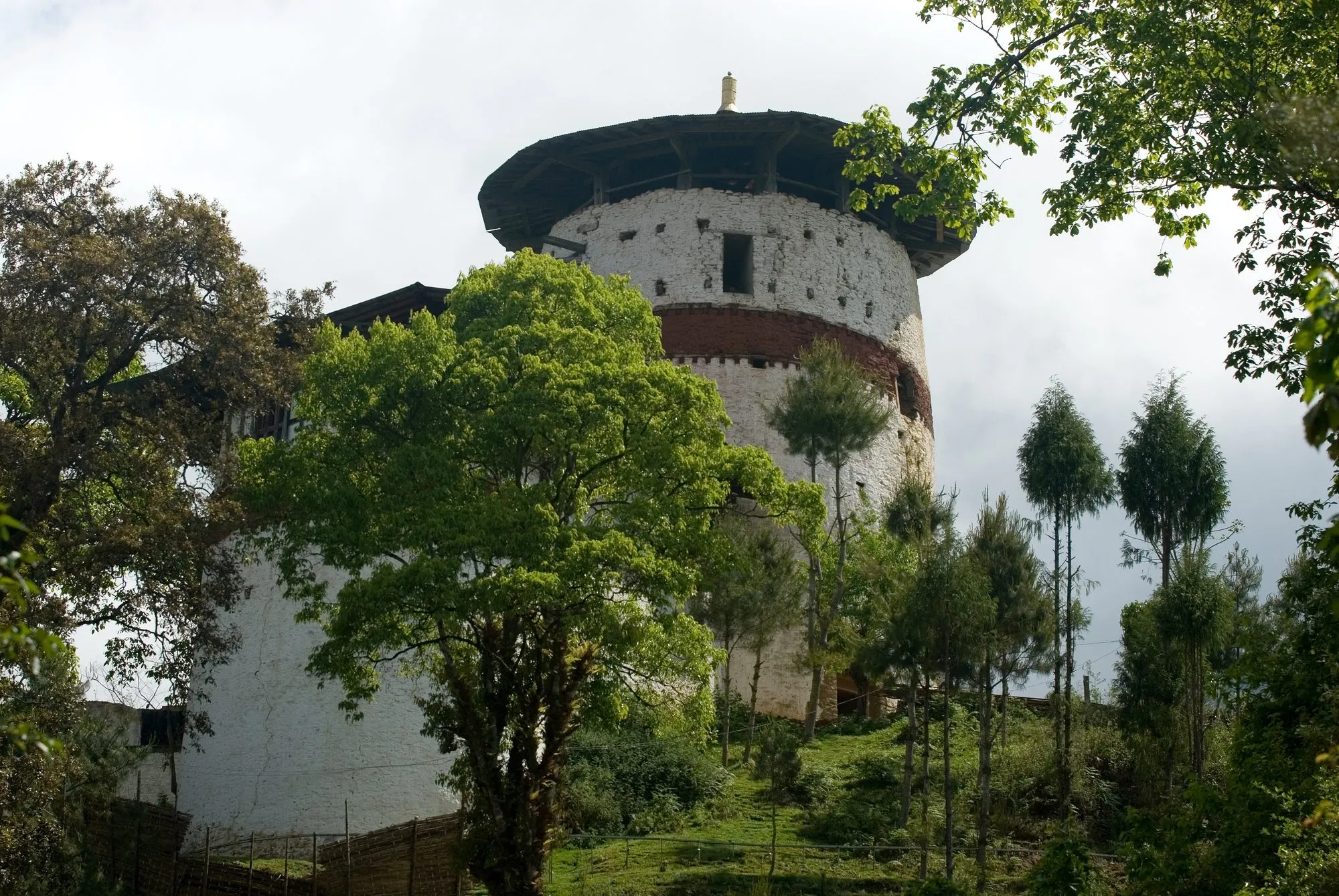
Above it stands the Ta Dzong, the watchtower Minjur Tempa built in the same year, now the Royal Heritage Museum — eleven galleries, two of them working temples, including the Raven Crown and the temple of Ling Gesar. It was restored with Austrian support and opened in 2008, and it publishes its own opening hours, which almost nothing in Bhutan does.
Do them in that order — dzong first, then the tower. The museum explains what you have just walked through, and the view down onto the dzong from the tower is the shot.
The rest of the district
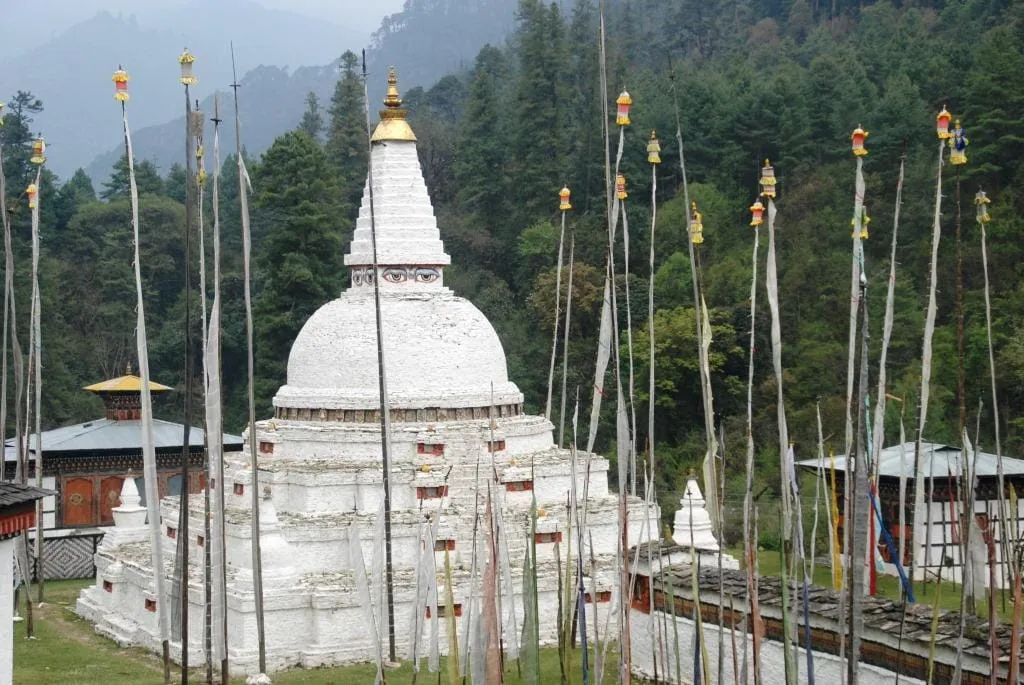
Chendebji Chorten stands beside the highway 41 km west, below Pele La — a whitewashed copy of Boudhanath in Kathmandu with eyes on all four sides, built in the 18th century over the remains of a subdued demon. It is one of two of its kind in Bhutan; the other is Chorten Kora at the far eastern end.
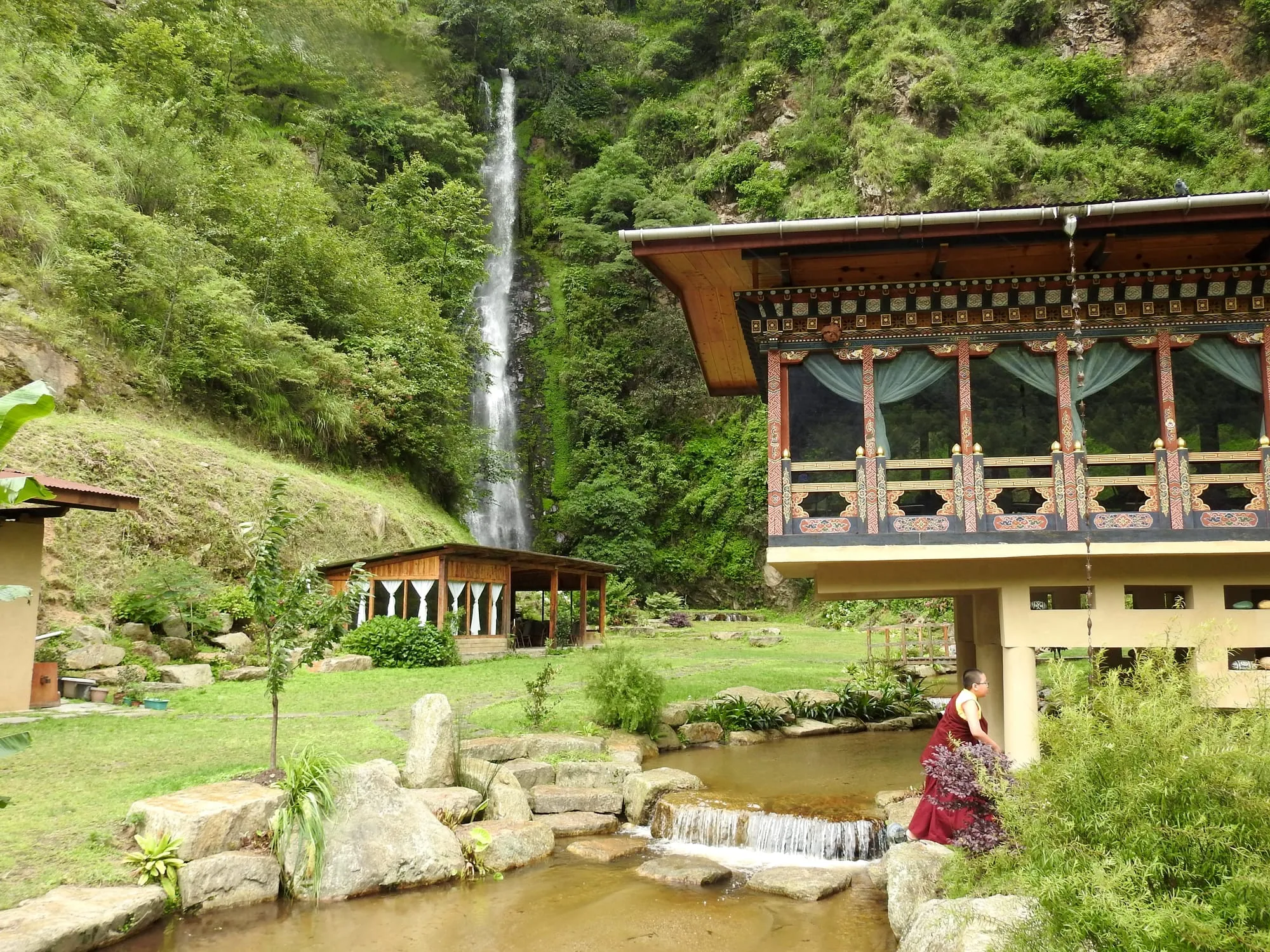
Willing Waterfall is on the same road, five kilometres out of town, with a café built at its foot on ground that was a stone quarry in the 1990s.
Kuenga Rabten was the second King's winter residence, 23 km south and some 330 m lower — which is the point of it. Built in 1929, it is lived in today by monks of the central monastic body, so what a visitor sees depends on the day. Thruepang Palace, where the third King was born, is up in Trongsa town — it is still a royal residence, the present King's winter palace, and we do not take guests in.
Most of this district is not any of that, though. The dzongkhag covers 1,807 km² across five gewogs — Dragteng, Korphu, Langthil, Nubi and Tangsibji — running from about 800 m to over 4,800 m, with 19,960 people at the 2017 census. Jigme Singye Wangchuck National Park — 1,730 km² across five dzongkhags — covers most of it, all of Korphu gewog included, and it is golden langur country. The low-altitude Nabji–Korphu trail runs through six villages inside the park.
When to come
March to May and September to November for the driving and the light.
December or January for the Trongsa Tshechu, five days of dances in the dzong's northern courtyard ending with the unfurling of a thongdrol. It moves with the lunar calendar and can land on either side of the new year, so check the dates rather than the month — our festival calendar carries 17–21 December 2026; ask us for the year you are planning.
Trongsa keeps a fuller festival calendar than districts many times its size: Lhamoi Dromchhen in February, Goenpai Drupchen in late autumn, the Nabji Lhakhang Drup in late December or January, and the Chendebji Tshechu at the chorten. All of them move with the lunar calendar, so check the dates rather than the months.
Getting here
Trongsa sits in the middle of the country, on the east–west highway that almost everyone arrives by; a second road runs south to Zhemgang past Kuenga Rabten, which is how our own eastern itinerary leaves. Our own driving table gives Punakha → Trongsa 141 km and four to four and a half hours, and Trongsa → Bumthang 67 km and two to two and a half hours; from Thimphu it is a full day. See getting to Bhutan for the rest of the road distances.
Attractions in Trongsa
Tailor-made travel
Begin your journey to the Last Shangri-La
Every Little Bhutan itinerary is private and tailor-made. Tell us what draws you to Bhutan — festivals, treks, monasteries, food — and we will design the journey around it.