
Chendebji Chorten
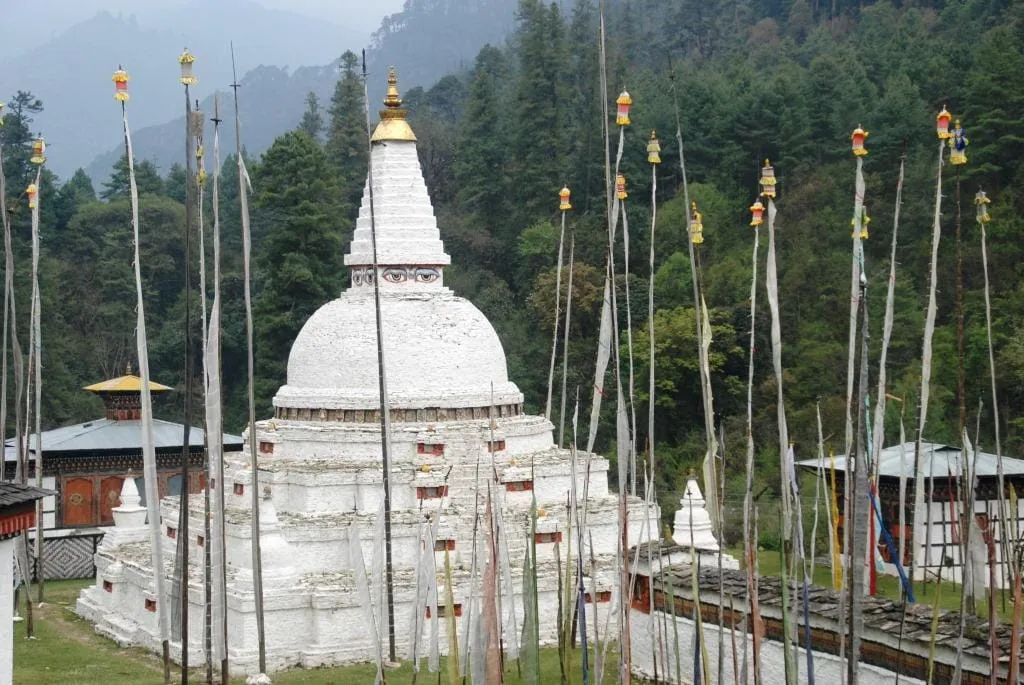
Chendebji Chorten stands beside the highway 41 km west of Trongsa, at about 2,430 m, and it is the reason the drive in from Wangdue has a stop in it. Twenty minutes to half an hour does it: walk the circuit clockwise, look at the mani wall, get back in the car.
Why does it look wrong for Bhutan?
Because it is not Bhutanese in form. It was built in the style of Boudhanath in Kathmandu — a whitewashed dome under a golden spire, with eyes painted on all four sides. If you have seen a photograph of Boudhanath you will recognise it at once, standing among Bhutanese prayer-flag poles in a Bhutanese forest.
There is exactly one other like it in the country, and it is a long way east: Chorten Kora on a riverbank in Trashi Yangtse, near the Indian border. Two Nepalese stupas — this one in the middle of Bhutan, that one at its eastern edge — and both were built over something that had to be put down.
What is it built over?
The remains of a demon. The Trongsa district administration says the chorten stands on the spot where the head of a powerful demon was buried; other accounts say the stupa covers the body. We are not going to choose for you. The demon has a name — Ngala — and subduing it is the reason there is a building here rather than a bend in the road.
Who built it?
A Tibetan master, in the 18th century. You will see the chorten credited to Lama Shida and you will see it credited to Lam Oensey Tshering Wangchuk; the district’s own account is that those are two names for the same man. No source gives a year, only the century, so neither do we.
It stands on the Chorten Lam, the route that links chortens across Bhutan, and there is a mani wall in the complex — the long low wall of carved stones you keep on your right as you walk.
Where does it fall on the drive?
On the Wangdue–Trongsa highway, west of the town — so you reach it before Trongsa if you are coming from Punakha or Phobjikha, and it is the last thing you see if you are heading back west.
You will have crossed Pele La shortly before it, the pass at about 3,420 m that our own itineraries call the traditional boundary between east and west. On some of them the chorten is where lunch happens.
Coming the other way, from Trongsa, everything else in the district is closer: the dzong and the Royal Heritage Museum are in town, and Willing Waterfall is on this same road, about five kilometres out of it.
Is there a festival here?
Yes — the Chendebji Tshechu, held on the 21st to 25th day of the ninth Bhutanese lunar month. It is on the district administration’s own list and it is not yet on our festival calendar, so ask us if the timing interests you.
See things to do in Trongsa for the rest of the district.
Tours that visit Trongsa


Frequently asked questions
Why does Chendebji Chorten look Nepalese?
Because it is. It was built in the style of Boudhanath in Kathmandu — whitewashed dome, golden spire, and eyes painted on all four sides. It is one of two of its kind in Bhutan: the other is Chorten Kora, on a riverbank near the eastern border. One in the middle of the country and one at the eastern edge of it, both built over something subdued.
Who built Chendebji Chorten, and when?
In the 18th century, by a Tibetan master known both as Lama Shida and as Lam Oensey Tshering Wangchuk — the Trongsa district administration's own account is that these are two names for the same man, which is why you will see the chorten credited to either. No year is published, only the century.
What is it built over?
The remains of a demon subdued on this spot. Accounts differ on whether what is buried here is the head or the whole body, so we will not tell you which. The demon is named Ngala.
How long do you need at Chendebji Chorten?
Twenty minutes to half an hour — enough to walk the circuit clockwise, look at the mani wall in the complex and stretch your legs. It is a roadside stop, and a good one, on a drive that badly needs them.
Tailor-made travel
Begin your journey to the Last Shangri-La
Every Little Bhutan itinerary is private and tailor-made. Tell us what draws you to Bhutan — festivals, treks, monasteries, food — and we will design the journey around it.