Bomena: What Bhutan's 'Night Hunting' Really Was

Writing about Bhutan from outside reliably arrives at “night hunting”, a phrase that has kept the country’s rural courtship custom in circulation as travel-listicle exotica for twenty years. It is also a poor translation. In Wamling, a village in Zhemgang, the word is bomena — literally “going towards a girl”: no hunter in it, and no prey. The Bhutanese anthropologist Dorji Penjore, who did fieldwork there in 2007 and published the resulting study in Asian and African Area Studies, calls the English name “ethnocentrically and ignorantly translated”. The custom carries different names in different Bhutanese languages — among the Sharchops of eastern Bhutan, where it was most widespread, it is yamlang, “going out as young men” — and was practised across rural eastern and central Bhutan rather than in one district. The historian Karma Phuntsho, writing for the Bhutan Cultural Library, makes the same point about the English name: it smuggles in an exploitation and animality that none of the original words carry.
What bomena actually was
A boy walks after dark to a girl’s house and lets himself in — through the door, or through a window whose timber shutter latches only from the inside. What follows, in Penjore’s account, is not a raid but a negotiation: the boy initiates the visit, and whether it goes anywhere mostly rests with the girl. Acceptance and refusal both had recognised forms, and refusals were understood as refusals. First visits could take a long persuasion, and boys who oversold themselves to get through it gave Bhutanese its proverb about suitors “promising even the whole estate at night”.
Courtship ran on indirect signals — teasing, joking, a held stare — and, in older generations, on tsangmo, the four-line verses a couple traded, where the verse that came back told you the answer. Penjore doesn’t romanticise it: bomena was also simply how a village without any other outlet handled sex and recreation. But when it was aimed at finding a spouse, the process could run for the better part of a year.
Why a village needed it
Wamling had no cafés, no cinema and no such thing as a date. It also had a chronic shortage of working hands, having lost people to migration. Bhutanese custom divides inheritance between sons and daughters, and villages placed a high value on marrying within the village: a local marriage kept land, labour and the next generation in place. Bomena gave young people a limited say in who they married without requiring anyone to leave. Elaborate weddings were beyond the means of a village like Wamling; bomena was also the cheapest route to a household there was.
Similar customs existed elsewhere — Japan’s yobai is a well-documented parallel, and Phuntsho notes the practice in parts of Tibet too — and faded for much the same reasons.
The house made it possible
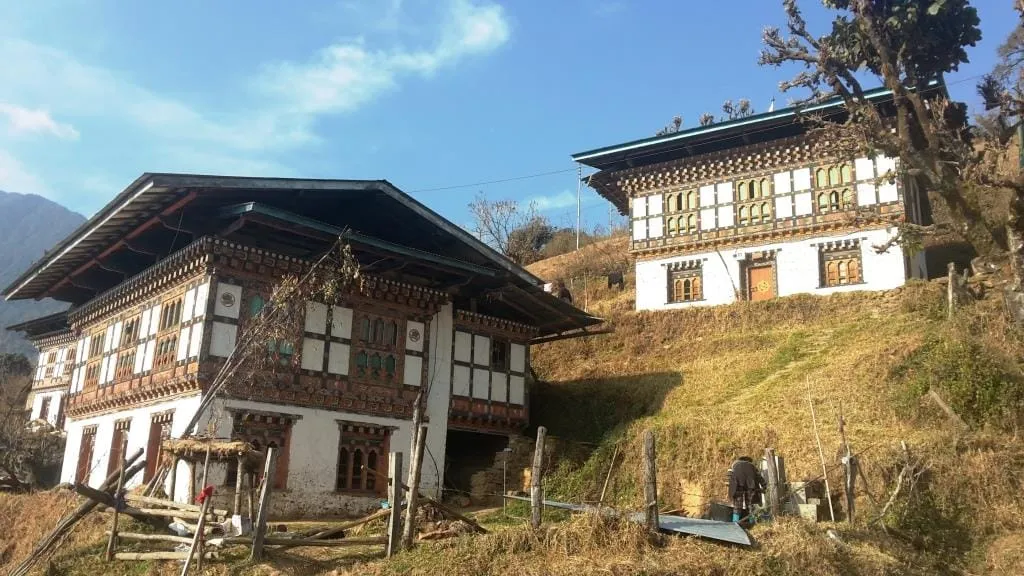
The traditional farmhouse put livestock on the ground floor and the family above, often sleeping in one shared room, behind sliding timber shutters held by a wooden latch on the inside. Nothing in the building was designed to give one person privacy from another: a house was built to hold a household. Getting in was a matter of quiet feet, not force — and a wrong step woke everyone, which is how most of the stories about bomena end.
How a night became a marriage
The village recognised jai do jong, “coming to the surface”: a couple found together in the morning were from that point husband and wife. Parents were not simply asleep through all this. They could speed a liaison along, slow it down or end it, weighing the boy’s family, land and the question of keeping the marriage local — and in a settlement of a few dozen households, nobody was anonymous. Some parents pretended to sleep precisely because they approved of the visitor.
Where the custom stands now
Its frequency has fallen sharply. Roads, mobile phones, boarding schools and wage work in the towns did most of the work; awareness of the marriage laws and sharper parental vigilance did the rest. The houses themselves retired the custom too — metal doors and fixed window latches replaced the wooden shutters, and electric light means a parent can end a visit with a switch. Penjore also notes a quieter cause — bomena came to mark a rural, farming identity that young Bhutanese were no longer keen to claim.
The law leaves no ambiguity, and never treated the custom as a licence. Entering a house uninvited is trespass, sex without consent is rape, and the age of consent is 18. A father owes maintenance for a child regardless of marriage: the Marriage Act of 1980 sets sothue at twenty percent of monthly income per child, capped at forty percent in total, as the judiciary’s guideline sets out (section Kha 7.3.1). And the sharpest criticism of bomena has long been Bhutanese, not foreign: urban commentators, government agencies and NGOs have condemned it as gender discrimination and a driver of teenage pregnancy and single motherhood. Penjore’s answer is twofold — those harms attach to any courtship institution, urban ones included, and the real abuses came when men from outside the village, answerable to no one in it, treated the custom as permission. Phuntsho is more specific about who those men were: officials on rural postings in the late twentieth century, who had girls brought to them by coercion or false promises and called it tradition — leaving behind single mothers, and children who under Bhutanese law struggle to establish citizenship without a registered father.
Why the translation matters
“Night hunting” gets two things wrong at once. It flattens a courtship institution — one that carried the work of dating, engagement and wedding in a place that had none of them — into a joke about prowling men. And in the same move it files the cases where consent was absent under the heading of tradition, which is exactly where they do not belong. Bhutanese writers have spent years correcting both errors. If you want the custom in one phrase, the village’s own will do: going towards a girl — and finding out what she says.
Bomena belongs to a rural Bhutan that is passing quickly, and it is better understood as part of how villages made marriages and households than as a curiosity about the dark.


