
Wangduechhoeling Palace
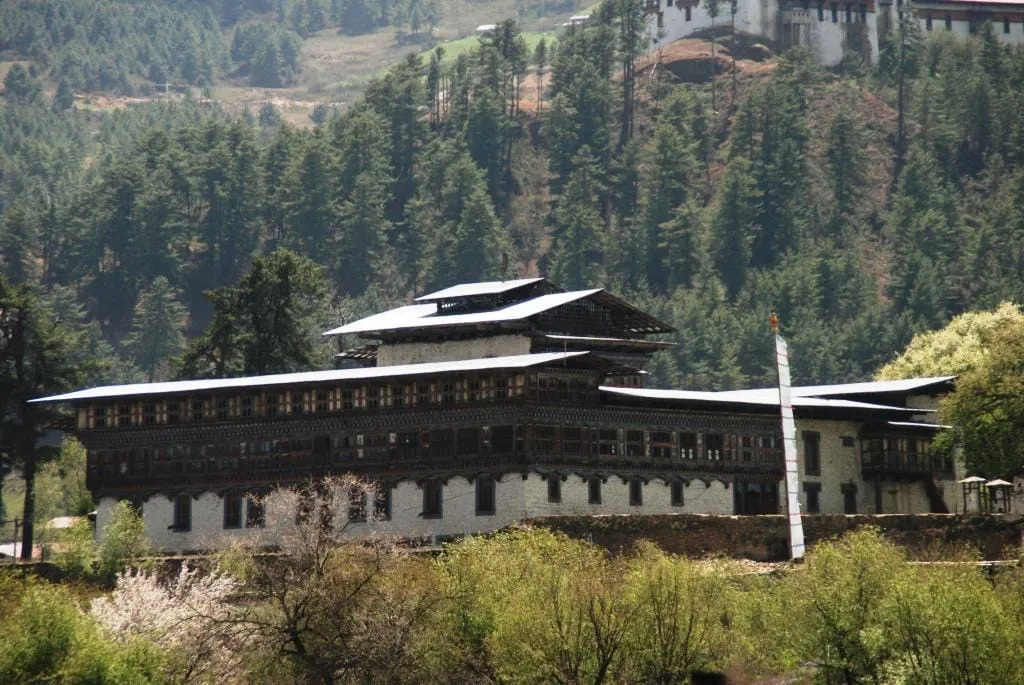
Wangduechhoeling is the palace Trongsa Penlop Jigme Namgyel built in 1857 in the Chamkhar valley, and the house where his son Ugyen Wangchuck — Bhutan’s first King — was born in 1862. After a twelve-year restoration it reopened as a museum with 27 gallery rooms, consecrated in October 2024. Allow an hour to an hour and a half. Ask us before you plan a day around it: nobody publishes its opening hours.
Why this building is different from everything else in Bhutan
Every great building in Bhutan before this one was a fortress. Dzongs are magnificent and they are also military architecture — walls that lean inward, courtyards that can be sealed, water supplies that survive a siege.
Wangduechhoeling was the first major structure in Bhutan designed as a residence. Not a dzong with rooms in it: a house, on the flat, surrounded by fields, with windows where a dzong would have had none. Jigme Namgyel built it as his final residence and he built it as a man who no longer expected to be attacked.
Fifty years later his son was crowned the first King of Bhutan, and the country he ruled had stopped being a place that needed fortresses. The building said so first.
What there is to see now
Twenty-seven gallery rooms, running through the palace as it was lived in. The restoration went to unusual lengths to keep the fabric rather than replace it — including replicating the mineral- and plant-based pigments the walls were originally painted with, rather than matching the colour in modern paint.
That is the thing worth knowing while you are inside. Most restored heritage in the Himalaya is rebuilt. This one was conserved, which is slower, more expensive and much harder to notice — and noticing it is most of the pleasure.
Twelve years is also a long time for a building this size, and the reason is the order the work was done in. The first phase was neither conservation nor construction: it was documenting what was there — measuring the building, recording the paintwork, researching how the rooms had been used — before anything was touched. The second phase was the physical conservation. Only in the third did anyone design a museum.
That sequence is unusual anywhere and it is close to unheard of in the Himalaya, where heritage work usually starts with scaffolding. It is why the galleries here can tell you what a room was for, rather than just what is in it now.
When to go, and how it fits your day
Year-round. It is indoors, and it is the one thing in Bumthang that does not care what the weather is doing.
It sits in Chamkhar directly below Jakar Dzong, so the two are a natural half-day: the dzong first for the light and the view, the palace afterwards. See things to do in Bumthang for how the rest of the district fits around them.
Ask us before you count on it. The museum opened to the public in 2025 and publishes no hours — its own website was still under construction when we last looked. That is a genuinely new institution finding its feet, not an oversight, and it is exactly the kind of thing an operator is for. Your guide checks; you do not drive across town on a guess.
A little history
Gongsa Jigme Namgyel — the Black Regent, Trongsa Penlop, the most formidable Bhutanese political figure of the nineteenth century — built Wangduechhoeling in 1857. His son Ugyen Wangchuck was born here in 1862 and was enthroned as Bhutan’s first King in 1907.
The court did not stay put. In winter it moved south to Kuenga Rabten in Trongsa, which is why that palace exists and why it is worth seeing if your route goes that way.
Restoration began in 2012 — twelve years, in three phases: architectural documentation and research first, then conservation, then the work of turning a house into a museum. It was led by the Bhutan Foundation with the Division for Conservation of Heritage Sites, working with the World Monuments Fund, Tsao & McKown Architects and the U.S. Ambassadors Fund for Cultural Preservation. Her Majesty the Queen attended the consecration on 30 October 2024.
If you have read elsewhere — including, until this update, on this website — that Wangduechhoeling is a monastic school, that was true before the restoration and it is not true now.
Tours that visit Bumthang


Frequently asked questions
Is Wangduechhoeling Palace open to visitors?
It reopened as a museum in 2025, after a twelve-year restoration, and it was consecrated on 30 October 2024. No opening hours are published anywhere — the museum's own website was still under construction when we last checked — so ask us and we will confirm before your day is planned around it.
Who built Wangduechhoeling Palace?
Gongsa Jigme Namgyel, the Trongsa Penlop and father of Bhutan's first King, built it in 1857 as his final residence. His son Ugyen Wangchuck, the first King, was born here in 1862.
Why does Wangduechhoeling matter?
It is the first major building in Bhutan designed as a residence rather than a fortress. Every great building in the country before it was a dzong — built to be defended. This one was built to be lived in, by the family that would become the monarchy fifty years later.
How long does the museum take?
Allow an hour to an hour and a half for the 27 gallery rooms. It sits in Chamkhar directly below Jakar Dzong, so the two make a comfortable half-day together.
Who restored the palace?
A project begun in 2012 by the Bhutan Foundation with the Division for Conservation of Heritage Sites, working with the World Monuments Fund, Tsao & McKown Architects and the U.S. Ambassadors Fund for Cultural Preservation — in three phases: documentation and research, conservation, then the museum itself.
Tailor-made travel
Begin your journey to the Last Shangri-La
Every Little Bhutan itinerary is private and tailor-made. Tell us what draws you to Bhutan — festivals, treks, monasteries, food — and we will design the journey around it.