
Dungtse Lhakhang
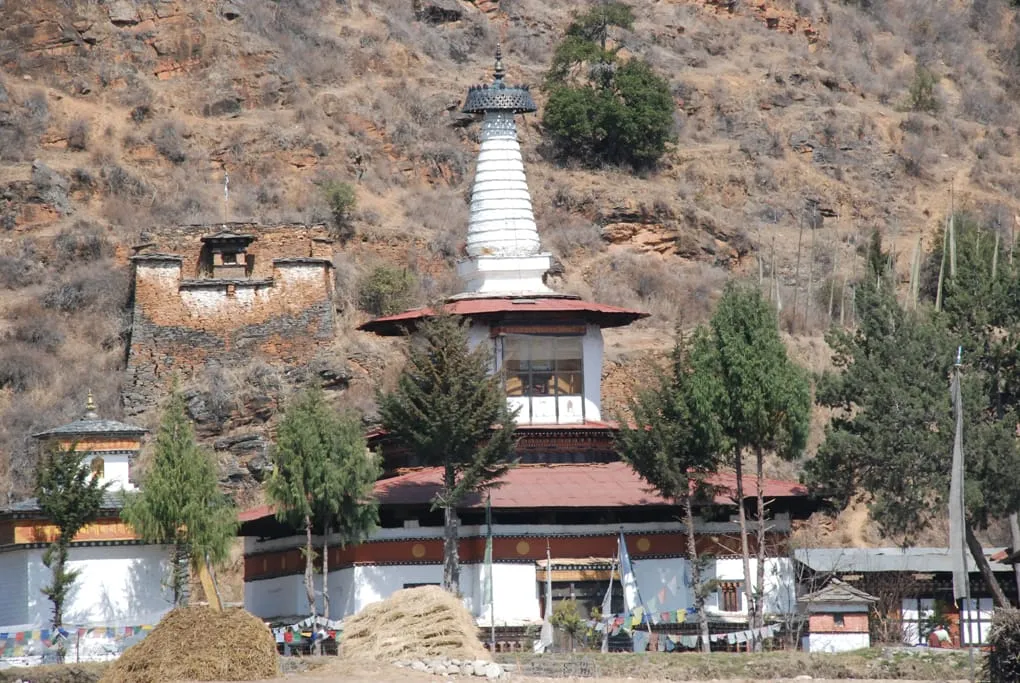
Dungtse Lhakhang — properly Jangtsa Dumtseg Lhakhang — is a temple built in the shape of a chorten, on a hillock across the Pa Chhu from Paro town. Three floors, steep internal stairs, and one of the most complete painting cycles in Bhutan. It is completely unlit inside: bring a torch. Allow 20–30 minutes; entry is included in your tour.
Why the shape matters
A chorten is a reliquary, not a building you go into — which makes a chorten you can climb rare in Bhutan and a little unnerving once you understand what it is for.
The three floors represent hell, earth and heaven, and they correspond to ascending levels of tantric initiation. You are meant to read the building upwards. The paintings on each level change accordingly, and the collection as a whole is described as rivalling anything in a Tibetan Buddhist monastery.
Underneath it, by tradition, is a demoness, causing illness among the valley’s people until this was built on her to subdue her. (A second account has the temple standing on a frog-shaped hill to counteract a sadag, an earth-owning spirit. Both are told; the demoness is the one you will hear on the day.)
Bring a torch — we are serious
There is no lighting inside. Not dim: none. The ground floor takes what comes through the door and the upper two levels are dark.
The paintings are the reason to come, and without a light you will climb three flights of steep stairs to see nothing at all. A phone torch does the job. Your guide will have one, but bring your own — three people sharing one beam in a stairwell is not a visit.
The stairs are steep and narrow, in the way that stairs inside a chorten have to be. There is no way round them.
Before you go
Ask us whether it is open. This is the one page in Paro where that sentence is doing real work: accounts split between simply walking in during daylight hours and finding a locked door with the key held by a caretaker nearby, and no official source publishes hours at all. A guide rings ahead; a guest who drives across the river on spec loses half an hour.
It is a few minutes from Paro town across the river, on the edge of the hill between the Paro and Dopshari valleys, which puts it naturally with Rinpung Dzong and the National Museum as an extension of a Paro town morning. See things to do in Paro for how everything compares.
A little history
Built by Thangtong Gyalpo (1385–1464), “Chagzampa”, the iron-bridge maker — the same figure behind Tachog Lhakhang down the valley, and the reason two of Paro’s temples are the work of a Tibetan blacksmith. Sources date it to 1421 or 1433; both are published and neither is settled, so: the 1420s or 1430s.
It was restored in 1841 by the 25th Je Khenpo, Sherab Gyaltshen, with the help of local villagers — whose names were carved into the tree-trunk columns, which is a better memorial than most donors get. The same Je Khenpo restored Kyichu Lhakhang up the road a few years earlier; between the two of them, the 1830s and 40s are why Paro’s oldest temples are still standing.
Tours that visit Paro


Frequently asked questions
Do you need a torch at Dungtse Lhakhang?
Yes. There is no lighting inside and the upper levels are pitch black — the paintings, which are the entire reason to come, are invisible without one. A phone torch is enough. This is the most useful thing anyone can tell you about this temple and almost nobody does.
Why is Dungtse Lhakhang shaped like a chorten?
Because it is one. A chorten-shaped temple is rare in Bhutan, and this form was built to immobilise what is underneath it. The three floors represent hell, earth and heaven, and correspond to successive levels of tantric initiation — so the building is meant to be read from the bottom up as you climb it.
Can you go inside Dungtse Lhakhang?
Ask us before you cross the river. Some accounts describe walking in during daylight, others a locked door and a caretaker with the key, and nothing official publishes hours. Your guide checks, which turns a wasted half-hour into a good one.
Is there an entry fee for Dungtse Lhakhang?
Yes, and it is recent enough that most fee tables online still miss it. The adult admission is Nu 500. Dungtse was recognised as a national monument after the Department of Tourism's March 2023 fee circular — which is why it does not appear on the "seven charging sites" list still copied across the web — and it began collecting at the start of 2026, taking Nu 750,000 from more than 1,500 visitors in its first four months. It is included in your tour, so there is nothing to pay at the gate. Child concessions are not published for Dungtse; ask us and we will check before you go.
Tailor-made travel
Begin your journey to the Last Shangri-La
Every Little Bhutan itinerary is private and tailor-made. Tell us what draws you to Bhutan — festivals, treks, monasteries, food — and we will design the journey around it.