
Phobjikha Valley

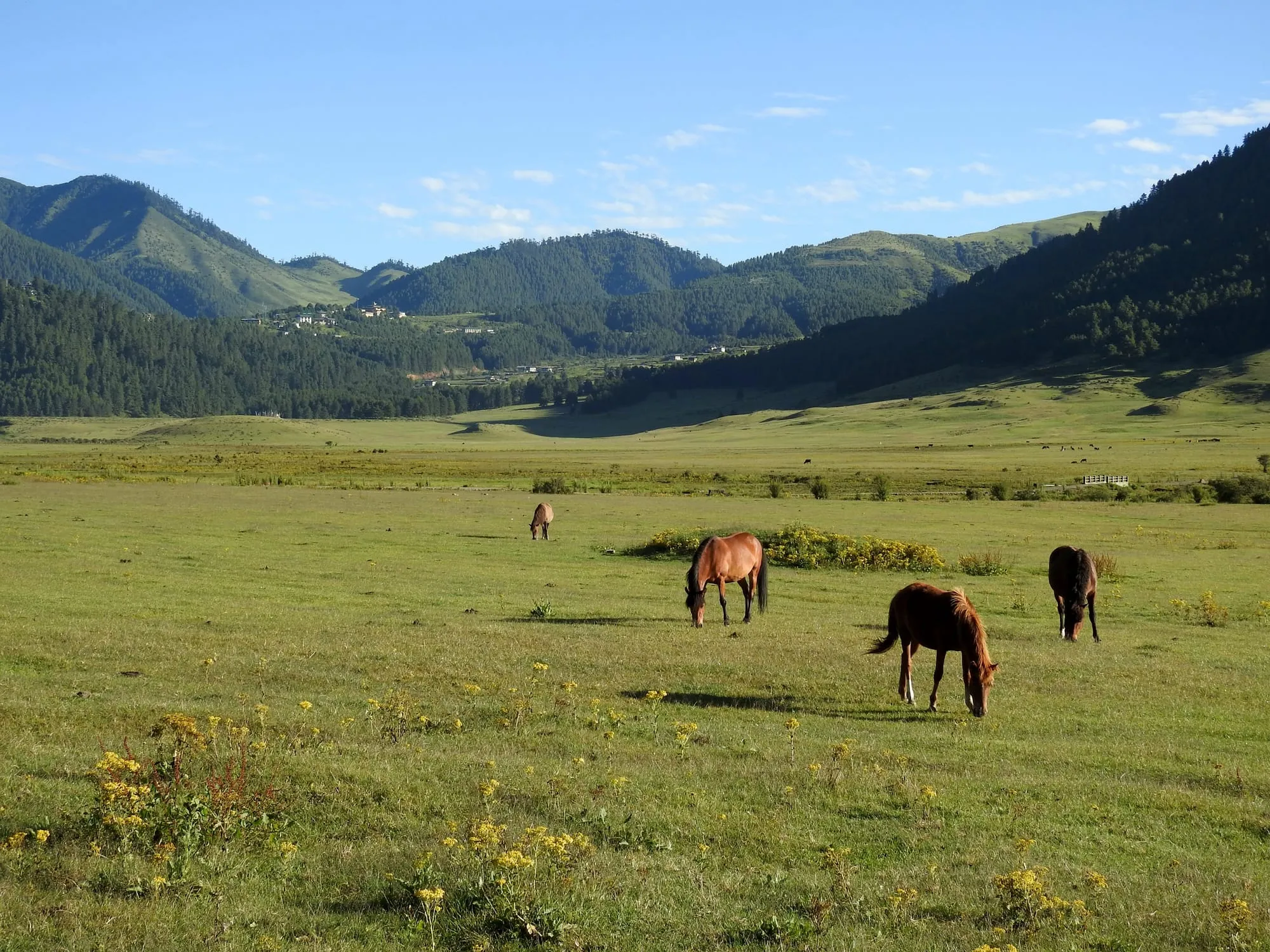
Phobjikha is a wide U-shaped glacial valley at 3,000 m in Wangdue Phodrang, and the main wintering ground of Bhutan’s black-necked cranes. The birds arrive in late October and leave in mid-February. Give the valley a full day, and two nights if you want to walk it.
When the cranes are here, and how many
The flock comes down from the Tibetan plateau in the last week of October and leaves in mid-February. On arrival, and again when they go, the cranes are recorded circling Gangtey Goenpa three times before settling on the marsh — a local observation, repeated for as long as anyone here has been watching.
640 cranes wintered in Phobjikha in 2024–25, including 75 juveniles, out of a record 709 across Bhutan. That is roughly double what most travel pages still quote, and it is the product of forty years of counting: the Royal Society for Protection of Nature has monitored the birds here since 1986, through a low of 255 nationally in 1991–92.
The number moves every winter, so any figure needs its season attached. Ask us for the current one — and for the honest window, which is narrower than the published one. Late October to mid-February is when birds are present; mid-November to mid-January is when they are reliably there in numbers.
Why the sky above the valley is empty
Electricity reached Phobjikha only in 2010, and every cable was buried.
Overhead transmission lines have never been permitted in this valley, because the cranes fly low across the floor at dawn and dusk and a wire is the thing that kills them. Until the underground connection was made, the valley ran on solar panels and diesel generators.
It is the detail that tells you what kind of place this is: the expensive option, taken in a farming district, for the sake of a bird. The payoff is visible the moment you arrive — a wide open valley with an unbroken skyline, which is a rarer sight than the cranes.
What there is to do here
The valley is the attraction; everything else is a way of being in it.
- Gangtey Goenpa on the spur at the north end, founded in 1613 and the seat of the Pema Lingpa lineage. It is the thing on the skyline from everywhere on the floor. Allow 1–1.5 hours.
- The Gangtey nature trail — about 4 km and an hour and a half, downhill from the goenpa to Khewang Lhakhang on the valley floor. It runs one way; the car meets you at the end.
- The Black-Necked Crane Information Centre, facing the roost, with telescopes indoors so that nobody has to walk out onto the marsh. Two flightless cranes live in its aviary year-round.
- Cycling the valley floor — 20–40 km of farm road with no traffic on it, and the only genuinely flat riding on a western itinerary.
The Black-Necked Crane Festival is held in the goenpa’s courtyard on 11 November, with school children in crane costume, folk dance and masked dance. It is one of the few Bhutanese festivals on a fixed solar date rather than a lunar one, falling on the Fourth King’s birthday.
What the valley is, technically
Phobjikha is not a national park, and the distinction is worth having.
The valley borders Jigme Singye Wangchuck National Park. The marsh at its centre — about 970 hectares — is a Ramsar wetland of international importance, designated in May 2014 as the “Gangtey-Phobji” site. Around it, RSPN has run a 163 km² conservation area since 2003, working with the households that farm the valley on sustainable agriculture, ecotourism and living standards.
So the protection here is an agreement rather than a boundary. The people who grow seed potatoes on the valley floor — the district’s cash crop, most of it exported to India — are the same people whose fields the cranes feed in. That balance is the real subject of this valley, and it is why the crane festival is run by a conservation society and a village committee rather than by a tourism board.
Getting there, and the altitude
From Punakha, about 85 km and two and a half to three hours, over Lawa La at around 3,300 m. From Thimphu, 130 km and four to five hours — long enough to be a travel day rather than a morning out. Road works on the Punatsangchhu stretch have been moving these numbers around, so ask us for the current one.
What the map does not show is the climb. You leave Punakha at 1,200 m in orange-growing weather, pass Wangdue Phodrang Dzong at 1,273 m, and arrive at 3,000 m in an open valley that families leave for January and February. That is a 1,800 m gain in a morning, and it is why Phobjikha feels like a different country from the valley you had breakfast in.
Nothing here is strenuous — the floor is flat and the walking is easy. The altitude is the constraint, and it is the argument for two nights rather than one.
How it fits your trip
Phobjikha sits at the eastern edge of a classic western itinerary: the last valley before the road climbs to Pele La and central Bhutan. Most trips reach it from Punakha and turn around; a longer one carries on to Trongsa and Bumthang.
If you are building a trip around the cranes, the season decides everything else — see when to visit Bhutan for how a November trip compares with a spring one, and things to do in Wangdue Phodrang for how the valley’s half-dozen options compare with each other.
Tours that visit Wangdue Phodrang

Gangtey/Phobjikha Festival (13th–15th October 2027)

Punakha Festival (16th–18th February 2027)

Thimphu Festival (10th–12th October 2027)

Wangdue Festival (8th–10th October 2027)

Western Bhutan in Depth — 8 Days
Frequently asked questions
When do the black-necked cranes arrive in Phobjikha?
From the last week of October, and they leave again in mid-February. On arrival — and again on departure — the birds are recorded circling Gangtey Goenpa three times before they settle. Mid-November to mid-January is when the flock is reliably on the marsh in numbers.
How many black-necked cranes come to Phobjikha?
640 in the winter of 2024–25, including 75 juveniles, out of a record 709 across the whole of Bhutan. The number changes every winter — the Royal Society for Protection of Nature counts them each season — so treat it as the current figure rather than a fixed one.
Is Phobjikha worth visiting outside crane season?
Yes, for different reasons. From March to May and again from September the valley is at its best for walking, the Gangtey nature trail is dry, and you get a wide glacial valley at 3,000 m with almost nobody in it. The information centre keeps two flightless cranes year-round, so it is still the one place in Bhutan you can see the bird up close in July.
How long should you spend in Phobjikha?
A full day covers the valley, the goenpa and the crane centre. Two nights is the honest recommendation — it buys you the nature trail, an unhurried morning on the marsh and time to feel the altitude less, and this is the valley people most often wish they had given longer.
How do you get to Phobjikha from Punakha?
About 85 km and roughly two and a half to three hours, climbing over Lawa La at around 3,300 m. From Thimphu it is 130 km and four to five hours, which still makes it a travel day rather than a morning out. Ask us for the current figure — road works on the Punatsangchhu stretch have been changing it.
Is Phobjikha a national park?
No, and the difference is the interesting part. The valley borders Jigme Singye Wangchuck National Park but is not inside it: the marsh is a Ramsar wetland of international importance, and the 163 km² around it is a conservation area the Royal Society for Protection of Nature runs with the households that farm the valley — an agreement, not a fence.
How cold does Phobjikha get in winter?
Cold enough that families leave. The floor sits at 3,000 m, and in January and February there is seasonal migration down to warmer ground — at exactly the point the cranes are at their most numerous. Come prepared for a proper mountain winter, and ask us how the lodges are heated.
Why are there no power lines in Phobjikha?
Because the cranes fly low over the valley floor at dawn and dusk. Electricity only reached Phobjikha in 2010, and when it did every cable was laid underground — overhead transmission lines have never been permitted here. Until then the valley ran on solar panels and diesel generators.
Tailor-made travel
Begin your journey to the Last Shangri-La
Every Little Bhutan itinerary is private and tailor-made. Tell us what draws you to Bhutan — festivals, treks, monasteries, food — and we will design the journey around it.